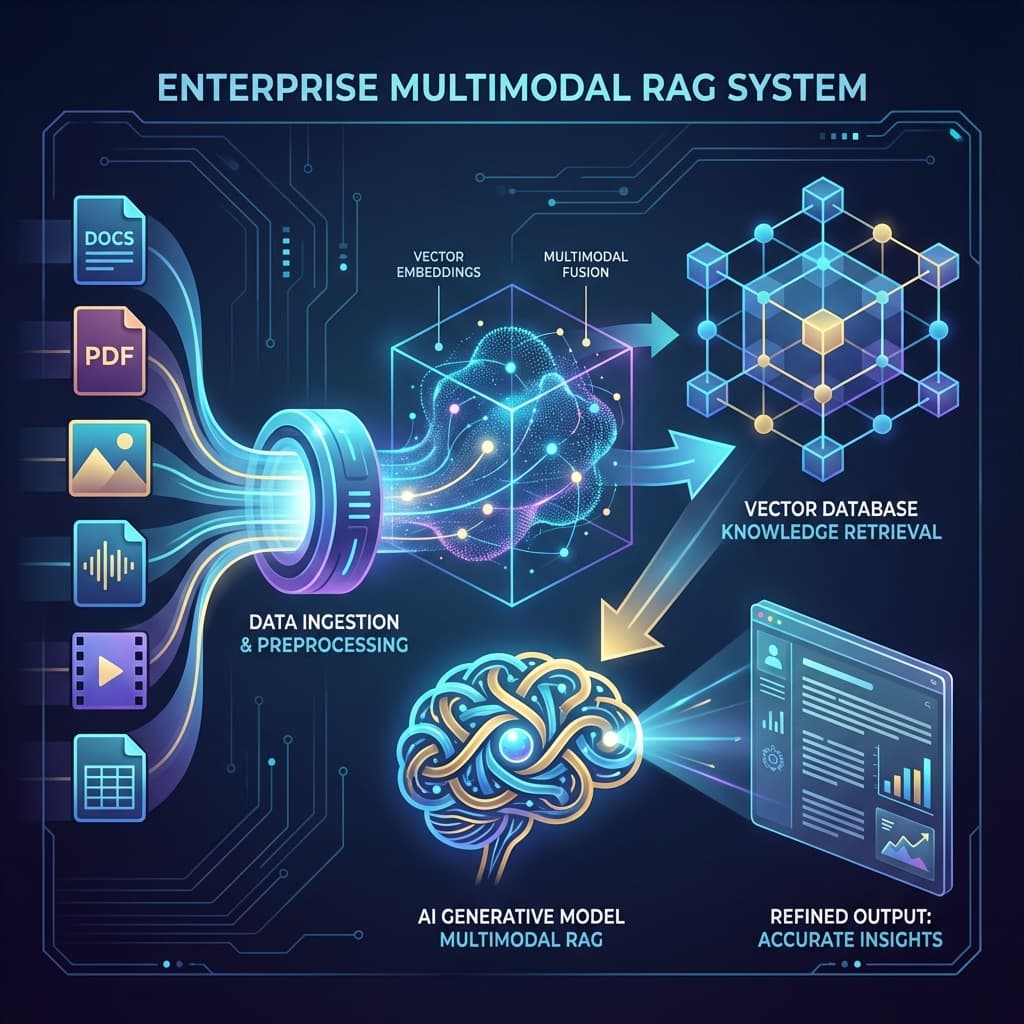
End-to-End Multimodal RAG: From Raw Data to Production Systems
Course Curriculum
24 modules designed to master the subject.
Module 1: Foundations of RAG and Multimodal AI
Understanding RAG fundamentals, multimodal concepts, and real-world architectures.
What is Retrieval-Augmented Generation?
Understanding the fundamentals of RAG and why it's essential for grounding LLM responses in factual, up-to-date information.
Why RAG Matters for Accuracy and Trust
Explore how RAG systems improve accuracy, enable verification, and build trust in AI-generated responses.
Limitations of Pure LLM Prompting
Understanding the fundamental constraints of relying solely on LLM knowledge without external retrieval.
From Text-Only RAG to Multimodal RAG
Discover why modern RAG systems must handle images, audio, video, and structured data alongside text.
Real-World Multimodal RAG Use Cases and Architectures
Explore proven multimodal RAG patterns across industries and learn reference architectures for production systems.
Module 2: Multimodal LLM Landscape
Explore multimodal models, Claude Sonnet 3.5+, and trade-offs between local and hosted solutions.
Overview of Multimodal Models
Understanding the landscape of multimodal LLMs and their capabilities across text, vision, and audio.
Capabilities of Claude Sonnet 3.5+
Deep dive into Claude Sonnet 3.5's multimodal capabilities and why it excels for production RAG systems.
Local vs Hosted Models (Ollama vs Bedrock)
Compare local and cloud model deployments for multimodal RAG systems and learn when to use each approach.
Trade-offs: Cost, Latency, Privacy, Performance
Analyze the critical trade-offs in RAG system design across cost, speed, security, and quality.
Choosing the Right Model Per Modality
Learn to select optimal models for different data types: text, images, audio, video, and structured data.
Module 3: RAG System Architecture
Design end-to-end RAG systems from ingestion to generation and verification.
Ingestion Layer
Learn how to connect to data sources and ingest multimodal content for RAG systems.
Preprocessing and Conditioning Layer
Transform raw data into clean, normalized content ready for embedding and retrieval.
Embedding and Indexing Layer
Convert preprocessed content into vector embeddings and store them efficiently for retrieval.
Retrieval and Ranking Layer
Search the vector database and rank results by relevance for optimal context assembly.
Generation and Verification Layer
Generate accurate responses using LLMs and verify outputs for hallucinations and grounding.
Module 4: Data Types and File Formats
Master handling text, PDFs, images, audio, video, spreadsheets, and structured data.
Text Formats (TXT, MD, HTML)
Processing plain text, Markdown, and HTML for RAG systems with best practices.
PDFs (Native vs Scanned)
Master PDF processing for RAG, handling both native digital PDFs and scanned documents.
Images (PNG, JPG, Diagrams, Screenshots)
Process images for multimodal RAG including photos, diagrams, charts, and screenshots.
Audio (Speech, Meetings, Interviews)
Transcribe and process audio content for searchable RAG systems.
Video (Lectures, Demos)
Extract and index both visual and audio content from video files for comprehensive RAG.
Spreadsheets and CSVs
Process tabular data from spreadsheets and CSV files for structured RAG queries.
Structured Data (Databases, APIs)
Integrate structured data from databases and APIs into your RAG system.
Module 5: Data Ingestion Pipelines
Build robust batch and streaming ingestion from file systems, cloud storage, and APIs.
Batch vs Streaming Ingestion
Compare batch and streaming ingestion patterns for RAG systems and learn when to use each.
File System Ingestion
Ingest documents from local and network file systems with monitoring and change detection.
Cloud Storage Ingestion
Ingest documents from S3, Google Cloud Storage, and Azure Blob Storage.
API-Based Ingestion
Ingest data from REST APIs, Slack, Google Drive, and other third-party services.
Incremental Updates and Re-Indexing
Efficiently update your RAG index with changed documents while avoiding redundant processing.
Module 6: Data Conditioning and Cleaning
Clean, deduplicate, and enrich data for optimal RAG performance.
Why Data Conditioning Matters
Understand the critical importance of data cleaning and conditioning for RAG quality.
Deduplication
Identify and remove duplicate content to improve index quality and reduce costs.
Noise Removal
Clean documents by removing headers, footers, boilerplate, and other non-content text.
Layout Normalization
Normalize document layouts and formatting for consistent processing across different sources.
Language Detection
Detect document languages for proper embedding model selection and multilingual RAG.
Metadata Enrichment
Extract and enrich metadata to improve retrieval accuracy and enable advanced filtering.
Module 7: Document Parsing and Structure Extraction
Extract structured information from complex documents while preserving hierarchy.
Parsing Structured vs Unstructured Documents
Learn to extract content from structured documents (forms, invoices) and unstructured documents (reports, articles) with different parsing strategies.
Page-Level vs Section-Level Parsing
Choose the right granularity for document parsing to optimize retrieval relevance and context quality.
Table Extraction Challenges
Master the complexities of extracting tables from PDFs and documents for accurate RAG indexing.
Preserving Document Hierarchy
Learn how to maintain the parent-child relationships and heading structures during document parsing for RAG.
Metadata Schemas for RAG
Design robust metadata schemas to enhance filtering, retrieval, and traceability in multimodal RAG systems.
Module 8: OCR for Scanned and Image-Based Documents
Implement layout-aware OCR for scanned PDFs and images with error handling.
When OCR is Required
Identify the triggers for Optical Character Recognition (OCR) and learn how to detect non-searchable document components.
OCR for Scanned PDFs - When and How
Identify when OCR is needed and implement effective OCR strategies for scanned documents in RAG systems.
OCR for Images and Screenshots
Techniques for extracting high-quality text from screenshots, UI captures, and complex diagrams.
Layout-Aware OCR and Error Handling
Implement layout-aware OCR for complex documents and handle OCR errors gracefully in RAG systems.
OCR Accuracy and Error Handling
Techniques for measuring OCR performance, cleaning noisy outputs, and building resilient pipelines.
Module 9: Multimodal Preprocessing
Preprocess images, audio, and video for retrieval and context alignment.
Image Preprocessing for Retrieval
Optimize images for vector search and visual content extraction in RAG systems.
Audio Preprocessing and Transcription
Techniques for cleaning audio, segmenting speech, and generating high-accuracy transcripts for RAG.
Video Preprocessing and Scene Segmentation
Learn how to break video files into meaningful scenes and keyframes for efficient indexing.
Aligning Text with Visual/Audio Context
Master the techniques for synchronizing transcripts with keyframes and metadata to create cohesive multimodal chunks.
Handling Large Multimodal Assets
Strategies for processing and storing multi-gigabyte files efficiently in a RAG ingestion pipeline.
Module 10: Chunking Strategies
Apply advanced chunking across text, PDFs, tables, transcripts, and video.
Why Chunking is Critical
Understand the fundamental role of chunking in determining retrieval relevance and LLM response quality.
Chunking Text Documents
Master chunking techniques specifically for text documents to optimize RAG retrieval.
Chunking PDFs with Layout Awareness
Learn how to chunk PDFs by respecting their visual structure, headers, and page boundaries.
Chunking Tables and Spreadsheets
Master the art of breaking down structured data into searchable chunks for RAG pipelines.
Chunking Transcripts and Videos
Strategies for breaking down temporal data into semantically cohesive and searchable units.
Chunk Overlap and Context Windows
Optimize chunk overlap to maintain context while avoiding redundancy in RAG systems.
Module 11: Embeddings for Multimodal Data
Generate and optimize embeddings for text, images, and cross-modal retrieval.
Text Embeddings
Master the fundamentals of text-to-vector transformation, model selection, and vector space theory.
Image Embeddings
How to convert visual data into vectors for similarity search and visual RAG applications.
Multimodal Embeddings
Master the concept of shared vector spaces where text and images coexist and interact.
Local Embeddings with Ollama
Learn how to generate high-quality embeddings locally for privacy and cost efficiency.
Hosted Embeddings via Bedrock
Leverage AWS Bedrock for enterprise-grade, scalable, and secure multimodal embeddings.
Embedding Dimensionality Trade-offs
Understand the relationship between vector size, search speed, storage costs, and retrieval accuracy.
Module 12: Vector Databases with Chroma
Design scalable vector storage with metadata filtering and collections.
Why Vector Databases are Essential
Discover why traditional relational databases struggle with semantic search and why Vector DBs are the backbone of RAG.
Chroma Architecture Overview
Understand the internals of Chroma, from storage engines to embedding functions.
Metadata Filtering in Chroma
Learn how to use Chroma's powerful 'where' and 'where_document' filters to narrow down search results.
Namespace and Collection Design
Strategies for organizing your vector data into logical collections to optimize retrieval and security.
Persistence and Scaling Considerations
Preparing your vector database for production by understanding storage backends and scaling limits.
Module 13: Advanced Retrieval Techniques
Implement hybrid search, metadata filtering, and cross-modal retrieval.
Similarity Search Basics
Deep dive into vector distance metrics: Cosine Similarity, Euclidean Distance, and Inner Product.
Hybrid Search: Keyword + Vector
Combine the semantic power of vector search with the keyword precision of traditional BM25 search.
Metadata-Based Filtering
Precision retrieval through the marriage of semantic vectors and structured metadata constraints.
Multi-Query Retrieval
Overcome semantic ambiguity by generating and searching multiple variations of a user query.
Cross-Modal Retrieval
Master the ability to search seamlessly across different data types, like using text to find images or using images to find transcripts.
Module 14: Re-Ranking and Retrieval Optimization
Optimize retrieval quality through re-ranking and context window management.
Why Initial Retrieval is Not Enough
Understand the limitations of raw vector search and why a second pass—Re-Ranking—is essential for production RAG.
Re-Ranking Strategies
Master the different types of re-rankers, from Cohere to BGE, and learn where to place them in your RAG pipeline.
Cross-Encoder Concepts
Understand the mathematical and architectural differences between Bi-Encoders and Cross-Encoders in retrieval systems.
Context Window Optimization
Strategies for fitting the most relevant information into the LLM's limited context window without losing meaning.
Reducing Irrelevant Context
Master techniques to strip noise and maintain high-density information for your LLM generation step.
Module 15: Context Assembly and Injection
Assemble multi-modal contexts with proper ordering and traceability.
Context Window Constraints
Understand the hard and soft limits of LLM context windows and how they impact RAG quality.
Ordering Retrieved Chunks
Strategically position your documents within the prompt to maximize the LLM's attention and accuracy.
Mixing Modalities in Context
Master the art of presenting text, image descriptions, and audio transcripts to an LLM for holistic reasoning.
Avoiding Context Pollution
Techniques for ensuring only relevant, high-quality data enters your generation prompt.
Traceability and Citations
Build user trust by implementing robust source attribution and verifiable citations in your RAG responses.
Module 16: Generation with Claude Sonnet 3.5+
Leverage Claude for multimodal reasoning with cost and latency optimization.
Prompting Claude for RAG
Master the specific prompt engineering techniques required to get the best RAG performance out of Anthropic's Claude models.
Multimodal Reasoning Capabilities
Explore Claude's ability to 'reason' across visual and textual data to answer complex, cross-modality questions.
Handling Long Contexts
Master the operational side of multi-thousand token prompts, including batching and context management.
Safety and Refusal Behaviors
Understand why Claude might refuse to answer a query and how to tune its guardrails for RAG.
Cost and Latency Considerations
Optimize the ROI of your Claude-based RAG system by balancing model choice, token count, and performance.
Module 17: Verification and Grounding
Prevent hallucinations through answer grounding and source attribution.
Why Hallucinations Still Happen
Understand the root causes of RAG errors and learn to distinguish between 'Creative' and 'Harmful' hallucinations.
Answer Grounding Techniques
Master the techniques for forcing the LLM to stay strictly within the bounds of your retrieved data.
Source Attribution and IDs
Implement automated source attribution to ensure every factual claim in your RAG system is verifiable.
Confidence Scoring for Responses
Master the techniques for quantifying how 'sure' your RAG system is about its generated output.
Verification Loops
Implement multi-step validation processes to ensure every RAG response meets your quality standards before reaching the user.
Module 18: Local vs Cloud RAG Architectures
Choose the right architecture: local, hybrid, or fully managed cloud.
Fully Local RAG with Ollama
Build a high-performance RAG system that runs entirely on your local machine, without any cloud dependencies.
Hybrid Local-Cloud Architectures
Combine the security of local data processing with the power of cloud-based generation.
Fully Managed Cloud RAG with Bedrock
Master Amazon Bedrock's 'Knowledge Bases' to build production RAG systems without managing servers or database clusters.
Privacy and Compliance Trade-offs
Navigate the complex landscape of data residency, GDPR, and AI ethics in RAG architecture selection.
Module 19: Performance, Cost, and Scaling
Optimize latency, costs, and scale retrieval layers for production.
Latency Bottlenecks in RAG
Identify and eliminate the slow points in your multimodal RAG pipeline to ensure a snappy user experience.
Index Size Optimization
Techniques for shrinking your vector database and reducing RAM usage without sacrificing retrieval quality.
Caching Strategies in RAG
Implement Multi-Level Caching to avoid redundant calculations and reduce RAG costs.
Cost Control with Bedrock
Master the financial side of RAG by managing AWS Bedrock quotas, model selection, and provisioned throughput.
Scaling Chroma and Retrieval Layers
Learn how to move from a single-machine Chroma instance to a distributed, production-ready retrieval cluster.
Module 20: Security and Privacy
Implement data access control, prevent leakage, and secure pipelines.
Data Access Control in RAG
Master the techniques for ensuring users only retrieve information they are authorized to see.
Prompt Injection via Retrieved Content
Understand the 'Indirect Prompt Injection' attack vector and how to defend your RAG system against malicious data.
Sensitive Data Leakage
Techniques for preventing the accidental inclusion of PII and confidential data in your public-facing RAG systems.
Secure OCR Pipelines
Protect your data during the Optical Character Recognition process by building air-gapped or encrypted pipelines.
Audit Logging in RAG Systems
Implement a comprehensive logging strategy to track data lineage, user queries, and system responses for compliance.
Module 21: Observability and Debugging
Trace retrieval, inspect embeddings, and build feedback loops.
Tracing Retrieval Steps
Learn how to 'open the black box' of RAG by tracing the path from user query to final answer.
Inspecting Embeddings and Similarity Scores
Techniques for debugging the mathematical heart of your RAG system by analyzing vector distances and index quality.
Debugging Poor Answers
A systematic guide to diagnosing and fixing low-quality RAG outputs.
Feedback Loops & User Corrections
Harness the power of user feedback to create a self-improving RAG system.
Continuous Improvement (A/B Testing)
Learn how to iteratively improve your RAG system using systematic testing and evaluation frameworks.
Module 22: Deployment and Operations
Deploy API-based RAG services with versioning and rollback strategies.
API-Based RAG Services
Expose your multimodal RAG system as a secure, scalable REST API for web and mobile applications.
Batch vs Interactive Workloads
Optimize your infrastructure for real-time user chat vs large-scale automated data processing.
Versioning Embeddings and Indexes
Techniques for managing breaking changes in your vector data when embedding models or architectures evolve.
Rollbacks and Re-Indexing Strategies
Prepare for disasters by implementing robust rollback procedures for your RAG data and models.
Module 23: Real-World Multimodal RAG Patterns
Apply RAG to enterprise knowledge, compliance, media, and documentation.
Enterprise Knowledge Assistants
Design patterns for building cross-departmental AI assistants that securely solve employee queries.
Compliance and Legal Document RAG
Techniques for building high-precision RAG systems for auditing, discovery, and legal research.
Media and Research RAG
Master the patterns for building RAG systems for podcasts, video archives, and scientific publications.
Internal Developer Documentation RAG
Learn how to build a RAG system that understands code, API specs, and technical documentation.
Module 24: Capstone Project
Build a production-grade multimodal RAG platform with full documentation.
Course Overview
Format
Self-paced reading
Duration
Approx 6-8 hours
Found this course useful? Support the creator to help keep it free for everyone.
Support the Creator