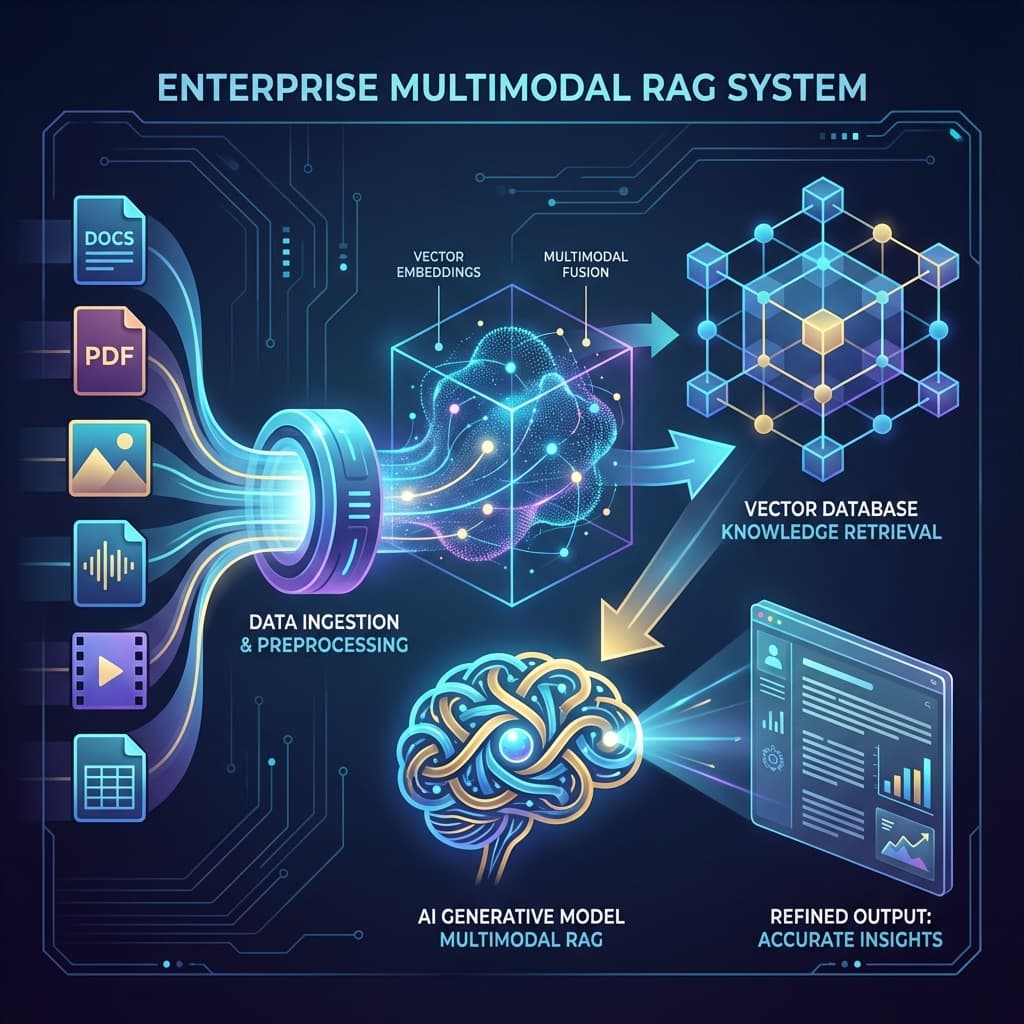
Real-World Multimodal RAG Use Cases and Architectures
Explore proven multimodal RAG patterns across industries and learn reference architectures for production systems.
Real-World Multimodal RAG Use Cases and Architectures
Multimodal RAG is transforming how organizations work with knowledge. Let's explore real-world applications and proven architectural patterns.
Industry Use Cases
1. Healthcare: Medical knowledge Assistant
graph TD
    A[Doctor Query] --> B[Multimodal RAG]

    C[Medical Literature] --> B
    D[Patient X-Rays] --> B
    E[Lab Results] --> B
    F[Treatment Videos] --> B

    B --> G[Evidence-Based Recommendation]
    G --> H[Source Citations]

    style B fill:#d4edda
    style G fill:#d1ecf1
Data Sources:
- Text: Medical journals, clinical trial results
- Images: X-rays, MRIs, CT scans
- Tables: Lab results, patient vitals
- Audio: Doctor-patient consultations
- Video: Surgical procedures, treatment demonstrations
Query Example:
"What are the latest treatment protocols for Stage 2 diabetes
 in patients with cardiovascular risk?"

Response includes:
✓ Latest research papers (text)
✓ Treatment flowcharts (images)
✓ Drug interaction tables (structured data)
✓ Patient education videos
✓ Source citations for compliance
2. Manufacturing: Technical Support System
graph LR
    A[Technician] --> B{Issue Type}

    B -->|Electrical| C[Wiring Diagrams]
    B -->|Mechanical| D[Assembly Videos]
    B -->|Software| E[Code Docs]
    B -->|Safety| F[Warning Images]

    C & D & E & F --> G[RAG System]
    G --> H[Step-by-Step Repair Guide]
Data Sources:
- Text: Service manuals, troubleshooting guides
- Images: Wiring diagrams, part photos
- Video: Assembly/disassembly procedures
- Spreadsheets: Part numbers, specifications
- Audio: Training recordings
Query Example:
"Motor making grinding noise, error code E47"

Response:
1. Error code E47 indicates bearing failure [Manual p.142]
2. See diagram for bearing location [Image: bearing_assembly.png]
3. Watch removal procedure [Video: timestamp 3:45]
4. Order replacement part #BRG-2847 [Parts catalog]
5. ⚠️ Disconnect power first [Safety guide]
3. Legal: Case Research Platform
graph TD
    A[Legal Query] --> B[Multimodal RAG]

    C[Case Law Text] --> B
    D[Court Diagrams] --> B
    E[Hearing Transcripts] --> B
    F[Evidence Photos] --> B
    G[Financial Tables] --> B

    B --> H[Legal Brief]
    H --> I[Verified Citations]

    style B fill:#fff3cd
    style I fill:#f8d7da
Data Sources:
- Text: Court opinions, statutes, contracts
- Images: Crime scene photos, diagrams
- Audio: Hearing recordings, depositions
- Tables: Financial evidence, timelines
- Video: Security footage, witness testimony
Critical Requirements:
- Perfect Source Attribution: Every fact must be cited
- No Hallucinations: Legal accuracy is non-negotiable
- Version Control: Track document revisions
- Access Control: Different permission levels
4. E-Learning: Adaptive Education Platform
graph LR
    A[Student Question] --> B[RAG System]

    C[Textbook Content] --> B
    D[Lecture Videos] --> B
    E[Practice Problems] --> B
    F[Visual Aids] --> B

    B --> G{Student Level}
    G -->|Beginner| H[Simple Explanation + Video]
    G -->|Advanced| I[Detailed Text + Exercises]
Data Sources:
- Text: Course materials, articles
- Images: Diagrams, infographics
- Video: Lectures, experiments
- Audio: Podcasts, interviews
- Interactive: Simulations, quizzes
Personalization:
# Conceptual: Adaptive retrieval
retrieval_strategy = {
    "beginner": {
        "prefer": ["videos", "simple_explanations"],
        "chunk_size": "smaller",
        "examples": "more"
    },
    "advanced": {
        "prefer": ["research_papers", "detailed_text"],
        "chunk_size": "larger",
        "examples": "fewer"
    }
}
5. Financial Services: Investment Research
Data Sources:
- Text: Earnings reports, analyst notes
- Images: Charts, technical analysis
- Tables: Financial statements, metrics
- Audio: Earnings calls
- Video: Company presentations
Query Example:
"Analyze Tesla's Q4 2025 performance"

Response synthesizes:
- Revenue data from financial statements (tables)
- CEO commentary from earnings call (audio transcript)
- Stock chart patterns (images)
- Analyst sentiment from reports (text)
- Competitive analysis (structured data)
Reference Architectures
Architecture 1: Fully Local (Privacy-First)
graph TD
    A[Data Sources] --> B[Local Ingestion]
    B --> C[Preprocessing]
    C --> D[Ollama Embeddings]
    D --> E[Chroma DB]

    F[User Query] --> E
    E --> G[Retrieved Context]
    G --> H[Ollama LLM]
    H --> I[Response]

    style A fill:#e1f5ff
    style E fill:#fff3cd
    style I fill:#d4edda

    J[All Processing On-Premise] -.-> B & C & D & E & G & H
When to Use:
- Highly sensitive data (healthcare, legal)
- Regulatory compliance requirements
- No internet connectivity
- Cost-sensitive deployments
Trade-offs:
- ✅ Complete data privacy
- ✅ No API costs
- ✅ No vendor lock-in
- ❌ Lower model quality
- ❌ Higher infrastructure costs
- ❌ Maintenance burden
Architecture 2: Hybrid (Best of Both Worlds)
graph TD
    A[Data Sources] --> B{Data Sensitivity}

    B -->|Sensitive| C[Local Processing]
    B -->|Non-Sensitive| D[Cloud Processing]

    C --> E[Local Embeddings]
    D --> F[Bedrock Embeddings]

    E & F --> G[Unified Vector DB]

    H[User Query] --> G
    G --> I[Retrieved Context]
    I --> J{Query Type}

    J -->|Simple| K[Ollama]
    J -->|Complex| L[Claude Sonnet 3.5]

    K & L --> M[Response]
When to Use:
- Mixed sensitivity data
- Balance cost and quality
- Gradual cloud migration
- Testing cloud capabilities
Trade-offs:
- ✅ Flexible deployment
- ✅ Optimized costs
- ✅ Quality where needed
- ❌ Complex to manage
- ❌ Data classification required
Architecture 3: Fully Managed Cloud (Bedrock)
graph LR
    A[S3 Data Sources] --> B[Bedrock Knowledge Base]
    B --> C[Automatic Embeddings]
    C --> D[Vector Store]

    E[User Query] --> F[Bedrock Agent]
    F --> D
    D --> G[Retrieved Docs]
    G --> H[Claude 3.5 Sonnet]
    H --> I[Response]

    style B fill:#ff9800
    style H fill:#ff9800
When to Use:
- Rapid development
- AWS-native applications
- Minimal ML team
- Enterprise SLAs needed
Trade-offs:
- ✅ Managed infrastructure
- ✅ Built-in security
- ✅ Auto-scaling
- ✅ Latest models
- ❌ Higher costs
- ❌ AWS vendor lock-in
- ❌ Less customization
Architecture 4: Enterprise Scale (Production-Grade)
graph TD
    A[Ingestion API] --> B[Message Queue]
    B --> C[Processing Cluster]

    C --> D[OCR Service]
    C --> E[Transcription Service]
    C --> F[Embedding Service]

    D & E & F --> G[Vector DB Cluster]

    H[Load Balancer] --> I[RAG API Fleet]
    I --> G
    I --> J[LLM Pool]
    J --> K[Cache Layer]
    K --> L[Response]

    M[Monitoring] -.-> A & C & G & I & J
    N[Logging] -.-> A & C & G & I & J
Components:
- Ingestion: Scalable data pipeline
- Processing: Distributed preprocessing
- Storage: Replicated vector DB
- Serving: Load-balanced API
- Caching: Redis for frequently accessed data
- Observability: Full metrics and tracing
When to Use:
- High-traffic applications (>1M queries/day)
- Mission-critical systems
- Multiple teams/services
- Strict SLAs (<100ms p95 latency)
Common Patterns
Pattern 1: Hierarchical Retrieval
graph TD
    A[Query] --> B[Coarse Retrieval]
    B --> C[10,000 docs → 100 candidates]
    C --> D[Fine Retrieval]
    D --> E[100 candidates → 5 relevant]
    E --> F[Re-Ranking]
    F --> G[5 → Top 3 for LLM]
Why: Efficient search over millions of documents
Pattern 2: Multi-Query Decomposition
User: "Compare our Q3 and Q4 revenue by region"

System decomposes into:
1. "Q3 revenue by region"
2. "Q4 revenue by region"
3. "Regional revenue trends"

Retrieves for each, then synthesizes
Pattern 3: Iterative Refinement
graph LR
    A[Initial Query] --> B[First Retrieval]
    B --> C[LLM Analysis]
    C --> D{Need More Info?}
    D -->|Yes| E[Refined Query]
    E --> B
    D -->|No| F[Final Response]
Success Metrics
Track these KPIs:
- Retrieval Precision: % of retrieved docs that are relevant
- Retrieval Recall: % of relevant docs that are retrieved
- Answer Quality: Human evaluation scores
- Latency: p50, p95, p99 response times
- Cost: $ per 1000 queries
- User Satisfaction: Feedback ratings
Key Takeaways
- Multimodal RAG is industry-proven across healthcare, legal, manufacturing, and more
- Architecture choice depends on privacy requirements, scale, and budget
- Start simple, scale gradually: Local → Hybrid → Cloud
- Measure everything: Instrument your system from day one
In Module 2, we'll explore the multimodal LLM landscape and how to choose the right models for your RAG system.