What is Retrieval-Augmented Generation?
Understanding the fundamentals of RAG and why it's essential for grounding LLM responses in factual, up-to-date information.
What is Retrieval-Augmented Generation?
Retrieval-Augmented Generation (RAG) is a design pattern that combines the power of large language models with external knowledge retrieval to produce accurate, grounded, and verifiable responses.
The Problem RAG Solves
Large language models are trained on massive datasets, but they have fundamental limitations:
- Static Knowledge: Training data has a cutoff date
- No Access to Private Data: Cannot reason over your internal documents
- Hallucinations: May generate plausible-sounding but incorrect information
- Generic Responses: Lack domain-specific or personalized context
How RAG Works
graph LR
    A[User Query] --> B[Retrieval System]
    B --> C[Vector Database]
    C --> D[Relevant Documents]
    D --> E[LLM with Context]
    E --> F[Grounded Response]

    style A fill:#e1f5ff
    style F fill:#d4edda
RAG follows a simple but powerful workflow:
- Query: User asks a question
- Retrieval: System searches a knowledge base for relevant information
- Augmentation: Retrieved context is added to the LLM prompt
- Generation: LLM produces a response grounded in the retrieved facts
RAG vs. Pure LLM Prompting
| Aspect | Pure LLM | RAG |
|---|---|---|
| Knowledge Source | Training data only | Training data + external knowledge |
| Accuracy | Limited by training cutoff | Up-to-date and domain-specific |
| Verifiability | Difficult to verify | Can cite sources |
| Cost | Lower per query | Higher (retrieval + generation) |
| Customization | Requires fine-tuning | Add new documents anytime |
Key Components
A RAG system consists of:
- Knowledge Base: Documents, databases, or structured data
- Embedding Model: Converts text to vector representations
- Vector Store: Indexes and retrieves similar content efficiently
- LLM: Generates responses using retrieved context
- Orchestration Layer: Coordinates retrieval and generation
Why RAG Matters
RAG enables:
- Factual Accuracy: Responses grounded in real data
- Source Attribution: Track where information came from
- Dynamic Knowledge: Update knowledge without retraining
- Domain Expertise: Specialize models for specific industries
- Privacy: Keep sensitive data out of model training
Real-World Example
Without RAG:
User: "What is our current return policy?"
LLM: "I don't have access to your specific return policy..."
With RAG:
User: "What is our current return policy?"
System retrieves: [policy_document.pdf, section 3.2]
LLM: "According to your return policy (updated Nov 2025),
     customers have 30 days for full refunds..."
The Evolution to Multimodal RAG
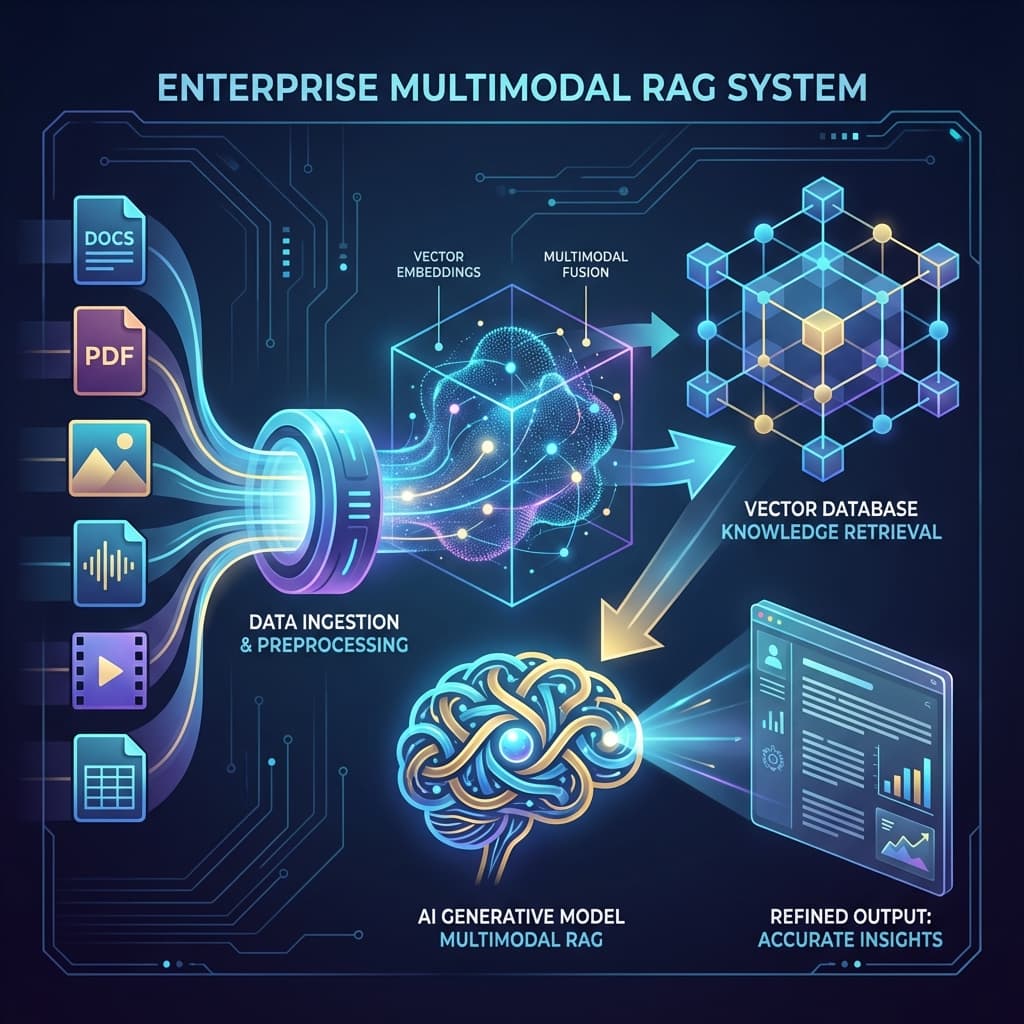
Traditional RAG focused on text documents. Multimodal RAG extends this to:
- PDFs with images and tables
- Audio transcripts and recordings
- Video content and presentations
- Spreadsheets and structured data
- Diagrams and screenshots
This course teaches you to build production-grade multimodal RAG systems that can reason over any data type.