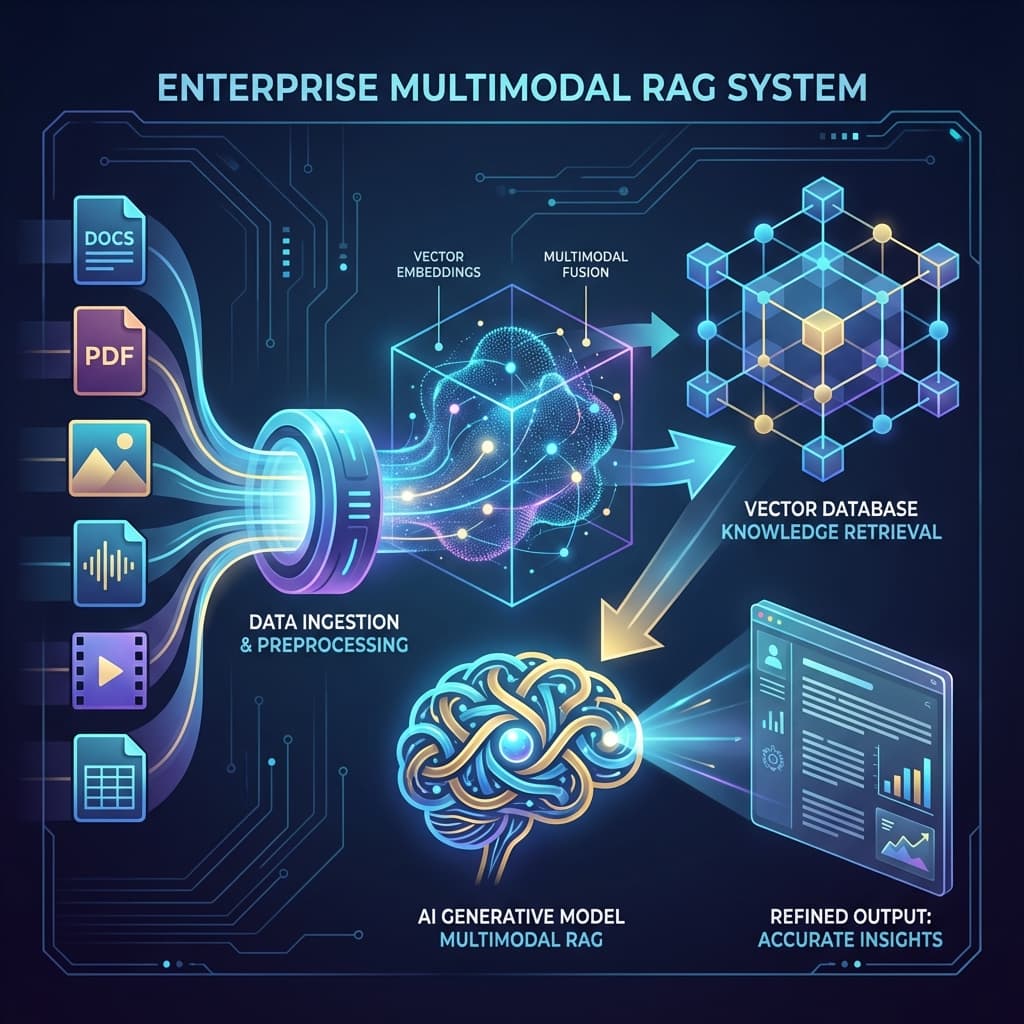
From Text-Only RAG to Multimodal RAG
Discover why modern RAG systems must handle images, audio, video, and structured data alongside text.
From Text-Only RAG to Multimodal RAG
Real-world knowledge doesn't exist only in text. To build truly comprehensive RAG systems, we must handle images, audio, video, spreadsheets, and structured data.
The Limitation of Text-Only RAG
graph TD
    A[Real-World Knowledge] --> B[Text Documents]
    A --> C[Images & Diagrams]
    A --> D[Audio & Video]
    A --> E[Spreadsheets]
    A --> F[Databases]

    G[Text-Only RAG] --> B
    G -.->|Ignores| C
    G -.->|Ignores| D
    G -.->|Ignores| E
    G -.->|Ignores| F

    style G fill:#fff3cd
Traditional RAG systems only process text, missing:
- Visual Information: Charts, diagrams, screenshots, photos
- Audio Content: Meetings, interviews, podcasts, lectures
- Video Content: Presentations, demos, training videos
- Tabular Data: Spreadsheets, CSV files, database exports
- Structured Data: JSON, XML, API responses
What is Multimodal RAG?
Multimodal RAG extends the RAG pattern to all data types:
graph LR
    A[Query] --> B[Multimodal RAG]

    B --> C[Text Retrieval]
    B --> D[Image Retrieval]
    B --> E[Audio Retrieval]
    B --> F[Video Retrieval]
    B --> G[Data Retrieval]

    C & D & E & F & G --> H[Multimodal LLM]
    H --> I[Comprehensive Answer]

    style B fill:#d4edda
    style I fill:#d1ecf1
Key Capabilities
- Ingest Any Format: PDFs, images, audio, video, spreadsheets
- Extract Meaning: OCR, transcription, object detection
- Unified Search: Find relevant content across all modalities
- Cross-Modal Reasoning: Combine text, images, and data in answers
Why Multimodal Matters
Real Documents Are Multimodal
Consider a typical business document:
📄 Q4_Report.pdf
├── Text: Executive summary
├── Images: Product photos
├── Charts: Revenue graphs
├── Tables: Financial data
└── Diagrams: Organization chart
Text-only RAG would only see the executive summary.
Multimodal RAG understands the complete document.
Business Use Cases
1. Technical Documentation
graph TD
    A[Technical Manual] --> B[Text Instructions]
    A --> C[Wiring Diagrams]
    A --> D[Safety Warnings]
    A --> E[Parts List Table]

    F[User Query: How to install?] --> G[Multimodal RAG]
    G --> B & C & D & E
    G --> H[Complete Answer with Diagram]
Query: "How do I install the power supply?"
Text-Only RAG: "Follow the installation instructions..."
Multimodal RAG:
"Follow these steps:
1. Connect the red wire to terminal A (see diagram below)
2. Ensure voltage matches the table in section 3.2
3. ⚠️ Warning: Disconnect power before installation

[Retrieved Diagram: wiring_schematic.png]
[Retrieved Table: voltage_specifications.xlsx]"
2. Medical Records
Patient Record:
├── Text notes from doctor
├── X-ray images
├── Lab results (tabular)
└── Prescription history
Query: "Are there signs of bone density issues?"
Multimodal RAG can:
- Read text notes mentioning bone health
- Analyze X-ray images for density patterns
- Check lab calcium levels from tables
- Correlate medications that affect bone density
3. E-Commerce
Product Catalog:
├── Product descriptions (text)
├── Product photos (images)
├── Pricing tables (structured)
└── Demo videos
Query: "Show me blue sneakers under $100"
Multimodal RAG:
- Searches descriptions for "sneakers"
- Filters images for blue color
- Queries pricing table for < $100
- Returns products with images and videos
The Evolution of RAG
timeline
    title RAG Evolution
    2020 : Dense Passage Retrieval
           : Text-only retrieval
    2021 : FAISS + GPT-3
           : Scaled vector search
    2022 : LangChain + Chroma
           : Developer-friendly RAG
    2023 : GPT-4V + CLIP
           : Vision-language models
    2024-2026 : Multimodal RAG
           : All data types unified
Generation 1: Text-Only RAG (2020-2022)
- Focus: Text documents
- Embeddings: Text-only models (BERT, Ada)
- Use Cases: Q&A, chatbots
- Limitation: Ignored non-text content
Generation 2: Enhanced Text RAG (2022-2023)
- Focus: Better text processing
- Improvements: Chunking strategies, hybrid search
- Use Cases: Enterprise search, documentation
- Limitation: Still text-only
Generation 3: Multimodal RAG (2023-Present)
- Focus: All data types
- Technology: Multimodal embeddings, OCR, transcription
- Use Cases: Complete knowledge systems
- Advantage: Mirrors how humans learn
Technical Enablers
1. Multimodal Language Models
Models like Claude Sonnet 3.5, GPT-4V, and Gemini can:
- Understand images and text together
- Reason over charts and diagrams
- Process tables and structured data
- Integrate multiple modalities in responses
2. Multimodal Embeddings
# Conceptual: Unified embedding space
text_embedding = embed("The cat is sleeping")
image_embedding = embed(cat_photo.jpg)

# Both embeddings in same vector space!
similarity = cosine_similarity(text_embedding, image_embedding)
# High similarity for related content
Models like CLIP create shared embedding spaces:
- Text and images in the same vector space
- Enable cross-modal search
- "Find images similar to this text description"
3. Processing Pipelines
graph LR
    A[Raw Data] --> B{Data Type}

    B -->|PDF| C[OCR + Layout]
    B -->|Image| D[Vision Model]
    B -->|Audio| E[Transcription]
    B -->|Video| F[Scene Detection]
    B -->|Table| G[Structure Extract]

    C & D & E & F & G --> H[Embeddings]
    H --> I[Vector DB]
Modern tools enable:
- OCR: Extract text from scanned documents
- Transcription: Audio to text (Whisper)
- Object Detection: Identify objects in images
- Table Extraction: Parse spreadsheets and PDFs
Challenges of Multimodal RAG
1. Complexity
Multimodal systems must handle:
- Different file formats
- Various preprocessing needs
- Multiple embedding models
- Cross-modal alignment
2. Cost
- More storage (images, videos)
- Higher compute (preprocessing)
- Larger vector databases
3. Quality Control
- OCR errors
- Transcription mistakes
- Image interpretation failures
- Data alignment issues
Why Learn Multimodal RAG?
Real World ≠ Text-Only

Your users ask questions about:
✓ Text documents
✓ Product images
✓ Training videos
✓ Data dashboards
✓ Meeting recordings

Your RAG system should handle ALL of them.
Competitive Advantage
Organizations with multimodal RAG can:
- Unlock Dark Data: 80% of enterprise data is unstructured
- Faster Decision-Making: Find answers across all sources
- Better User Experience: Comprehensive, multimedia responses
- Compliance: Search across all document types
- Innovation: Enable new use cases
Course Focus
This course teaches you to build production-grade multimodal RAG systems:
- Module 1-3: Foundations and architecture
- Module 4-9: Processing all data types
- Module 10-17: Retrieval and generation
- Module 18-24: Production deployment
You'll learn to handle:
- Text, PDFs, images, audio, video
- OCR and transcription
- Embeddings and vector databases
- Claude Sonnet 3.5 and Bedrock
- Local models with Ollama
- LangChain orchestration
In the next lesson, we'll explore real-world multimodal RAG architectures and use cases.