Limitations of Pure LLM Prompting
Understanding the fundamental constraints of relying solely on LLM knowledge without external retrieval.
Limitations of Pure LLM Prompting
While large language models are incredibly powerful, relying on them alone for production applications introduces significant limitations.
The Knowledge Cutoff Problem
timeline
    title LLM Knowledge Gap
    2023-09 : GPT-4 Training Cutoff
    2024-03 : Major Industry Event
    2025-01 : New Regulations
    2026-01 : User Query (Now)

    section LLM Knowledge
        Knows events up to Sept 2023

    section Knowledge Gap
        2.5 years of missing information
The Issue
Every LLM has a training cutoff date. Asking about recent events yields:
User: "What happened in the 2025 AI Summit?"
LLM: "I don't have information about events after September 2023.
      I cannot provide details about the 2025 AI Summit."
Why It Matters
- News and Current Events: Cannot discuss recent developments
- Product Updates: Doesn't know about new releases
- Regulatory Changes: Unaware of new laws or policies
- Market Data: Cannot reference current prices or trends
No Access to Private Data
graph TD
    A[LLM Training Data] --> B[Public Internet]
    A --> C[Licensed Datasets]

    D[Your Data] --> E[Internal Documents]
    D --> F[Databases]
    D --> G[Customer Records]
    D --> H[Proprietary Knowledge]

    A -.->|No Access| D

    style D fill:#fff3cd
    style A fill:#d1ecf1
The Problem
LLMs are trained on public data. They don't know:
- Your company's internal policies
- Customer account details
- Proprietary research or IP
- Private codebases or documentation
- Confidential meeting notes
Business Impact
Without access to private data, you can't build:
- Internal AI Assistants: "What's our vacation policy?"
- Customer Support Bots: "What's the status of order #12345?"
- Code Assistants: "Explain our authentication module"
- Research Tools: "Summarize our Q4 research findings"
The Hallucination Problem
What Are Hallucinations?
Hallucinations occur when an LLM generates plausible but false information.
User: "Who won the 2024 Nobel Prize in Physics?"
LLM: "Dr. Sarah Chen won for her work on quantum computing."
     (This is completely fabricated)
Why Hallucinations Happen
graph LR
    A[LLM Architecture] --> B[Next-Token Prediction]
    B --> C[Probability Distribution]
    C --> D{High Probability?}
    D -->|Plausible| E[Generated]
    D -->|True?| F[Unknown]

    E --> G[May be False]
    F --> G

    style G fill:#f8d7da
LLMs predict the most likely next token, not the most true next token:
- No Fact Database: Models don't have a truth table
- Pattern Matching: They learn patterns, not facts
- Confidence ≠ Correctness: Models are often confident when wrong
- No Self-Verification: Cannot check their own outputs
Hallucination Examples
Fake Citations:
"According to Smith et al. (2024), the rate is 47%."
(This paper doesn't exist)
Fabricated Statistics:
"Studies show that 73% of developers prefer..."
(This statistic is invented)
False Historical Facts:
"The treaty was signed in Berlin in 1987."
(Wrong city and date)
Context Window Limitations
The Constraint
Even with large context windows (e.g., 128K tokens), you cannot fit:
- Entire codebases
- Full documentation sets
- Large databases
- Multi-year email archives
The Math
128K tokens ≈ 96K words ≈ 192 pages

Your Documentation: 10,000 pages ❌
No Real-Time Data Access
sequenceDiagram
    participant U as User
    participant L as LLM
    participant D as Database

    U->>L: "What's the current stock price?"
    L->>L: Check training knowledge
    L->>U: "I don't have real-time data"

    Note over U,D: LLM cannot query databases
Pure LLMs cannot:
- Query APIs
- Access databases
- Fetch web pages
- Read file systems
- Monitor real-time streams
Inconsistency and Non-Determinism
The Problem
Ask the same question twice, get different answers:
Try 1: "The policy allows 15 days of vacation."
Try 2: "Employees receive 2 weeks of vacation time."
Try 3: "The standard vacation allotment is 10-20 days."
All three might be plausible, but which is correct?
Why It Happens
- Temperature Settings: Randomness in token selection
- Different Contexts: Subtle prompt variations
- No Memory: Each query is independent
Lack of Traceability
The Black Box Problem
graph LR
    A[Query] --> B[LLM Black Box]
    B --> C[Answer]

    D[❓ Where did this come from?] -.-> B
    E[❓ Is it accurate?] -.-> C
    F[❓ Can I verify it?] -.-> C

    style B fill:#6c757d,color:#fff
With pure LLM prompting:
- Unknown Sources: Can't trace where "facts" originated
- No Attribution: Cannot cite original documents
- Difficult Debugging: Hard to understand why model gave specific answer
- Compliance Risk: Cannot prove data lineage
Scaling Challenges
Updating Knowledge
To update an LLM's knowledge without RAG:
- Fine-Tuning: Expensive, slow, requires ML expertise
- Retraining: Prohibitively expensive for most organizations
- Prompt Engineering: Limited by context window
With RAG:
- Add Documents: Upload new files to knowledge base
- Re-Index: Vector database updates automatically
- Ready: New knowledge available immediately
Cost Comparison
Updating Knowledge Base (RAG): \< 1 hour, $0-10
Fine-Tuning LLM: Days-weeks, $1,000-50,000+
##ignment Problems
Pure LLMs may generate:
- Biased Outputs: Reflecting training data biases
- Unsafe Content: Without proper guardrails
- Inconsistent Tone: Varying formality or style
- Inappropriate Responses: Not aligned with brand values
RAG helps by:
- Grounding responses in approved documents
- Retrieving only vetted, safe content
- Maintaining consistency through controlled knowledge base
Summary: Why RAG is Essential
| Limitation | RAG Solution |
|---|---|
| Knowledge cutoff | Retrieve current documents |
| No private data | Index internal knowledge base |
| Hallucinations | Ground in factual sources |
| Context limits | Retrieve only relevant chunks |
| No real-time data | Integrate with live data sources |
| Inconsistency | Deterministic retrieval |
| No traceability | Source attribution |
| Expensive updates | Update docs, not model |
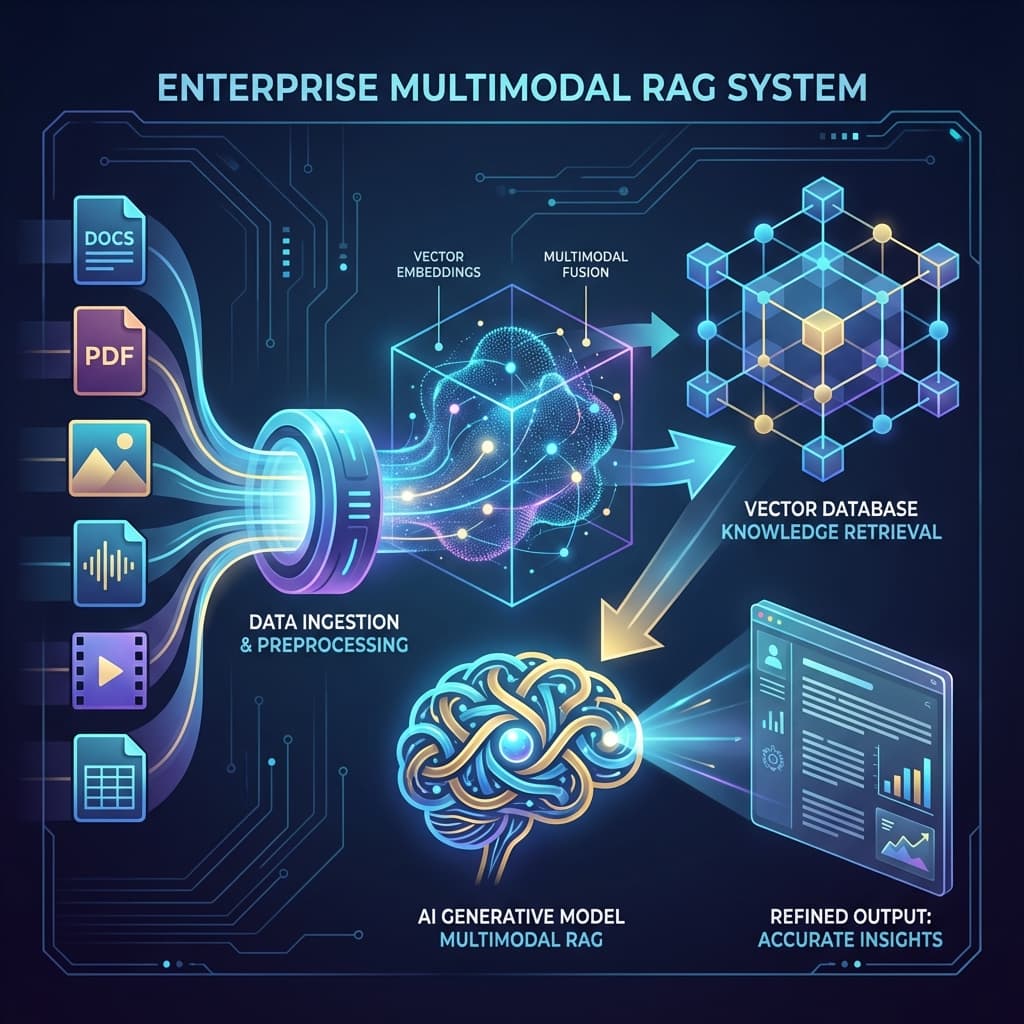
In the next lesson, we'll explore how multimodal RAG extends these benefits to images, audio, video, and beyond.