Capstone Project: The AI Architect
It's time to put it all together. In this final Capstone Project, you will design a high-stakes AI application from scratch, applying every concept from the 12 modules of this course.
127 articles

It's time to put it all together. In this final Capstone Project, you will design a high-stakes AI application from scratch, applying every concept from the 12 modules of this course.

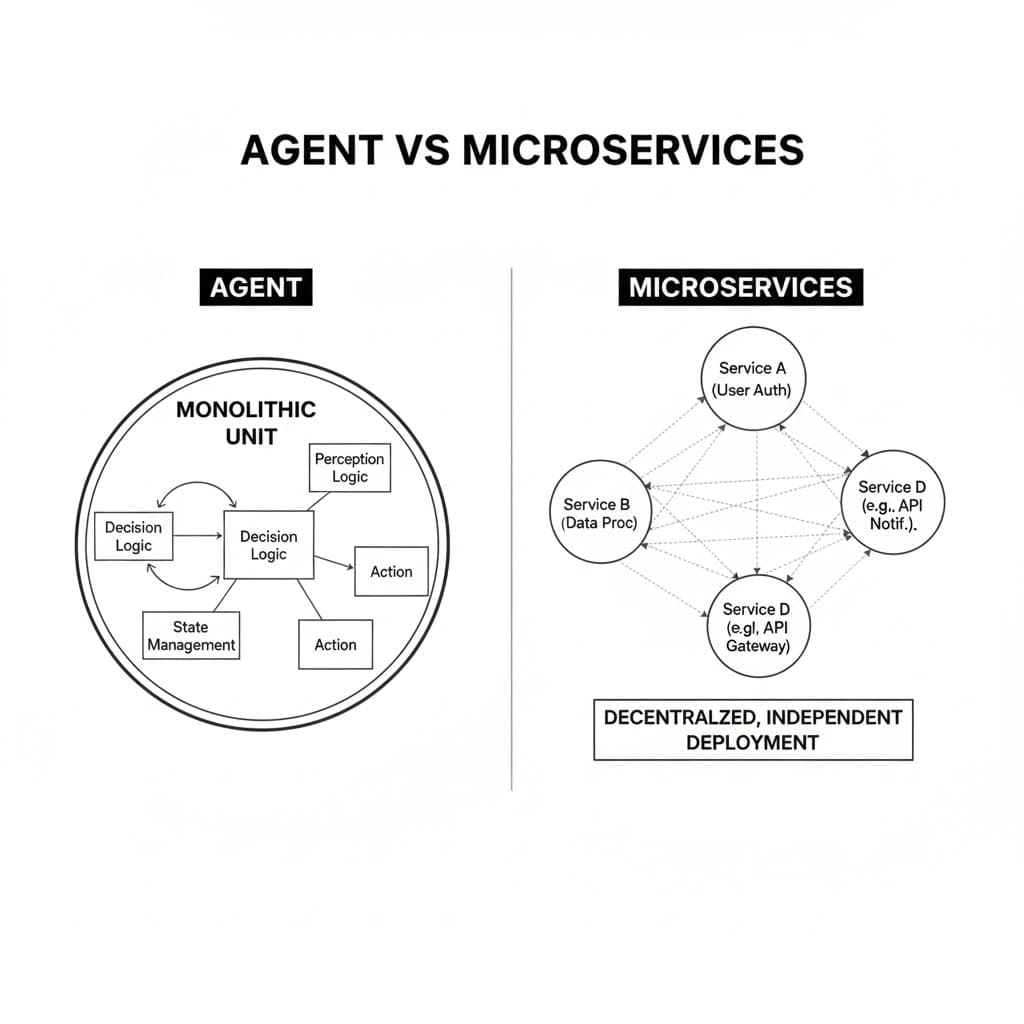
Is an agent just a specialized microservice? Explore the fundamental differences in control flow, observability, and reliability between agents and traditional services.
AI tokens are the new cloud bill. Learn how to optimize your AI costs through semantic caching, model routing, and prompt compression.
Is AI coming for your job? Explore how the role of the software engineer is evolving from writing syntax to orchestrating intelligent systems.

Automation is not all-or-nothing. Learn how to design effective Human-in-the-Loop (HITL) systems that combine AI speed with human judgment.
Stop talking about ethics and start building with safety. Learn the practical engineering guardrails, audit trails, and logging strategies for responsible AI.
The AI tech stack is moving beyond the OpenAI API. Explore the layers of the modern AI platform: vector stores, orchestration, and specialized deployment.

Moving from a prototype to production is the hardest part of AI. Explore the 4 major killers of AI PoCs: data quality, cost, latency, and governance.

Defining the role. A deep dive into the day-to-day responsibilities, toolsets, and team dynamics of a professional AI Security Engineer.
AI is the new attack surface. Learn about prompt injection, data leakage, and model misuse, and how to build production-grade security for your AI systems.
Defining Persona and Role. How to create an 'Invisible' layer of instructions that controls the AI's personality and safety.
The Final Challenge. Build a production-ready, agentic RAG system that analyzes companies and returns structured research reports via a REST API.
The starting point. How to set up a clean, isolated Python environment for your LangChain projects.
Connecting to the brains. How to install specialized packages for OpenAI, Anthropic, and local model providers.
Security First. How to securely manage your API keys using .env files and prevent accidental leaks.
Hands-on: Verify your complete installation and take the Module 1 challenge.
How the Agent decides. Deep dive into the mechanics of tool selection and processing tool outputs.
Hands-on: Combine tools, memory, and reasoning into a single autonomous Research Agent.
Hands-on: Build an Information Extraction agent that converts raw text into a clean Python object.
Connecting the Hearths. How to pass your custom handlers to models, tools, and executors to start capturing events.
Hands-on: Build a Cost-Monitoring Callback that calculates and prints the price of every AI request.
Finding the Bug. Techniques and tools for identifying where a multi-step chain is failing or hallucinating.
The Cloud Control Room. Introduction to LangSmith, the enterprise platform for tracing and optimizing your AI applications.
Hands-on: Set up LangSmith and trace a complex multi-tool agentic decision.
Connecting to the Frontend. How to wrap your LangChain apps in a professional REST API using FastAPI.
From Script to Service. How to organize your code and dependencies for reliable deployment on any server.
The Power of Agnosticism. Why LangChain uses wrappers to ensure you can switch models without rewriting your code.
Messages vs. Strings. Understanding the different ways LLMs process input and why Chat models are the modern standard.
Hands-on: Implementing a model switcher that allows you to change the 'Brain' of your app via a simple configuration.
Reviewing model abstractions, streaming, and batching. Your final check before moving to Prompts.
The Art of Instruction. Learning the basic principles of prompt engineering: Context, Task, and Format.
From Static to Dynamic. Using PromptTemplate to create reusable instructions with variables.
The Agent's Blueprint. How to create templates for multi-role conversations (System, Human, AI).
Leading by Example. How to provide the model with sample Q&A pairs to enforce style and accuracy.
Prompts as Code. How to version-control your instructions and use the LangChain Hub to share and pull best-in-class prompts.
Hands-on: Build a reusable prompt library and implement a few-shot dynamic classifier.
Piping the Brain. Learning how to use the | operator to create your first executable LangChain Expression Language chain.
Multi-Step reasoning. How to pipe the output of one LLM call directly into the input of a second LLM call.
Dynamic Decision Making. How to use an LLM to decide which sub-chain should handle a specific user request.
Parallel Reasoning. How to run multiple chains at the same time and combine their results into a final synthesized answer.
Optimizing for Logic. Why we must split long documents into smaller 'Chunks' to fit within LLM context windows.
Context-Aware Splitting. How to split Python code by functions and Markdown by headers to maintain semantic integrity.
Choosing your engine. Comparing OpenAI cloud embeddings with local HuggingFace models for speed and privacy.
Fine-Tuning Retrieval. Learning how to control how many results (k) your vector store returns and what 'Score' means.
The Search Object. How LangChain standardizes vector store lookups into a 'Retriever' that can be used in any chain.
Piping Facts. Putting it all together into a single LCEL chain that retrieves context and generates an answer.
The Art of Grounding. How to write the perfect system prompt to ensure your AI stays factual and cites its sources.
Hands-on: Finalize your first production-ready RAG system over your own local documents.
The Raw Transcript. Using the simplest memory type to keep a literal record of every message in a conversation.
Dense context. How to use an LLM to periodically summarize a conversation to keep the memory footprint small.
Production State. How to move your memory from local RAM to persistent databases for multi-user applications.
Hands-on: Build a persistent chatbot that remembers your name across different CLI sessions.
Creating Superpowers. How to turn any Python function into a LangChain tool using a simple decorator.
Hands-on: Build a toolbox for an agent that can multiply numbers and search Wikipedia.

Chatbots are just the entry point. Discover how enterprises are using Large Language Models for automated search, summarization, and complex decision support.

Move beyond simple chat interfaces. Explore how autonomous AI agents are transforming software design from static code to dynamic, self-optimizing systems.
The shift from generative to agentic. Understanding the third wave of AI development.
Stability in the storm. Managing the unpredictability of LLMs within structured software environments.
Avoiding the 'Everything is a Nail' trap. Understanding the cost, latency, and reliability trade-offs.
Standardizing the agent factory. Understanding the need for enterprise-grade management, configuration, and policies.
From cradle to grave. Managing versioning, rolling updates, and retirement of AI agents.
Separating logic from code. Using YAML and JSON to define agent personas, tools, and constraints.
The Speed Demon. Understanding the scenarios where LangChain's core abstractions outshine more complex frameworks.
The Enterprise Choice. Why LangGraph is the standard for high-reliability, long-running agent systems.
Understanding the glitch. The psychological and technical causes of AI hallucinations in agentic systems.
Words that matter. Advanced prompting techniques like Chain-of-Thought and Few-Shot that reduce agentic errors by 40%.
Structured safety. Using Pydantic and JSON schemas to ensure the agent's output is machine-readable and error-free.
The double-check. Implementing internal loops where one agent reviews and corrects the errors of another.
Measuring progress. How to build an Evals suite to test your agent's accuracy, tool usage, and cost over time.
Hacking the brain. Understanding how users can trick your agent into bypassing its own rules.
Protecting the user. How to handle Personally Identifiable Information (PII) and ensure your agent is GDPR/CCPA compliant.
Economic security. Preventing runaway costs and protecting your API keys from exhaustion.
Why LLMs aren't enough. Understanding the limit of probabilistic reasoning in deterministic business systems.
Old school intelligence. Learning how to define states, transitions, and triggers to create unshakeable logic.
The bridge. How to use an LLM to classify user intent and trigger a specific state change in your FSM.
Mathematically impossible to fail. Using libraries like Outlines and Guidance to force the LLM to follow a specific grammar or regex.
The support architect. Designing an automated ticket system that uses an FSM for policy and an LLM for empathy.
The Long-Term Memory. Learning how to use Pinecone, Chroma, and PGVector to give your agents a massive knowledge base.
Save time, save money. Using GPTCache to avoid calling the expensive LLM for identical (or similar) queries.
The eyes of the system. Implementing real-time tracking for agent health, token usage, and user sentiment.
Handling the crowd. How to manage thousands of concurrent agents without crashing your database or hit API limits.
Pipelining intelligence. How to automate the testing, benchmarking, and deployment of your agentic code and prompts.
Breaking the box. Why traditional chat interfaces fail to communicate the complexity of multi-agent systems.
Beyond text. How to use Vercel AI SDK and specialized tokens to render interactive UI components (dashboards, charts) on the fly.
Dissecting the agent. Understanding the four pillars: LLM, Memory, Tools, and the Control Loop.
The snapshot of intelligence. Managing variables, message history, and flags within a running agent.
The mechanics of action. How LLMs trigger external functions using structured JSON.
Self-correcting AI. How agents learn from errors and retry failed attempts during execution.
Mastering the fundamental agent loop. How to prompt for Thought, Action, and Observation.
Divide and conquer. Using one agent to build the map and another to walk the path.
The framework of choice. Understanding the high-level Agent abstractions in LangChain.
The heartbeat of LangChain agents. Managing the while-loop and handling the ReAct cycle.
Connecting the threads. How to implement chat history and windowed memory in LangChain agents.
Why agents break. Understanding hallucinations, tool loops, and parsing errors in LangChain.
The AI feedback trap. Why agents get stuck in repetitive cycles and how to break them.
When models get lazy. Understanding how agents take shortcuts or misuse tools to avoid difficult reasoning.
Ghost tools. How to handle agents that try to execute functions that don't exist in their toolbox.
The Black Box problem. Why traditional debuggers fail and how to use traces to find the glitch.
From magic to structure. Why giving an agent too much freedom is a recipes for disaster.
The successor to the Loop. Understanding the need for cyclic graphs in agent development.
Designing the flowchart of intelligence. Understanding nodes, edges, and state transitions.
The building blocks of LangGraph. Learning how to write functions that play nice with the graph schema.
The logic of the graph. Mastering how to route control based on tool calls, state variables, and LLM output.
The zero-trust agent. How to implement verification steps that ensure output quality before finishing.
Hands-on: Build a complex research agent with routing, loop guards, and a validation gate.
From single actors to ensemble casts. Understanding the specialized role-playing framework for multi-agent systems.
Designing the persona. How to write effective Roles, Goals, and Backstories to maximize agent performance.
Breaking it down. How to turn a complex project into a set of discrete, delegated Tasks in CrewAI.
How agents share data. Understanding context passing, memory sharing, and the 'Kitchen' environment in CrewAI.
Reacting in real-time. How to design agents that trigger actions based on external signals rather than internal loops.
Choosing the right tool. Understanding when to use event-driven strands over complex graphs or crews.
RAG vs Fine-Tuning. Knowing when to give the AI a book and when to perform surgery on its brain.
Trust but verify. Understanding the security boundaries of the Ollama server and how to protect your API.
Protecting the prompt. How to ensure sensitive user data like PII doesn't end up in your AI logs.
Buying for the future. A guide to RAM, VRAM, and processing power for high-uptime AI applications.
How Ollama works under the hood. Understanding the service, the CLI, and the llama.cpp engine.
Talking to the machine. Why prompting a local 8B model requires a different approach than ChatGPT.
The universal file type. Why GGUF is the 'PDF of AI' and why it's the foundation of the Ollama ecosystem.
The bridge between words and numbers. How LLMs translate your typing into something a computer can process.
Optimization 101. Balancing speed vs quality vs memory in your local AI setup.
Fine-tuning the engine. A dictionary of PARAMETER options to control speed, creativity, and memory.
Not all models are equal. Understanding which architectures (Llama, Mistral, BERT) work with the Ollama engine.
Going deep on compression. Exploring the technical differences between Q4_0, Q4_K_M, and GQA.
Optimization for 8B. Why 'Chain of Thought' is the secret weapon for making small models act like giants.
Hardening the persona. Using system prompts as a defensive layer to prevent 'Jailbreaking' and off-topic conversations.
Precision generation. Techniques to limit the model's verbosity and ensure it stays within character limits.
Stick to the facts. Techniques to prevent local AI from making up information.