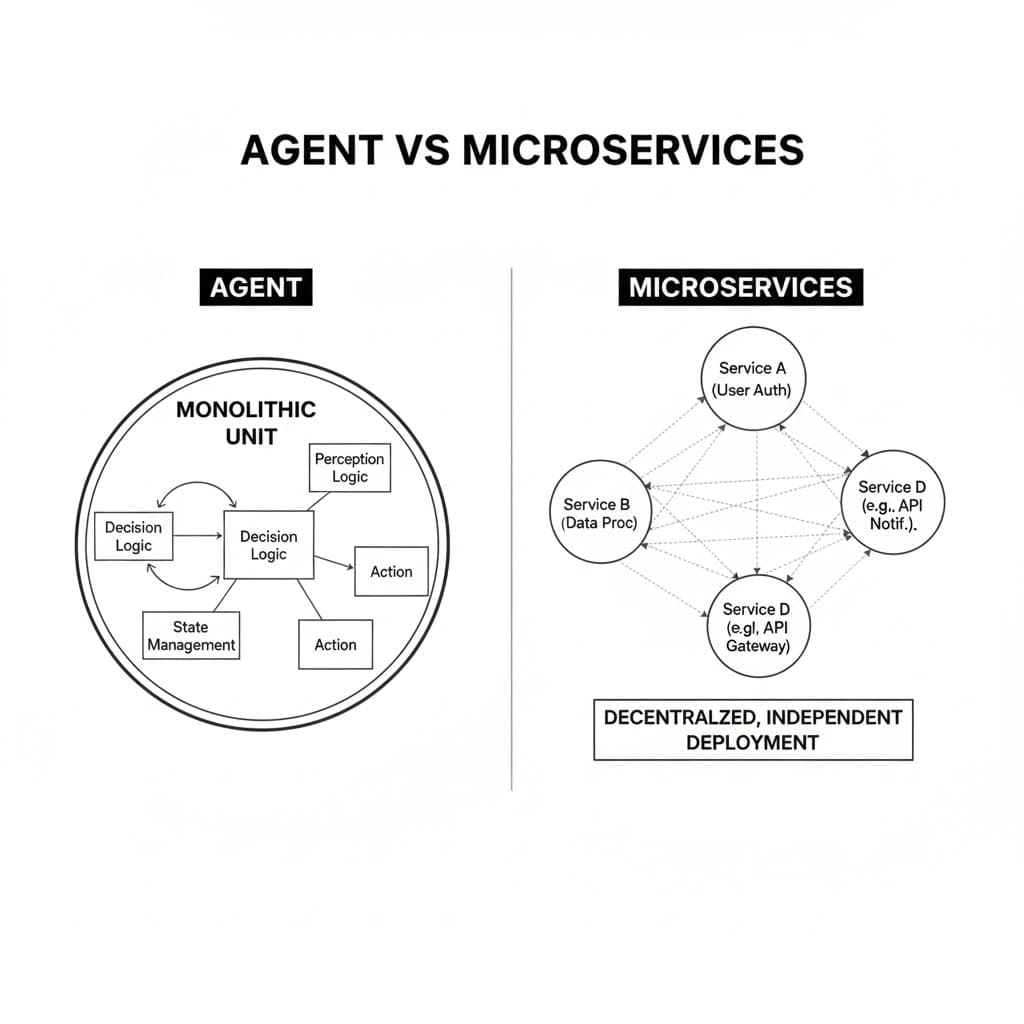
Agent vs Traditional Microservices
Is an agent just a specialized microservice? Explore the fundamental differences in control flow, observability, and reliability between agents and traditional services.
Agent vs Traditional Microservices
For the last decade, microservices have been the dominant architectural pattern for scaling complex software. We learned how to break monolithic applications into small, independent units that communicate over well-defined APIs.
Now, as AI agents enter the mainstream, we are seeing a new building block: the Autonomous Agent. But is an agent just a "Smart Microservice"? Or does it represent a fundamental shift in how we build systems?
This article compares traditional microservices with agentic architectures, highlighting the critical differences in control flow, observability, and reliability.
1. Control Flow: Deterministic vs. Probabilistic
The most significant difference lies in how logic is executed.
Traditional Microservices (Deterministic)
In a microservice architecture, the control flow is hardcoded.
- Service A calls Service B with a specific payload.
- The developer defines every
if-elsestatement and every potential error code. - The system is a state machine where the transitions are explicitly defined and predictable.
AI Agents (Probabilistic)
In an agentic architecture, the control flow is emergent.
- The developer gives the agent a Goal and a set of Tools.
- The agent decides which tool to call, in what order, and how to interpret the results.
- The same input can lead to different paths of execution each time, as the LLM reasons through the problem in real-time.
graph TD
    subgraph "Microservice (Static)"
    Start1([Input]) --> Auth[Auth Service]
    Auth --> Valid{Valid?}
    Valid -- Yes --> Data[Data Service]
    Valid -- No --> Error[Error 401]
    Data --> End1([Response])
    end

    subgraph "Agent (Dynamic)"
    Start2([Goal]) --> Reason[Reasoning Engine]
    Reason --> Decide{Action?}
    Decide -- "Search DB" --> tool1[DB Tool]
    Decide -- "Call API" --> tool2[API Tool]
    tool1 --> Reason
    tool2 --> Reason
    Reason -- "Task Complete" --> End2([Response])
    end
2. Observability: Metrics vs. Traces
How we monitor these systems is also shifting.
Traditional Observability
We rely on Metrics (latency, error rates, CPU usage) and Logs (string-based records of specific events). If a microservice fails, we look at the stack trace to find the exact line of code that threw the exception.
Agentic Observability
Because agents are non-deterministic, a stack trace is less useful. We need to see the Chain of Thought.
- The Trace: We need to see every prompt sent to the LLM, the model's raw reasoning, the tool call it suggested, and how it interpreted the result.
- Semantic Monitoring: We aren't just looking for "Error 500." We are looking for "Reasoning Loops" where the agent gets stuck in a repetitive cycle or "Logic Drift" where its responses become less accurate over time.
3. Reliability: Unit Tests vs. Evals
The "Testing" phase for an agent looks fundamentally different than for a microservice.
Microservice Reliability
We use Unit Tests and Integration Tests. We provide a specific input and assert that the output matches a precise value. This is binary: the test passes or fails.
Agent Reliability
We use Evaluations (Evals). Because an agent's output is natural language or complex tool calls, we cannot use a simple string match.
- LLM-as-a-Judge: We use a second, stronger model to evaluate if the agent's work met the goal.
- Benchmark Sets: We run the agent against 1,000 diverse scenarios and measure its "Accuracy Rate" rather than a pass/fail status.
4. Communication: JSON vs. Natural Language
Microservices talk in structured schemas (JSON, Protobuf). Agents talk—conceptually—in intents.
The Metadata Overhead
While an agent might technically send a JSON payload to a tool, the logic that determines that payload is wrapped in natural language prompts. This adds a layer of "Semantic Noise" that doesn't exist in traditional services. An agent might say: "I searched the database but found nothing. I will try searching the web instead." This high-level decision-making replaces the hardcoded fallback logic of a traditional service mesh.
graph LR
    subgraph "Microservice Sync"
    A[Service A] -- "JSON/gRPC" --> B[Service B]
    end

    subgraph "Agentic Loop"
    Ag[Agent] -- "Natural Language Prompt" --> M[LLM]
    M -- "Tool Call" --> T[API Tool]
    T -- "Raw Data" --> Ag
    end
5. Which Pattern Should You Choose?
The goal isn't to replace microservices with agents, but to use the right tool for the job.
- Use Microservices for: High-throughput, predictable, and mission-critical tasks (billing, authentication, database writes).
- Use AI Agents for: Unstructured data processing, complex decision-making, and tasks where the "How" is not known in advance (customer support, data synthesis, research).
4. State Management: ACID vs. Contextual Memory
In a microservice, state is usually managed in a relational database or a cache like Redis. We care about ACID properties: Atomicity, Consistency, Isolation, and Durability. A transaction either succeeds or fails, and the data is always "Correct."
Agents manage state in a more fluid way. They have Contextual Memory.
- Short-Term Memory: The current conversation thread and the immediate results of recent tool calls.
- Long-Term Memory: Historical patterns retrieved from a vector database. The "State" of an agent is not just a row in a table; it is a "Thought Workspace" that changes as new information is processed. This makes "Concurrency Control" much more complex. If two agents are working on the same goal, how do you prevent them from overwriting each other's "Thought Processes"?
5. Failure Modes: 500 Errors vs. Reasoning Loops
When a microservice fails, it returns a 500 error or a timeout. It's binary. When an agent fails, it might look like it's working.
The Reasoning Loop (Infinite Loop)
An agent can get stuck in a "Reasoning Loop." It picks a tool, the tool returns an error, and the agent decides to try the same tool again... and again... and again. This is the AI equivalent of an infinite loop in traditional code, but it's much harder to detect because each "Loop" is a unique, generated token stream.
- Mitigation: You must implement Hard Max Steps in your orchestration layer. If an agent hasn't reached its goal in 10 steps, kill the process and alert a human.
The "Confidence Trap"
An agent might successfully call a tool but misinterpret the result. For example, a search tool returns "No results found," and the agent reasons: "Since I found no records, the user must not exist," when in reality, the search query was simply poorly formatted.
6. Orchestration: Service Mesh vs. AI Orchestrator
In the microservices world, we use a Service Mesh (like Istio or Linkerd) to handle service-to-service communication, retries, and rate limiting. In the agentic world, we use an AI Orchestrator (like LangGraph or CrewAI).
The Orchestrator is more "Intelligent" than a Service Mesh. It doesn't just route traffic; it routes Intent.
- A Service Mesh doesn't care what the payload is, as long as it gets to the destination.
- An Orchestrator analyzes the payload to decide the next destination.
graph TD
    subgraph "Service Mesh (Transport)"
    S1[Service A] -- "TCP/mTLS" --> Proxy[Envoy]
    Proxy --> S2[Service B]
    end

    subgraph "AI Orchestrator (Logic)"
    Ag[Agent] --> Plan[Planner]
    Plan --> Logic{Does Step X need Data Y?}
    Logic -- Yes --> Tool[API Call]
    Logic -- No --> Finish[Final Answer]
    end
7. The Operational Cost Breakdown
Building an agentic system is often more expensive than a traditional microservice, both in terms of compute and development time.
| Aspect | Microservice Cost | AI Agent Cost |
|---|---|---|
| Development | High (Hardcoded logic) | Medium (Prompt engineering) |
| Maintenance | Medium (Dependency updates) | High (Model drift/Evals) |
| Inference/Execution | Very Low (Standard CPU) | High (GPU/Token usage) |
| Observability | Low (Standard Logs) | High (Semantic Traces) |
For high-volume, low-margin transactions, a microservice is almost always the better choice. For low-volume, high-value decision-making, the flexibility of an agent justifies the token cost.
8. Performance and Latency: The Reliability Paradox
Traditional services are "Reliable" because they are fast and predictable. Agents are "Unreliable" because they are slow and stochastic. However, agents can increase System-Level Reliability. Imagine a service that fails because a dependent API changed its schema.
- Microservice: Crashes, returns 500, needs a developer to fix it.
- Agent: Sees the schema error, reasons about the new structure, and "Heals" the request by adjusting its tool call in real-time.
This Self-Healing capability is the "Killer App" of agentic architecture.
9. Conclusion: The Hybrid Blueprint
We are entering the era of the AI-Grafted Architecture. The most successful systems of 2025 won't be pure agents or pure microservices. They will be traditional microservices that have "Agentic Pockets"—small, contained autonomous units that handle specific, unstructured tasks within a deterministic shell.
As an engineer, your job is to draw the boundary. Use microservices for the bones of the system—the skeleton that must not break. Use agents for the brain—the parts that need to think, adapt, and learn.
The architecture of the future is not a robot; it is a cyborg.