Final Capstone: The Autonomous Market Analyst
Bringing it all together. Build a complete, secure, and sovereign multi-agent system that researches stocks and generates a report.
98 articles
Bringing it all together. Build a complete, secure, and sovereign multi-agent system that researches stocks and generates a report.
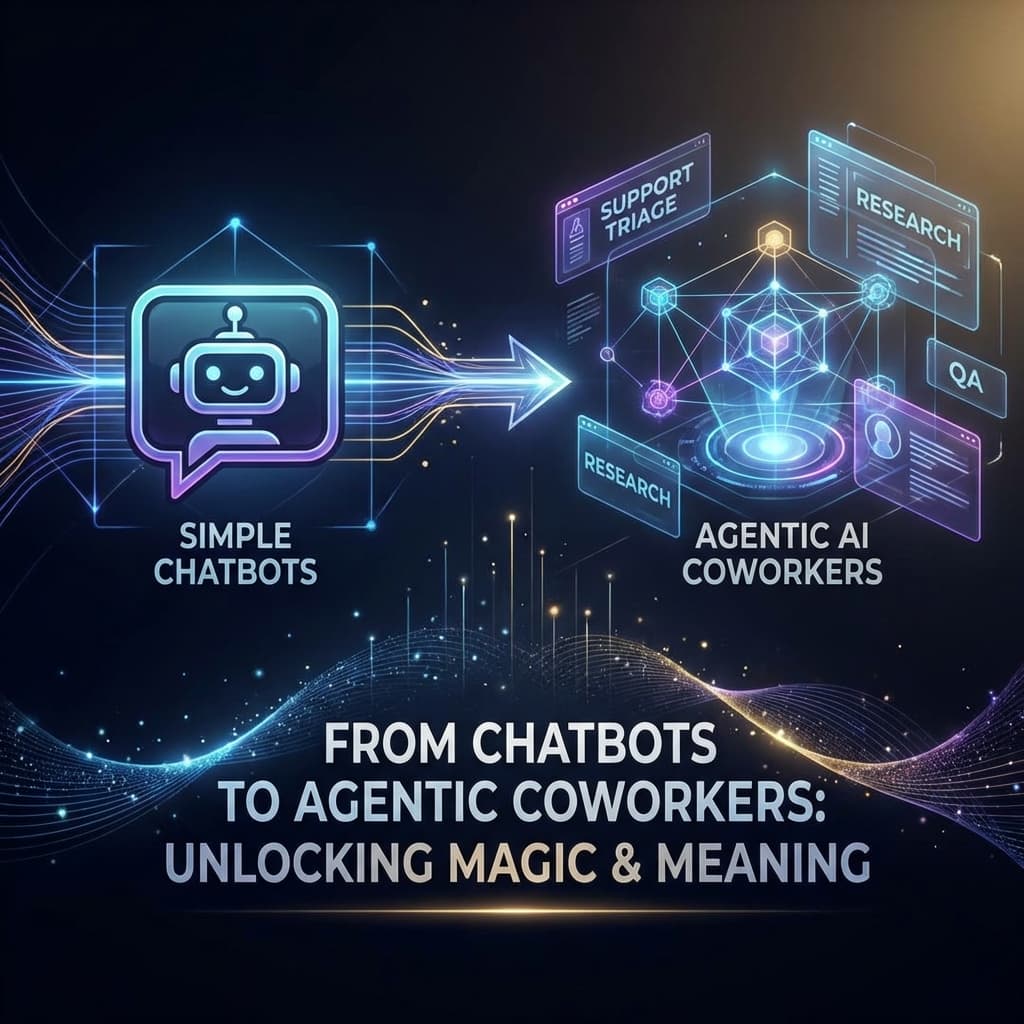
The shift from generative to agentic. Understanding the third wave of AI development.
Defining the boundary. Why adding a 'Search' tool to a chatbot doesn't make it an agent.
The engine of agency. Understanding the ReAct pattern and how LLMs navigate complexity.
Stability in the storm. Managing the unpredictability of LLMs within structured software environments.
Avoiding the 'Everything is a Nail' trap. Understanding the cost, latency, and reliability trade-offs.
From theory to production. Where agents are actually providing business value today.
Hands-on: Compare a chatbot vs an agent workflow and identify agent-worthy problems.
Standardizing the agent factory. Understanding the need for enterprise-grade management, configuration, and policies.
From cradle to grave. Managing versioning, rolling updates, and retirement of AI agents.
Separating logic from code. Using YAML and JSON to define agent personas, tools, and constraints.
Governance at scale. Implementing global rules that restrict agent behavior regardless of the prompt.
Connecting to the real world. Integrating agents with SQL, ERP systems, and internal authentication.
Hands-on: Design a configuration-driven agent with a global PII-filtering policy.
The Framework Showdown. Comparing the architecture, complexity, and performance of the top 3 agent frameworks.
The Speed Demon. Understanding the scenarios where LangChain's core abstractions outshine more complex frameworks.
The Enterprise Choice. Why LangGraph is the standard for high-reliability, long-running agent systems.
The Creative Engine. Scenarios where specialized roles and collaborative personas result in superior quality output.
The Hybrid Approach. How to combine LangGraph's control with CrewAI's collaboration for the ultimate system.
Hands-on: Use a decision matrix to select the right framework for three real-world business scenarios.
Understanding the glitch. The psychological and technical causes of AI hallucinations in agentic systems.
Words that matter. Advanced prompting techniques like Chain-of-Thought and Few-Shot that reduce agentic errors by 40%.
Structured safety. Using Pydantic and JSON schemas to ensure the agent's output is machine-readable and error-free.
The double-check. Implementing internal loops where one agent reviews and corrects the errors of another.
Measuring progress. How to build an Evals suite to test your agent's accuracy, tool usage, and cost over time.
Hands-on: Build a self-correcting agent loop that uses Pydantic to validate outputs.
Hacking the brain. Understanding how users can trick your agent into bypassing its own rules.
Protecting the user. How to handle Personally Identifiable Information (PII) and ensure your agent is GDPR/CCPA compliant.
Zero data leakage. Running high-performance agents on your own hardware using Ollama, MLX, and Llama.cpp.
Economic security. Preventing runaway costs and protecting your API keys from exhaustion.
The Responsible Engineer. Navigating the legal and ethical landscape of autonomous agents.
Hands-on: Secure an agent against jailbreaking and implement a PII redaction layer.
Why LLMs aren't enough. Understanding the limit of probabilistic reasoning in deterministic business systems.
Old school intelligence. Learning how to define states, transitions, and triggers to create unshakeable logic.
The bridge. How to use an LLM to classify user intent and trigger a specific state change in your FSM.
Mathematically impossible to fail. Using libraries like Outlines and Guidance to force the LLM to follow a specific grammar or regex.
The support architect. Designing an automated ticket system that uses an FSM for policy and an LLM for empathy.
Hands-on: Build a state-machine governed agent that handles a login and payment flow.
The Long-Term Memory. Learning how to use Pinecone, Chroma, and PGVector to give your agents a massive knowledge base.
Save time, save money. Using GPTCache to avoid calling the expensive LLM for identical (or similar) queries.
The eyes of the system. Implementing real-time tracking for agent health, token usage, and user sentiment.
Handling the crowd. How to manage thousands of concurrent agents without crashing your database or hit API limits.
Pipelining intelligence. How to automate the testing, benchmarking, and deployment of your agentic code and prompts.
Hands-on: Build a simple RAG agent that retrieves context from a local Vector DB before answering.
Breaking the box. Why traditional chat interfaces fail to communicate the complexity of multi-agent systems.
Beyond text. How to use Vercel AI SDK and specialized tokens to render interactive UI components (dashboards, charts) on the fly.
Watch the agent work. How to capture and stream the 'Thought' and 'Action' phases to the UI in real-time.
Patience is a virtue. How to handle research tasks that take minutes to finish using notifications and async status pages.
See and hear. Designing interfaces that allow agents to process images, diagrams, and voice commands.
Hands-on: Design a dashboard concept for a multi-agent research crew that shows planning and status.
Dissecting the agent. Understanding the four pillars: LLM, Memory, Tools, and the Control Loop.
The snapshot of intelligence. Managing variables, message history, and flags within a running agent.
The two speeds of learning. Understanding conversation buffers vs vector databases.
The mechanics of action. How LLMs trigger external functions using structured JSON.
Self-correcting AI. How agents learn from errors and retry failed attempts during execution.
Hands-on: Build a manual, single-step agent loop from scratch in Python.
Mastering the fundamental agent loop. How to prompt for Thought, Action, and Observation.
Divide and conquer. Using one agent to build the map and another to walk the path.
The CEO of Agents. Coordinating multiple specialist agents to solve multi-disciplinary problems.
Self-improving AI. Using one model to generate and another to find the flaws.
The safety net. When and how to pause an autonomous agent to ask for human approval.
Hands-on: Design a planner-executor flow for a multi-step research task.
The framework of choice. Understanding the high-level Agent abstractions in LangChain.
Equipping your agent. How to define tools using decorators, pydantic, and base classes.
The heartbeat of LangChain agents. Managing the while-loop and handling the ReAct cycle.
Connecting the threads. How to implement chat history and windowed memory in LangChain agents.
Why agents break. Understanding hallucinations, tool loops, and parsing errors in LangChain.
Protecting your wallet. Setting limits on iterations, time, and tokens in LangChain agent executors.
Hands-on: Build a tool-using LangChain agent and observe the reasoning traces in real-time.
The AI feedback trap. Why agents get stuck in repetitive cycles and how to break them.
When models get lazy. Understanding how agents take shortcuts or misuse tools to avoid difficult reasoning.
Ghost tools. How to handle agents that try to execute functions that don't exist in their toolbox.
The Black Box problem. Why traditional debuggers fail and how to use traces to find the glitch.
From magic to structure. Why giving an agent too much freedom is a recipes for disaster.
The successor to the Loop. Understanding the need for cyclic graphs in agent development.
Designing the flowchart of intelligence. Understanding nodes, edges, and state transitions.
The building blocks of LangGraph. Learning how to write functions that play nice with the graph schema.
Stability in the graph. Using edges and state counters to prevent infinite loops and ensure predictable behavior.
Managing the perimeter. Using specialized nodes to filter inputs and validate final results.
Hands-on: Convert a simple LangChain AgentExecutor into a controlled LangGraph workflow.
The logic of the graph. Mastering how to route control based on tool calls, state variables, and LLM output.
Setting boundaries. How to implement hard limits on cycles and token usage within your agent graphs.
Resilience by design. How to handle tool failures and rate limits within the agent graph.
The zero-trust agent. How to implement verification steps that ensure output quality before finishing.
The pause button. Implementing 'interrupts' that allow humans to review and edit agent state before final actions.
Hands-on: Build a complex research agent with routing, loop guards, and a validation gate.
From single actors to ensemble casts. Understanding the specialized role-playing framework for multi-agent systems.
Designing the persona. How to write effective Roles, Goals, and Backstories to maximize agent performance.
Breaking it down. How to turn a complex project into a set of discrete, delegated Tasks in CrewAI.
Sequential vs. Hierarchical. Choosing the right organizational structure for your agent team.
How agents share data. Understanding context passing, memory sharing, and the 'Kitchen' environment in CrewAI.
Hands-on: Build a two-agent research crew that identifies tech trends and writes a report.
The lightweight alternative. Understanding the event-driven, streaming-first architecture of StrandAgents.
Reacting in real-time. How to design agents that trigger actions based on external signals rather than internal loops.
Choosing your memory model. When to build agents that remember the past vs agents that treat every event as new.
Zero latency. Understanding how to build agents that speak while they think using async Python and SSE.
Choosing the right tool. Understanding when to use event-driven strands over complex graphs or crews.
Hands-on: Build an event-driven agent pipeline that detects toxicity and triggers a response.