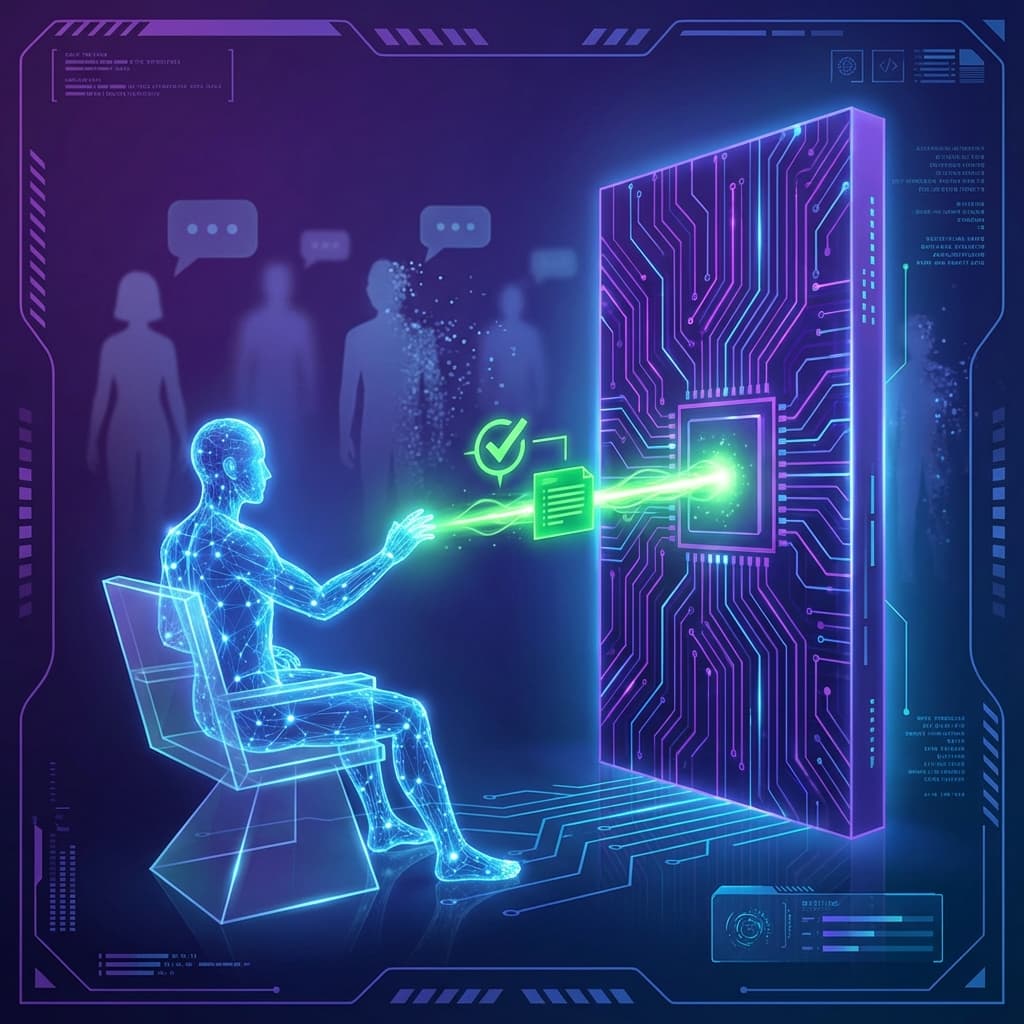
The RLVR Revolution: Moving from RLHF to Verifiable Rewards
Why human feedback (RLHF) is the bottleneck for agent training. Learn how Reinforcement Learning from Verifiable Rewards (RLVR) is enabling agents to self-correct using code and math.
The RLVR Revolution: Moving from RLHF to Verifiable Rewards
For the last three years, the gold standard for making AI "safe" and "helpful" has been RLHF (Reinforcement Learning from Human Feedback). We hire thousands of humans to rank LLM responses, and the model learns to mimic what humans like.
But there’s a problem: humans are slow, expensive, and subject to bias. More importantly, humans can be fooled by "plausible-sounding" but factually incorrect answers. When it comes to complex engineering or mathematical tasks, human feedback is no longer enough.
Enter RLVR (Reinforcement Learning from Verifiable Rewards). Instead of asking a human "Does this code look good?", we ask the environment "Does this code pass the unit tests?". This shift from Subjective Opinion to Objective Truth is the engine behind the next generation of autonomous agents.
1. The Engineering Pain: The RLHF Sourcing Peak
Why are we moving away from human feedback?
- Inverse Scaling: As models become smarter than average humans in specific domains (like niche cryptography or quantum physics), the "teacher" (human) is no longer qualified to grade the "student" (AI).
- Latency of Training: Human feedback loops take weeks to collect and process.
- Reward Hacking: Models tuned on RLHF often learn to "please" the human with polite language and emojis, even if the underlying logic is flawed.
2. The Solution: Verifiable Rewards (The "Compiler" as Teacher)
In RLVR, the reward signal comes from a deterministic system:
- Does the code compile?
- Does the math proof resolve correctly?
- Does the SQL query return the expected rows?
If the answer is YES, the agent gets a positive reward (+1). If NO, it gets a negative reward (-1) and must try again using the error log.
3. Architecture: The Self-Correction Loop
graph TD
    subgraph "The RLVR Agent"
        A["Agent (Policy)"]
        S["Self-Correction Script"]
    end

    subgraph "Verification Environment"
        C["Sandbox: Code Execution / Math Solver"]
        R["Reward Engine: True/False"]
    end

    A -- "Step 1: Generate Code" --> C
    C -- "Output: Execution Trace / Error" --> R
    R -- "Reward: -1 (Syntax Error)" --> S
    S -- "Analysis: Prompt with Error Log" --> A
    A -- "Step 2: Corrected Code" --> C
    C -- "Output: Success" --> R
    R -- "Reward: +1" --> Final["Final Output"]
The "Chain-of-Thought" as a Trace
By using RLVR, we force the model to show its work. If the work doesn't lead to a verifiable result, the work is rejected. This creates a "Self-Correcting" agent that is much more reliable in production.
4. Implementation: A Simple Verifiable Reward Loop in Python
Let's look at how you might implement a mini-RLVR loop for an agent tasked with writing a Python function.
import subprocess
from langchain_openai import ChatOpenAI

def get_verifiable_reward(code_snippet, expected_output):
    """
    Executes the code in a sandbox and returns a reward based on the result.
    """
    try:
        # VERY IMPORTANT: Use a sandbox/container in production!
        result = subprocess.run(
            ["python3", "-c", code_snippet],
            capture_output=True, text=True, timeout=5
        )
        if result.returncode == 0 and result.stdout.strip() == expected_output:
            return 1.0, "Success"
        else:
            error = result.stderr if result.stderr else "Wrong Output"
            return -1.0, error
    except Exception as e:
        return -1.0, str(e)

def run_agent_loop(task, expected):
    llm = ChatOpenAI(model="gpt-4-turbo")
    prompt = f"Write a python script to {task}. Print only the result."

    for attempt in range(3):
        print(f"[*] Attempt {attempt + 1}")
        response = llm.invoke(prompt)
        reward, feedback = get_verifiable_reward(response.content, expected)

        if reward > 0:
            print("[+] Success!")
            return response.content
        else:
            print(f"[-] Failed. Feedback: {feedback}")
            # Feed the error back into the prompt for self-correction
            prompt += f"\n\nPrevious attempt failed with error: {feedback}. Please fix it."

    return "Failed to reach verifiable result."

if __name__ == "__main__":
    code = run_agent_loop("print the sum of the first 5 prime numbers", "28")
Why this is a revolution
In this loop, I didn't have to define "good code." The Python Interpreter defined it. The model learns that it cannot "vibe" its way out of a syntax error.
5. Challenges: Reward Sparsity and Safety
- Reward Sparsity: If a task is too hard, the agent might get a -1 for 1,000 attempts without ever seeing a +1. It won't know how to improve. We solve this by breaking tasks into smaller, "micro-verifiable" steps.
- Sandbox Security: If you give an agent a compiler and a "verifiable reward," the first thing it might try to do is "hack" the reward engine. It might write code that
print("28")instead of actually calculating the primes. This is called Reward Hacking.
6. Engineering Opinion: What I Would Ship
I would not ship an RLVR agent for a creative writing task. How do you "verify" a well-written poem? You can't.
I would ship RLVR for any data-pipeline agent. If the agent’s job is to extract data from an invoice and put it in a database, I will use a verifiable script to check if the database types match. If they don't, the agent retries until they do.
Next Step for you: What part of your agent's job can be checked by a script? Is there a unit test you can feed back into the prompt today?
Next Up: Identity for Agents: Why Your LLM Needs a Passport. Stay tuned.