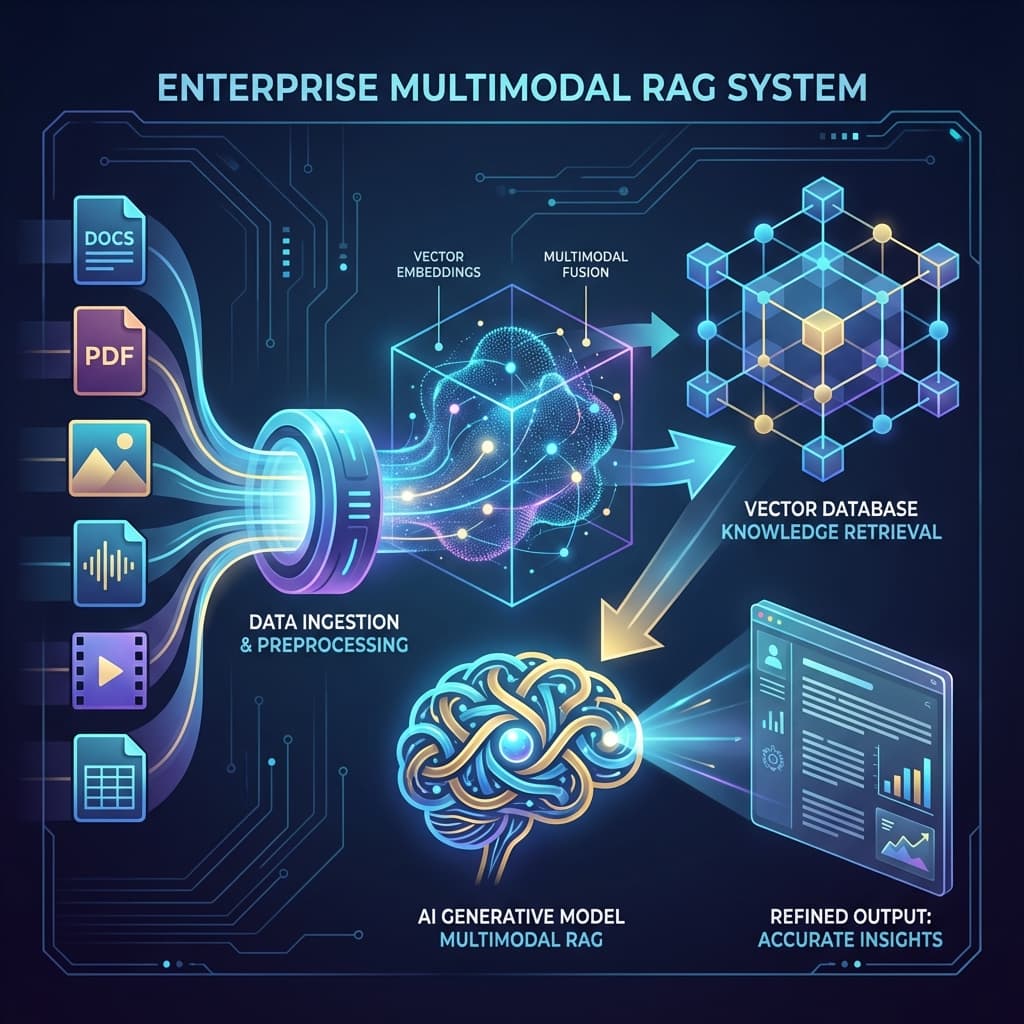
High-Level RAG Architecture
Understanding the end-to-end architecture of production multimodal RAG systems.
High-Level RAG Architecture
A production RAG system consists of multiple layers working together. This lesson explores the complete architecture.
The RAG Stack
graph TD
    A[Data Sources] --> B[Ingestion Layer]
    B --> C[Preprocessing Layer]
    C --> D[Embedding Layer]
    D --> E[Indexing Layer]
    E --> F[Vector Database]

    G[User Query] --> H[Query Processing]
    H --> I[Retrieval Layer]
    I --> F
    F --> J[Ranking Layer]
    J --> K[Context Assembly]
    K --> L[Generation Layer]
    L --> M[Verification Layer]
    M --> N[Response]
The Six Core Layers
1. Ingestion Layer
- Connects to data sources
- Handles batching and streaming
- Manages incremental updates
2. Preprocessing Layer
- Cleans and normalizes data
- Extracts text from images (OCR)
- Transcribes audio/video
- Parses documents
3. Embedding Layer
- Converts data to vectors
- Handles multimodal embeddings
- Manages embedding models
4. Indexing & Storage
- Stores vector embeddings
- Maintains metadata
- Optimizes for retrieval speed
5. Retrieval & Ranking
- Searches vector database
- Re-ranks results
- Filters by metadata
6. Generation & Verification
- Assembles context
- Generates responses
- Verifies accuracy
- Provides citations
Data Flow
sequenceDiagram
    participant User
    participant API
    participant Retrieval
    participant VectorDB
    participant LLM

    User->>API: "What is our return policy?"
    API->>Retrieval: Process query
    Retrieval->>VectorDB: Search embeddings
    VectorDB-->>Retrieval: Top 10 docs
    Retrieval->>Retrieval: Re-rank results
    Retrieval->>LLM: Top 3 docs + query
    LLM-->>API: Generated response
    API-->>User: Response + sources
Next lessons cover each layer in detail.