Supervised vs. Unsupervised Learning, Overfitting/Underfitting: What are these?
A developer's guide to the core concepts of machine learning: from data labeling to the delicate balance of model complexity.
Supervised vs. Unsupervised Learning, Overfitting/Underfitting: What are these?
If you are a software engineer entering the world of AI, you’ve likely been hit with a tidal wave of jargon. It feels like every concept is a separate, complex piece of math.
In reality, most of machine learning boils down to two questions: How are we teaching the machine? and How well is it actually learning?
Why This Matters Now
We are moving past the "wrapper" phase of AI. Just calling an LLM API isn't enough anymore. As developers, we are now fine-tuning models, building custom embeddings, and designing RAG systems. If you don't understand these fundamentals, you are just throwing tokens at a wall and hoping they stick.
1. The Methods: Supervised vs. Unsupervised Learning
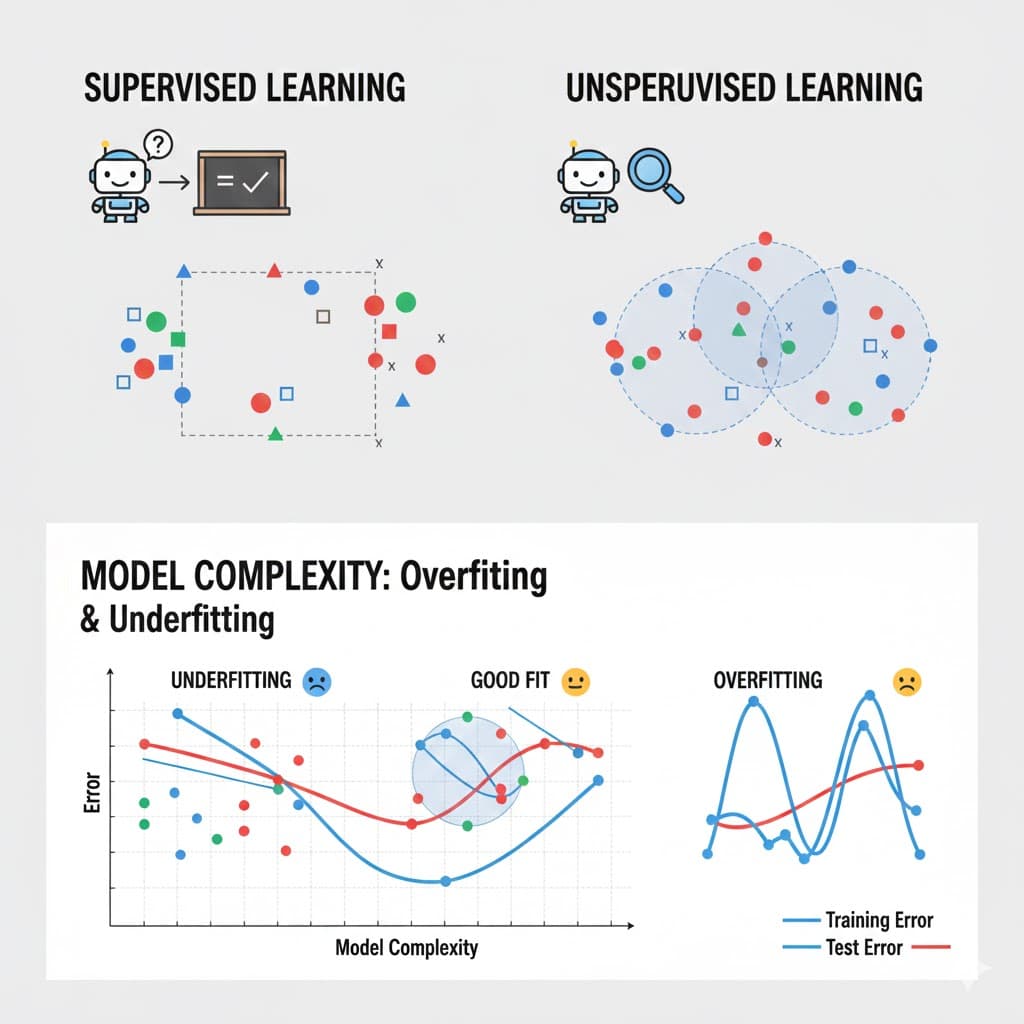
Supervised Learning (The Teacher)
Think of this as Flashcard Learning. You give the model a question (input) and the correct answer (label).
- Engineering Analogy: Unit Testing with expected outputs.
- Mental Model: A teacher grading a student's homework. The student learns by seeing the corrections.
- Examples: Email spam detection, house price prediction, image classification.
Unsupervised Learning (The Discoverer)
Think of this as Pattern Recognition. You give the model data but NO answers. It has to find structure on its own.
- Engineering Analogy: Log Analysis. You have millions of logs and you want to group them into "normal" vs "weird" without knowing exactly what "weird" looks like yet.
- Mental Model: Sorting a bucket of multi-colored LEGO bricks without being told the colors. You'd likely group them by shape or color based on their inherent properties.
- Examples: Customer segmentation, anomaly detection, topic modeling.
2. The Quality: Overfitting vs. Underfitting
This is the "Goldilocks" problem of machine learning.
Underfitting (The Lazy Learner)
The model is too simple. It doesn't capture the underlying trend of the data. It's like a student who only studies one page of a textbook and fails the exam because they missed the big picture.
- Result: High error on both training data and new data.
Overfitting (The Rote Memorizer)
The model is too complex. It memorizes the noise and specific details of the training data rather than the general pattern. It's like a student who memorizes the exact sequence of answers for a practice test but can't solve a single new problem.
- Result: Zero error on training data, but massive failure on any new, real-world data.
Hands-on Example: Detecting Overfitting
Here is a Python example using scikit-learn to visualize how model complexity leads to overfitting.
import numpy as np
from sklearn.pipeline import make_pipeline
from sklearn.preprocessing import PolynomialFeatures
from sklearn.linear_model import LinearRegression

# Generate sample data (a simple sine curve with noise)
np.random.seed(0)
X = np.sort(np.random.rand(20, 1), axis=0)
y = np.cos(1.5 * np.pi * X).ravel() + np.random.randn(20) * 0.1

# Underfitting: Degree 1 (Straight line)
model_underfit = LinearRegression().fit(X, y)

# Overfitting: Degree 15 (Complex jagged line)
model_overfit = make_pipeline(PolynomialFeatures(15), LinearRegression()).fit(X, y)

# Balanced: Degree 4 (Smooth curve)
model_good = make_pipeline(PolynomialFeatures(4), LinearRegression()).fit(X, y)

print("Models trained. Underfit is too simple, Overfit is too complex.")
Under the Hood: The Bias-Variance Tradeoff
Internally, we measure this using Bias and Variance.
- Bias is the error from erroneous assumptions (leads to Underfitting).
- Variance is the error from sensitivity to small fluctuations in the training set (leads to Overfitting).
As you increase model complexity, internal "weights" become extremely specific. In a neural network, this might mean a single neuron "locking on" to a specific pixel in one training image, rather than the concept of an "edge" or a "shape."
Author’s Take
I see developers falling into the Overfitting trap every day, especially with LLMs. They "over-engineer" a prompt for one specific edge case, only to find that it breaks the model's logic for 90% of other queries.
In engineering, simpler is almost always better. If a Linear Regression or a simple K-Means cluster solves your problem, do not build a neural network. Complexity is a liability, not a feature.
Conclusion
Understanding these concepts is about developing a "nose" for data.
- If your model performs perfectly in testing but fails in production, you are Overfitting.
- If your model can't even get the training data right, you are Underfitting.
- If you have labels, go Supervised.
- If you're exploring the unknown, go Unsupervised.
Master these four concepts, and you’ve mastered the foundational logic of the AI era.