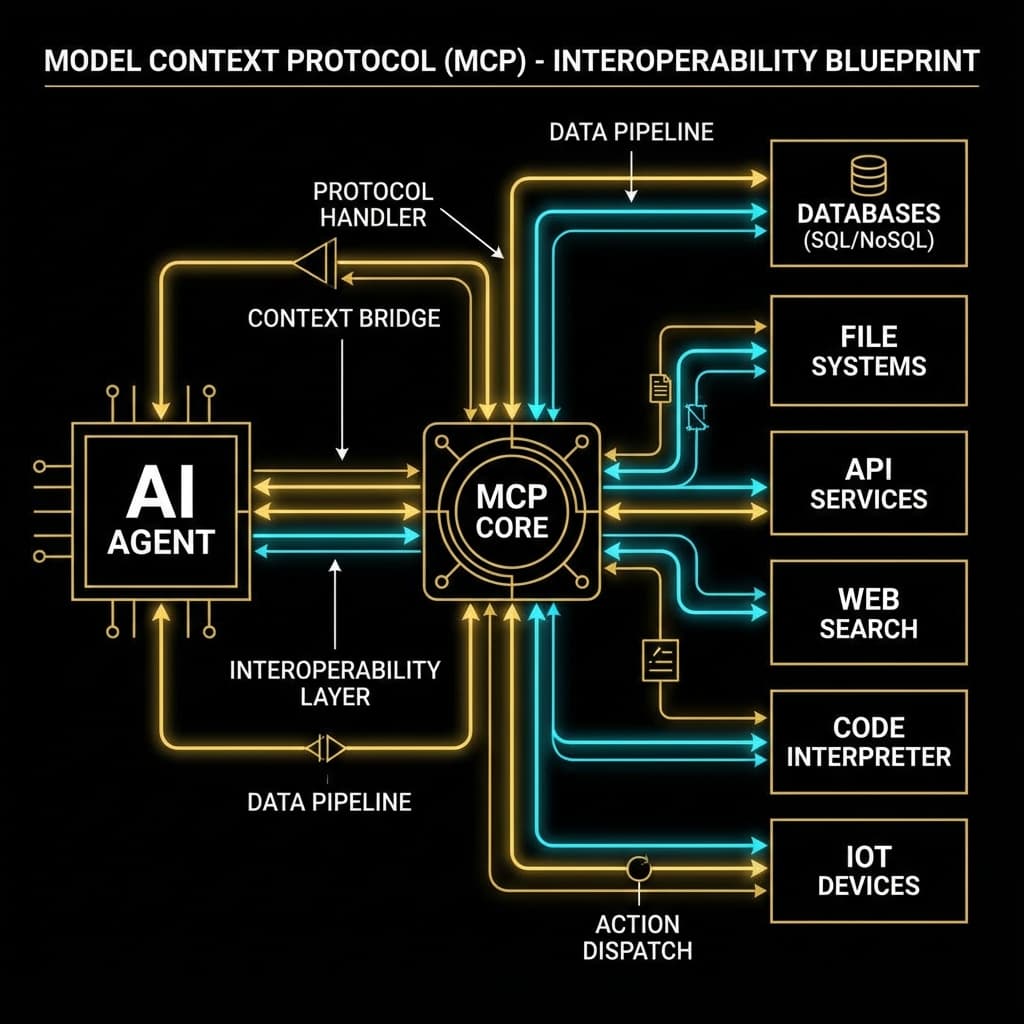
MCP Server for AI Agents: Why and How to Use It
A deep dive into the Model Context Protocol (MCP), explaining why it's the missing link for production AI agents and how to implement it.
MCP Server for AI Agents: Why and How to Use It
For the last year, we've been building "Frankenstein" agents. We glue together a vector database, a Python script for web searching, and a separate API client for Slack, all using brittle, custom prompt definitions.
It is a mess.
The Model Context Protocol (MCP) is the first serious attempt to standardize how AI models interact with the outside world.
Opening Context
If you have built an agent using LangChain or AutoGPT, you know the pain: Tool Definition Drift. You write a JSON schema for a tool, the model updates, and suddenly your agent stops calling the tool correctly.
MCP solves this by moving the context definition out of the prompt engineering black box and into a standardized server protocol. It is worth your attention because Anthropic and other major players are adopting it as the standard for tool interoperability.
Mental Model: USB for AI
Think of MCP as USB for AI models.
Before USB, if you wanted to connect a mouse, a printer, and a scanner, you needed three different ports (PS/2, Parallel, Serial).
Currently, connecting Postgres, Notion, and Google Drive to an LLM requires three different custom integrations.
MCP provides a standard "socket." You run an MCP Server (the device driver), and any MCP-compliant Client (Claude Desktop, Cursor, your custom agent) can instantly "plug in" and use the tools without custom glue code.
Hands-On Example
Let's build a simple MCP server that exposes a database to an agent. We'll use Python and the standard mcp library.
1. Installation
pip install mcp
2. The Server
This minimal server exposes a "query_users" tool.
from mcp.server import FastMCP

# Initialize the server
mcp = FastMCP("UserDatabase")

# Define a tool using valid python typing
@mcp.tool()
async def query_users(role: str) -> str:
    """Queries the internal database for users with a specific role."""
    # Simulation of a DB call
    users = [
        {"id": 1, "name": "Alice", "role": "admin"},
        {"id": 2, "name": "Bob", "role": "user"},
    ]

    filtered = [u for u in users if u["role"] == role]
    return str(filtered)

if __name__ == "__main__":
    mcp.run()
Notice what is missing: No JSON schema definition. The MCP SDK handles inspecting the function signature and docstring to generate the tool definition for the LLM automatically.
Under the Hood
When you run this server, it typically communicates over Stdio (standard input/output) or SSE (Server-Sent Events).
- Handshake: The client (e.g., Cursor) starts the server process.
- Discovery: The client asks
ListTools. The server replies using thequery_userssignature. - Execution: When the LLM decides to call the tool, the client sends a JSON-RPC message. The server executes the function and returns the result string.
Security Implication: Since the server runs locally or inside your private VPC, you don't need to send your database credentials to the AI provider. The LLM only sees the schema and the output text.
Common Mistakes
Treating MCP as "Just another API"
MCP is stateful in a way APIs aren't. It handles resource subscriptions.
Mistake: Polling for changes.
Better: Use MCP's resources/subscribe capability to let the server push context updates to the agent.
Over-exposing functions
Just because you can expose every function in your codebase as a tool doesn't mean you should.
Mistake: Exposing delete_user without checks.
Better: Create read-only "View" tools for the agent to explore safely first.
Production Reality
In production, you likely won't run MCP over Stdio. You will use SSE (Server-Sent Events) to decouple the agent runtime from the tool runtime.
This allows you to scale your "Tools Layer" independently of your "Inference Layer." You can have a fleet of Python pods serving heavy data analysis tools, accessed by a lightweight Node.js agent.
Author’s Take
MCP is the most important infrastructure shift in AI since vector databases.
I would not build a new agentic system today without it. The ability to swap out the "brain" (LLM) while keeping the "body" (Tools/Context) stable is critical for long-term maintenance.
Start by wrapping your messiest integration—usually your internal API or database—in an MCP server. You will be surprised smoothly it cleans up your agent code.
Conclusion
Standardization allows ecosystems to flourish. By adopting MCP, you future-proof your agents against model churn and gain access to a growing ecosystem of pre-built tools.
Stop writing custom glue code. Build a server instead.