K-Nearest Neighbor(KNN) Algorithm: A Simple, Supervised Machine Learning Method
An engineer's guide to the KNN algorithm, exploring its utility in classification and regression, its simplicity, and its performance trade-offs in production.
K-Nearest Neighbor(KNN) Algorithm
In an era of deep transformers and trillion-parameter models, the K-Nearest Neighbor (KNN) algorithm is often dismissed as "too simple." But in production engineering, "simple" usually means "reliable" and "predictable."
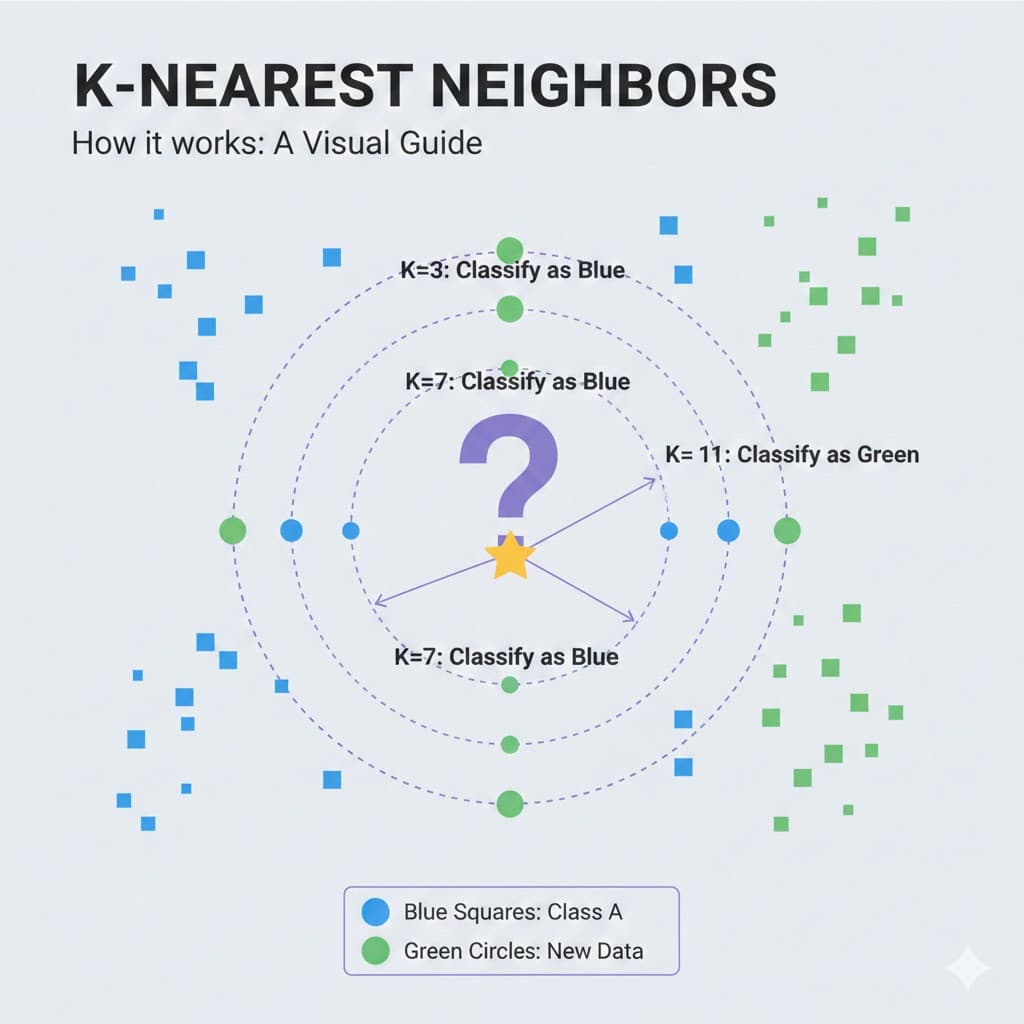
KNN is a non-parametric, lazy learning algorithm. It doesn't build an internal model during training; instead, it stores all training data and makes decisions at the moment of prediction based on proximity.
Opening Context
We often spend weeks fine-tuning complex models when a simple proximity search would have solved the problem in minutes. KNN is the algorithmic equivalent of asking your five closest neighbors for advice.
It is particularly relevant now as we build RAG (Retrieval-Augmented Generation) systems. The "Retrieval" part of RAG is essentially a massive KNN search over vector embeddings. Understanding the fundamentals of KNN is understanding the backbone of modern AI retrieval.
Mental Model: The Neighborhood Vote
Think of KNN as a Democratic Neighborhood.
If you move into a new house and want to know which internet provider to use, you don't look at a global mathematical model. You ask the K closest neighbors what they use.
- If 4 out of 5 use Provider A, you choose Provider A (Classification).
- If you want to know what your electricity bill will be, you take the average of those 5 neighbors' bills (Regression).
The "distance" between you and your neighbors is the core of the algorithm.
Hands-On Example
Let's implement a basic KNN classifier using Python and scikit-learn.
from sklearn.neighbors import KNeighborsClassifier
import numpy as np

# Features: [Weight (g), Texture (1 for smooth, 0 for bumpy)]
X = np.array([
    [150, 1], [170, 1], [140, 0], [130, 0], [160, 1]
])
# Labels: [0 for Apple, 1 for Orange]
y = np.array([0, 0, 1, 1, 0])

# Initialize with K=3
knn = KNeighborsClassifier(n_neighbors=3)
knn.fit(X, y)

# Predict for a new fruit: [145g, bumpy]
prediction = knn.predict([[145, 0]])
print(f"Predicted Class: {'Orange' if prediction[0] == 1 else 'Apple'}")
In production, you aren't just limited to 2D coordinates. You can use KNN on high-dimensional vectors (embeddings) to find similar images, documents, or user profiles.
Under the Hood
How do we measure "closeness"?
- Euclidean Distance: The "ordinary" straight-line distance. Best for continuous variables.
- Manhattan Distance: Used when paths are constrained to a grid (like blocks in a city).
- Cosine Similarity: Measures the angle between vectors. This is the industry standard for text and high-dimensional embeddings because it ignores the magnitude of the vectors and focuses on their orientation.
The Complexity Trap: Since KNN doesn't "train," the work of calculation happens during prediction.
- Latency: If you have 10 million data points, calculating the distance to every single one for every query is too slow.
- Scaling: This is why we use Approximate Nearest Neighbors (ANN) libraries like FAISS or HNSW in production—they sacrifice a tiny bit of accuracy for massive speed gains.
Common Mistakes
Forgetting to Scale Features
If one feature is "Annual Income" (0 to 1,000,000) and another is "Age" (0 to 100), the Income will completely dominate the distance calculation. Fix: Always normalize or standardize your features so they stay in the same range (e.g., 0 to 1).
Choosing the Wrong 'K'
- K is too small: The model becomes sensitive to noise and outliers (overfitting).
- K is too large: The model becomes too "blunt" and ignores local patterns (underfitting).
Production Reality
KNN is rarely used in its "pure" form for large-scale production classification because of the memory overhead. However, it is the fundamental logic behind:
- Recommendation Systems: "Users like you also bought..."
- Anomaly Detection: "This transaction is far away from all normal clusters."
- Search: Finding the most relevant documents in a vector store.
Author’s Take
I love KNN for prototyping. It gives you a baseline for "how much can I achieve with the data I already have?" without touching a neural network.
If you can't solve a problem with 10% of your data and a KNN search, you probably have a data quality problem, not a modeling problem. Don't let the simplicity fool you; it’s one of the most powerful tools in a data engineer’s belt.
Conclusion
KNN teaches us that state and local context often matter more than global trends. Whether you are classifying fruit or building the next generation of semantic search, keep the "neighborhood" in mind. Start with K, measure your distances, and scale when your latency starts to hurt.