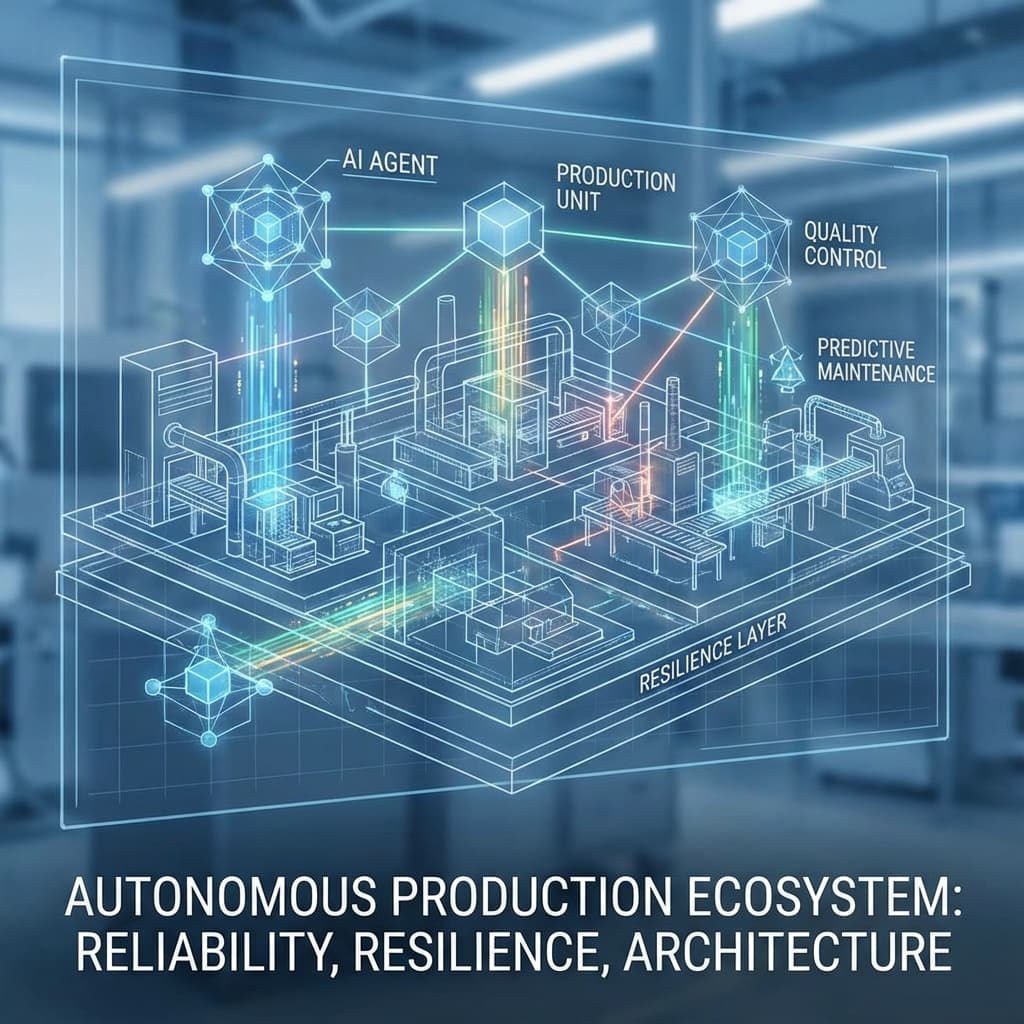
Architecting Resilient Autonomous Agents for Production
A deep dive into building reliable, production-ready autonomous agent systems, focusing on error handling, state management, and observability.
Architecting Resilient Autonomous Agents for Production
We have all built the "happy path" demo. You chain a few LLM calls together, give it a tool to search the web, and watch it magically solve a problem. It feels like the future.
Then you deploy it.
Suddenly, the API times out, the model hallucinates a parameter, or the agent gets stuck in a loop trying to "fix" a mistake it made three steps ago. Building autonomous agents for production isn't about making them smarter; it's about making them robust enough to fail gracefully.
Opening Context
The industry is currently shifting from "chatbots" to "agents"—systems that can execute multi-step workflows without human intervention. But developers are finding that non-determinism, which is a feature in creative writing, is a bug in system orchestration.
We are seeing a move away from single, monolithic "God Agents" toward systems of smaller, specialized agents. This isn't just an architectural preference; it's a necessity for control and debuggability.
Mental Model: The State Machine
Don't think of an agent as a "brain." Think of it as a Probabilistic State Machine.
In a traditional state machine, State A + Input = State B.
In an agentic system, State A + Input + (LLM * Temperature) ≈ State B (mostly).
Your job as an engineer is to constrain the "mostly." You do this by defining rigid state transitions and treating the LLM only as the router or the transform function, not the entire runtime.
Hands-On Example: The Circuit Breaker Pattern
One common failure mode is the "Retry Loop of Death," where an agent continually tries a failed tool call with the same invalid arguments. We can solve this with a circuit breaker.
interface AgentState {
  failureCount: number;
  history: Message[];
  status: 'idle' | 'running' | 'failed';
}

async function executeStep(state: AgentState): Promise<AgentState> {
  // Circuit Breaker: Stop if we've failed too many times
  if (state.failureCount > 3) {
    console.error("Agent stuck in loop. Terminating.");
    return { ...state, status: 'failed' };
  }

  try {
    const response = await llm.generate(state.history);
    // ... process response ...
    return { ...state, failureCount: 0 }; // Reset on success
  } catch (error) {
    // Increment failure count, don't just crash
    return {
      ...state,
      failureCount: state.failureCount + 1
    };
  }
}
This is simple code, but it prevents 80% of the runaway costs and infinite loops we see in production.
Under the Hood
When an agent "thinks," it is essentially managing a context window. Every step in the chain consumes tokens.
- Context Pollution: As the conversation grows, the signal-to-noise ratio drops. The model forgets earlier instructions.
- Latency Stacking: If you have a chain of 5 steps, and each takes 2 seconds, your user is waiting 10 seconds minimum.
- Serialization: Tools often require structured JSON. If the model outputs malformed JSON, your system breaks.
Common Mistakes
Over-reliance on "ReAct" Loops
The generic "Reason -> Act -> Observe" loop is great for research but terrible for production efficiently. It uses too many tokens and is too slow. Alternative: Use specific, directed DAGs (Directed Acyclic Graphs) where the path is known, and the LLM just decides which path to take.
Infinite Context
Trying to stuff the entire history into the prompt. Alternative: summarization steps or aggressive context pruning.
Production Reality
In production, observability is everything. You cannot debug an agent by looking at the final output. You need traces.
- Log every prompt and completion.
- Track tool execution time.
- Monitor cost per session.
Author’s Take
I would not ship a fully autonomous, unbounded agent to a customer today. The risk of hallucination or unintended action is too high.
Instead, ship "Semic-Autonomous" workflows. Let the agent do the prep work, the research, and the drafting, but keep a "human-in-the-loop" for the final commit or send action. We are building power tools, not replacements for the carpenter.
Conclusion
Resilient agents are built with rigid scaffolds. Trust the code to handle the flow and state; trust the model to handle the nuances of language and decision-making within that flow. Start small, instrument everything, and assume failure is the default state.