Graph-Based Thinking for Agents
Shift your mental model from sequential scripts to complex state machines. Learn why graphs are the superior abstraction for production AI agency.
Graph-Based Thinking for Agents
To build production-grade agents with LangGraph, you must undergo a Paradigm Shift. Most developers are trained to think in Imperative Loops (Do A, while B, do C). To succeed with LangGraph, you must think in States and Transitions.
In this lesson, we will explore the theory of Graph-based thinking and how it allows us to map the "Chaos" of LLM reasoning into a structured, manageable architecture.
1. Moving Beyond the "Chain"
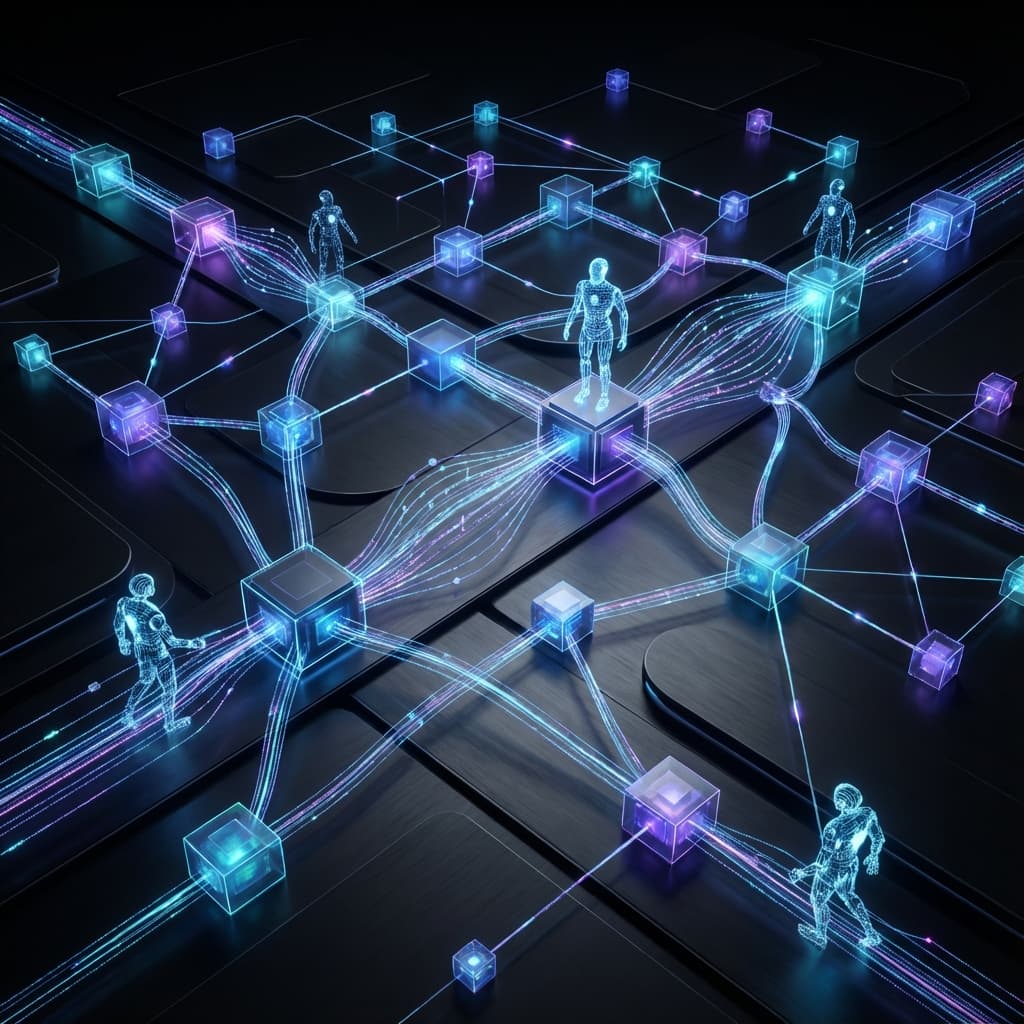
As we saw in Module 1, a Chain is linear. It assumes the world is predictable. A Graph is a set of vertices (Nodes) and connections (Edges). It assumes the world is interactive and iterative.
Why a Graph?
- Recursion: An agent can go back to a previous state if it needs more info.
- Conditional Logic: Decisions aren't just
if/else; they are many-to-many. - Transparency: A graph can be visualized. You can print your code as a flowchart that any stakeholder (even non-technical ones) can understand.
2. The Components of the Mental Model
In Graph-based thinking, everything is defined by these three objects:
A. The State (The Universe)
The State is the "Shared Memory" of your application. Every node in the graph can read from and write to this state.
- Concept: A single object that holds the current status of the task.
B. The Node (The Action)
A Node is a Python function that takes the current State, performs a specialized task (like calling an LLM or a Tool), and returns an "Update" to the state.
- Concept: A "Worker" at a specific station in a factory.
C. The Edge (The Logic)
An Edge defines the direction of travel between nodes.
- Fixed Edge: "Always go from A to B."
- Conditional Edge: "Look at the State and decide whether to go to B or C."
3. The ReAct Pattern in Graph Form
The most famous agent pattern, ReAct (Reason + Act), is actually a simple cyclic graph.
graph TD
    Start((Start)) --> Brain[Reasoning Node]
    Brain --> Logic{Action vs Finish?}
    Logic -->|Action| Tool[Tool Execution Node]
    Tool --> Brain
    Logic -->|Finish| End((End))
Mental Exercise: Trace how data moves here. The Brain writes a thought to the state. The Edge reads that thought and decides to go to the Tool. The Tool writes an observation to the state. The Brain reads the observation... and the cycle continues.
4. Designing from the Goal Backwards
When building a graph, don't start at the input. Start at the Output.
- What is the final state? (e.g., A verified financial report).
- What is the step right before that? (Verification).
- What does the Verification node need? (Raw data + Audit Tool).
- Where does the raw data come from? (Search + Extraction).
By working backwards, you ensure every node in your graph has a clear purpose and that your state schema is perfectly tuned for the mission.
5. The "Node Isolation" Principle
A key part of graph thinking is that Nodes should not know about each other.
Node Ashould not callNode Bdirectly.- Instead,
Node Amodifies the State, and the Edge logic decides to move toNode B.
Why? This allows you to test Node A in isolation. You can feed it a fake State and see if it produces the correct update, without ever running the whole expensive graph.
6. Real-World Analogy: The Emergency Room
Think of a hospital ER as a LangGraph:
- Triage Node: Assesses the patient (LLM Analysis).
- Conditional Edge:
- If life-threatening → Surgery Node.
- If stable → Labs Node.
- State: The patient's chart. Every doctor (Node) reads the chart and writes their findings.
- Join Pattern: The patient is released only when both Labs and Surgery are complete.
Summary and Mental Model
Think of LangGraph as a Programmable Factory.
- The State is the conveyor belt.
- The Nodes are the robotic arms at each station.
- The Edges are the logic that routes the belt to the next station.
In the next lesson, we will look at how to implement the code for these Nodes and Edges and manage the transitions between them.
Exercise: Graph Modeling
- Mapping: Sketch a graph for an agent that:
- Reads a news headline.
- Decides if it's "Clickbait" or "Real News."
- If Clickbait, rewrite it to be informative.
- If Real News, translate it to Spanish.
- Identify the Nodes and the Conditional Edges.
- State Design: What needs to be in the
Stateobject for the news agent above? - Reasoning: Why is it better to have a separate "Rewriting Node" and "Translation Node" rather than one giant "Cleanup Node"?
- (Hint: Think about Latency and Model Selection). Ready to write the code? Let's move to Nodes and Edges.