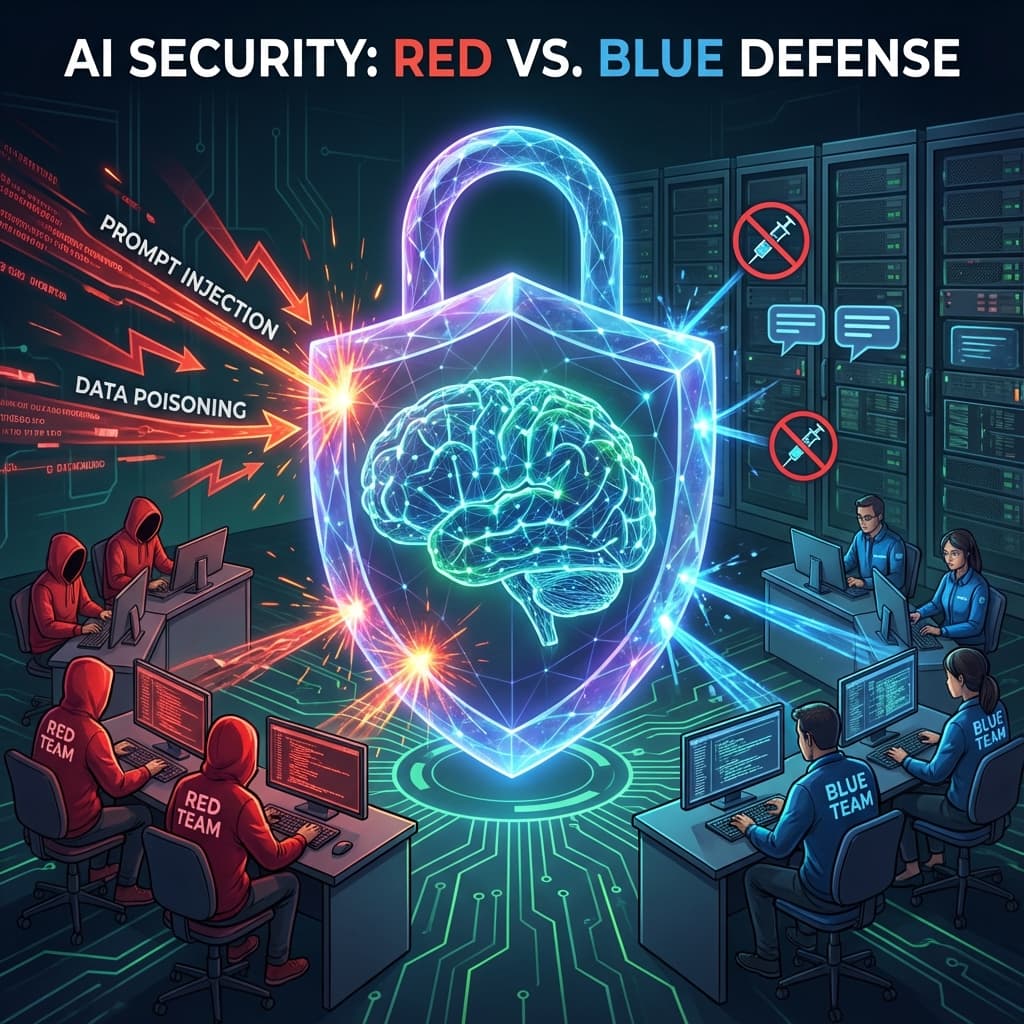
AI Security: From Fundamentals to Advanced Defense
Course Curriculum
22 modules designed to master the subject.
Module 1: Introduction to AI Security
What makes AI security different from traditional security and real-world failures.
Module 1 Lesson 1: What is AI Security
Understand what AI security is, why it's fundamentally different from traditional software security, and the unique challenges posed by probabilistic AI systems.
Module 1 Lesson 2: AI Security vs. Traditional Security
Why traditional security models fail when applied to AI. Explore the shift from deterministic vulnerability management to probabilistic behavior control.
Module 1 Lesson 3: AI as Probabilistic Systems
Why randomness is a feature, not a bug. Understand how the non-deterministic nature of AI creates unique security vulnerabilities and makes traditional testing difficult.
Module 1 Lesson 4: Security vs. Safety vs. Alignment
Words matter. Learn the critical differences between protecting against hackers (Security), preventing user harm (Safety), and ensuring AI goals match human values (Alignment).
Module 1 Lesson 5: Real-World AI Security Failures
Analyze real AI security incidents including ChatGPT data leaks, Bing Chat jailbreaks, and production system compromises. Learn from actual failures.
Module 2: AI System Architecture
Understanding AI components, trust boundaries, and expanded attack surfaces.
Module 2 Lesson 1: AI System Components
Deconstruct the components of modern AI systems, from data layers to infrastructure, to understand the critical pieces that require security monitoring.
Module 2 Lesson 2: Trust Boundaries in AI Systems
Understand the collapse of the traditional 'Data vs. Instructions' boundary in AI and how to redraw trust lines in LLM-powered applications.
Module 2 Lesson 3: Expanded Attack Surface
Why LLMs make your application harder to defend. Explore the new attack vectors introduced by prompt manipulation, tool use, and long-term memory.
Module 2 Lesson 4: AI Supply Chain Risks
Who built your model? Explore the security risks associated with third-party model weights, poisoned datasets, and malicious Python libraries in the AI ecosystem.
Module 3: Threat Modeling
STRIDE adapted for AI and AI-specific threat categories.
Module 3 Lesson 1: Limits of Traditional Threat Models
Why firewalls and input validation aren't enough. Learn why traditional security frameworks need to evolve to address the unique challenges of AI.
Module 3 Lesson 2: STRIDE Adapted for AI
The industry standard for threat modeling, updated for the era of intelligence. Learn how to map Spoofing, Tampering, and Elevation of Privilege to AI systems.
Module 3 Lesson 3: AI-Specific Threat Categories
Meet the new class of vulnerabilities. Explore unique AI threats recognized by OWASP and MITRE ATLAS, including Membership Inference and Model Extraction.
Module 3 Lesson 4: Adversarial Thinking
How to think like a manipulator. Master the mental model of 'prompt manipulation' and learn why the best AI hackers are often social engineers, not coders.
Module 3 Lesson 5: AI Risk Prioritization
Not all threats are equal. Learn how to use the 'Likelihood vs. Impact' matrix to prioritize AI security risks and manage your resource allocation effectively.
Module 4: Data Security
Focusing on data as a security asset and protection strategies.
Module 4 Lesson 1: Training Data as a Security Asset
Data is the code of AI. Learn why your training datasets must be protected with the same rigor as your production source code to prevent long-term vulnerabilities.
Module 4 Lesson 2: Data Poisoning Attacks
How attackers inject malicious behavior into models. Explore the mechanics of data poisoning and how small amounts of bad data can compromise global models.
Module 4 Lesson 3: Label Flipping & Backdoors
Precision poisoning. Learn how to execute label flipping attacks and how 'triggers' are used to create dormant backdoors in neural networks.
Module 4 Lesson 4: Data Leakage Risks
Why models shouldn't talk about their past. Explore the risks of personal data leaking from training sets and the 'over-memorization' problem in LLMs.
Module 4 Lesson 5: Data Provenance & Integrity
Know your sources. Learn how to implement data lineage and integrity checks to ensure that your training data hasn't been tampered with or replaced.
Module 5: Model Extraction
Model extraction, stealing, and IP theft.
Module 5 Lesson 1: Model Extraction & Stealing
Your model is your IP. Learn how attackers use 'Query-Answer' pairs to clone your proprietary models for a fraction of the original training cost.
Module 5 Lesson 2: Membership Inference Attacks
Is your data in there? Learn how attackers can determine if a specific record (like a medical file) was used to train a model, violating user privacy.
Module 5 Lesson 3: Training Data Leakage
How LLMs recite their training data. Explore the 'Memorization vs. Learning' trade-off and how to prevent your model from leaking secrets.
Module 5 Lesson 4: Model Inversion Attacks
Reverse-engineering the training set. Learn how attackers work backwards from a model's outputs to reconstruct the sensitive images or text used in training.
Module 5 Lesson 5: AI Intellectual Property Risks
Is your model legally protected? Explore the legal and technical landscape of AI IP, from copyright issues to the dangers of using 'License-Violating' data.
Module 6: Adversarial Examples
Understanding the basics of adversarial examples and evasion attacks.
Module 6 Lesson 1: What are Adversarial Examples?
Why models misidentify pandas as gibbons. Explore the phenomenon of adversarial examples and how imperceptible noise can fool neural networks.
Module 6 Lesson 2: Evasion Attacks
Slip past the guards. Learn about evasion attacks where AI models are bypassed in real-time to allow malicious files or actors through security filters.
Module 6 Lesson 3: Gradient vs. Black-Box
How to craft the perfect attack. Understand the difference between having the model's 'Code' (White-Box) and only having its 'Answers' (Black-Box).
Module 6 Lesson 4: Robustness Limitations
Why we can't just 'Patch' AI. Explore the fundamental reasons why deep neural networks are inherently fragile and vulnerable to adversarial noise.
Module 6 Lesson 5: AI Defense Strategies
How to fight back. Explore the most effective ways to defend against adversarial attacks, from adversarial training to input transformation and certified robustness.
Module 7: Prompt Injection
Mastering the basics of prompt injection and defense.
Module 7 Lesson 1: What is Prompt Injection?
The #1 AI security threat. Learn the foundations of prompt injection—how attackers hijack an LLM's logic by blending instructions with data.
Module 7 Lesson 2: Direct vs. Indirect Injection
Know your vectors. Learn the difference between a user attacking their own session (Direct) and an attacker poisoning external data (Indirect).
Module 7 Lesson 3: System Prompt Leakage
Your secret instructions, revealed. Learn how attackers trick LLMs into reciting their internal guidelines, codenames, and proprietary logic.
Module 7 Lesson 4: Jailbreak Techniques
Breaking the rules. Explore the history and mechanics of AI jailbreaks, from 'DAN' and 'Do Anything Now' to sophisticated persona adoption and adversarial suffixes.
Module 7 Lesson 5: Prompt Chaining Risks
The chain is only as strong as its weakest prompt. Learn how vulnerabilities propagate through multi-step AI workflows (chains) and how to break the cycle.
Module 8: Output Trust
Ensuring the reliability and safety of AI-generated outputs.
Module 8 Lesson 1: Why You Can't Trust AI Output
The 'Implicit Trust' trap. Learn why AI-generated content must be treated as untrusted user input and the dangers of bypassing conventional security checks.
Module 8 Lesson 2: XSS via AI Responses
How AI becomes an XSS vector. Learn how attackers use prompt injection to trick LLM-powered websites into rendering malicious scripts for other users.
Module 8 Lesson 3: SSRF & RCE via Tools
When AI gets a shell. Learn how attackers use tool-calling AIs to perform Server-Side Request Forgery and Remote Code Execution inside your infrastructure.
Module 8 Lesson 4: Sanitizing AI Content
The digital car wash. Learn the technical techniques for cleaning AI output before it touches your users, your database, or your infrastructure.
Module 8 Lesson 5: Human-in-the-Loop AI
The ultimate firewall. Learn how to implement 'Human-in-the-Loop' (HITL) patterns to prevent AI from executing critical actions without explicit human approval.
Module 9: AI Agents and Plugin Security
Securing autonomous agents and third-party plugin integrations.
Module 9 Lesson 1: The Agent Attack Surface
From Chatbot to Agent. Learn how giving AI 'Tools' and 'Plugins' exponentially increases your attack surface and creates new vectors for system compromise.
Module 9 Lesson 2: Tool Injection
How to trick a deputy. Learn the mechanics of tool injection, where attackers manipulate the arguments and payloads of AI-called functions.
Module 9 Lesson 3: Privilege Escalation
From Guest to Root. Learn how attackers use 'Confused Deputy' agents to gain administrative access to systems they should never be able to reach.
Module 9 Lesson 4: Agent-to-Agent Attacks
When robots disagree. Learn how advanced multi-agent systems are vulnerable to 'peer manipulation' and recursive exploitation loops.
Module 9 Lesson 5: Securing AI Plugins
The App Store of AI. Learn the risks of integrating third-party plugins and how to prevent malicious extensions from stealing user data or hijacking sessions.
Module 10: RAG Security
Protecting Retrieval-Augmented Generation systems and vector databases.
Module 10 Lesson 1: RAG Context Poisoning
The knowledge base is the weapon. Learn how attackers inject malicious 'facts' into RAG systems to influence AI responses from the inside.
Module 10 Lesson 2: Document Injections
The trojan horse. Learn how attackers embed prompt injection payloads inside legitimate-looking documents to hijack RAG sessions during retrieval.
Module 10 Lesson 3: Vector DB Security
Protecting the brain's storage. Learn how to secure Vector Databases (Pinecone, Weaviate, Milvus) against unauthorized access and data exfiltration.
Module 10 Lesson 4: RAG Access Control
Need-to-know AI. Learn how to implement Document-level Access Control (ACLs) to prevent an AI from accidentally leaking sensitive data to unauthorized users.
Module 10 Lesson 5: Grounding & Hallucinations
When the truth is not enough. Learn how attackers use 'Hallucination Anchoring' and 'Fact-Fudging' to make AI lie confidently even with perfect data.
Module 11: Supply Chain and Model Security
Securing the AI development lifecycle and model registries.
Module 11 Lesson 1: The AI Supply Chain
Who built your brain? Explore the complex supply chain of AI development, from dataset collection to model training and deployment security.
Module 11 Lesson 2: Hacking ML Libraries
Vulnerabilities in the engine. Learn about common CVEs and security flaws in core machine learning frameworks like PyTorch, TensorFlow, and NumPy.
Module 11 Lesson 3: Stealing AI Weights
Protecting the billions. Learn the methods attackers use to steal 'Model Weights' (the AI's brain) and the legal and technical defenses against exfiltration.
Module 11 Lesson 4: The Pickle Attack
Model-turned-malware. Learn the mechanics of the 'Pickle' attack, where downloading a machine learning model leads to full Remote Code Execution (RCE).
Module 11 Lesson 5: Model Registry Risks
The GitHub of AI under fire. Explore the security risks of Hugging Face, model squatting, and how to verify the authenticity of open-source AI weights.
Module 12: Privacy and Data Protection in AI
Managing PII leakage, differential privacy, and compliance.
Module 12 Lesson 1: PII in Training Data
Your data, remembered forever. Learn how Large Language Models accidentally memorize and leak Personally Identifiable Information from their training sets.
Module 12 Lesson 2: Data Minimization
Protecting through absence. Learn the crucial principles of data minimization—only giving the AI exactly what it needs and no more.
Module 12 Lesson 3: Differential Privacy
Privacy through noise. Learn the mathematical foundation of Differential Privacy and how it allows AIs to learn from data without knowing specific individuals.
Module 12 Lesson 4: Consent and Deletion
The right to be forgotten. Learn how to manage user consent for AI training and the complex challenge of deleting data from a 'Memorized' model.
Module 12 Lesson 5: AI Compliance
Navigating the rules. Learn how traditional privacy laws like GDPR and CCPA apply to AI systems and the emerging 'EU AI Act' requirements.
Module 13: Monitoring, Logging, and Incident Response
Detecting abnormal behavior, logging AI sessions, and incident playbooks.
Module 13 Lesson 1: Logging for AI
The flight recorder. Learn what to log (and what NOT to log) in LLM applications to ensure security without violating user privacy.
Module 13 Lesson 2: Real-Time Injection Detection
Detecting the invisible. Learn how to use 'Scanners' and 'Classifiers' to catch prompt injection attacks before they reach the LLM.
Module 13 Lesson 3: AI Anomaly Detection
Spotting the outlier. Learn how to detect 'Anomalous' AI behavior, from rapid token consumption to unusual tool-calling sequences.
Module 13 Lesson 4: The AI SOC
Managing the frontline. Learn how to build and staff a Security Operations Center (SOC) specialized in monitoring and defending Large Language Models.
Module 13 Lesson 5: AI Incident Response
When the bot goes bad. Learn how to respond to AI-specific security breaches, from containing a jailbreak to recovering from a data poisoning attack.
Module 14: AI Red Teaming and Pentesting
Automated and manual adversarial testing strategies for models.
Module 14 Lesson 1: Planning an AI Red Team
Think like a hacker. Learn the strategic steps for planning an AI Red Team engagement, from defining scope to choosing attack vectors.
Module 14 Lesson 2: AI Pentesting Tools
Firing the cannons. Learn how to use automated scanners like Garak and Microsoft's PyRIT to launch thousands of prompt injection and jailbreak attempts.
Module 14 Lesson 3: Creative Jailbreaking
The art of the exploit. Learn the manual techniques for creative jailbreaking, including persona adoption, hypothetical scenarios, and payload splitting.
Module 14 Lesson 4: Multi-Modal Pentesting
Beyond text. Learn how to test the security of Vision, Audio, and Agentic AI systems where attacks can be hidden in images or executed through tools.
Module 14 Lesson 5: AI Security Reporting
Fixing the flaws. Learn how to document AI security findings, calculate risk scores, and track the 'Remediation' of probabilistic vulnerabilities.
Module 15: AI Guardrails and Safety Filters
Implementing NeMo, Guardrails AI, and custom programmatic safety layers.
Module 15 Lesson 1: Intro to AI Guardrails
The safety net. Learn the core concepts of AI Guardrails—external security layers that monitor and control the flow of text into and out of an LLM.
Module 15 Lesson 2: NeMo Guardrails
The programmable barrier. Learn about NVIDIA's NeMo Guardrails architecture and how to define 'Colang' flows to control AI dialog.
Module 15 Lesson 3: Guardrails AI & Logic
Validation at the gate. Learn how to use the 'Guardrails AI' framework to enforce structural and factual constraints on LLM outputs.
Module 15 Lesson 4: Custom Guardrail Dev
Building the shield yourself. Learn how to write custom Python-based guardrails to enforce your organization's unique security and business policies.
Module 15 Lesson 5: Hardening Guardrails
Breaking the muzzle. Learn the techniques attackers use to bypass AI guardrails (obfuscation, translation, multi-turn) and how to harden your defenses.
Module 16: Cloud AI Infrastructure Security
Securing Azure OpenAI, AWS Bedrock, and cloud identity management.
Module 16 Lesson 1: Securing Cloud AI APIs
Locking the gate. Learn the specific security configurations and best practices for using enterprise AI services like Azure OpenAI and AWS Bedrock.
Module 16 Lesson 2: IAM for AI
Least privilege for models. Learn how to use IAM roles, policies, and identities to control which users and applications can access your AI models.
Module 16 Lesson 3: AI Network Isolation
Air-gapping the brain. Learn how to use VNETs, VPCs, and Firewalls to ensure your AI infrastructure is never exposed to the public internet.
Module 16 Lesson 4: AI Cost Monitoring
Protecting the wallet. Learn how to set up alerts and quotas to prevent 'Denial of Wallet' attacks and runaway AI spending.
Module 16 Lesson 5: Encryption & Residency
Sovereign AI. Learn the technical and legal requirements for keeping AI data within specific geographic boundaries and encrypted at every stage.
Module 17: Securing LLM Frameworks
Hardening LangChain and LlamaIndex orchestration layers.
Module 17 Lesson 1: Orchestrator Risks
The glue that breaks. Learn how framework orchestrators like LangChain and LlamaIndex introduce new security vulnerabilities through complex chaining and data handling.
Module 17 Lesson 2: Securing LangChain
Hardening the chains. Learn specific security configurations for LangChain Agents, including sandboxing, tool limiting, and secure memory management.
Module 17 Lesson 3: Securing LlamaIndex
Data bridge security. Learn how to secure LlamaIndex data loaders, prevent context poisoning, and implement private data connectors.
Module 17 Lesson 4: AI Security Proxies
The intelligent firewall. Learn how to use Middleware and Proxies (like LiteLLM, Portkey) to centralize security, logging, and access control for all your AI models.
Module 17 Lesson 5: Framework-Specific Exploits
Poking the glue. Learn how to identify and test for vulnerabilities unique to LangChain, LlamaIndex, and other AI orchestration frameworks.
Module 18: Advanced Model-Specific Attacks
Membership inference, model inversion, and poisoning foundation models.
Module 18 Lesson 1: Membership Inference
Were you in the dataset? Learn the mathematical attacks used to determine if a specific individual's data was used to train a machine learning model.
Module 18 Lesson 2: Model Inversion
Re-creating the secret. Learn how attackers use 'Model Inversion' to reconstruct raw images and text from a machine learning model's output.
Module 18 Lesson 3: Adversarial Reprogramming
New task, old model. Learn how attackers 'Reprogram' pre-trained models to perform entirely different (and potentially malicious) tasks without changing any weights.
Module 18 Lesson 4: Quantization Risks
Smaller is more vulnerable. Learn how technical optimizations like Quantization and Pruning can accidentally introduce new security vulnerabilities and 'Backdoors' into AI models.
Module 18 Lesson 5: Poisoning at Scale
The global hack. Learn how attackers influence the behavior of the world's most powerful Foundation Models (like GPT-4, Llama 3) by poisoning the public internet.
Module 19: Governance, Risk, and Compliance (GRC) for AI
Risk management frameworks, ethics, and AI security policy.
Module 19 Lesson 1: AI Risk Management
Managing the chaos. Learn how to build a formal Risk Management Framework specifically for AI, based on NIST and ISO standards.
Module 19 Lesson 2: AI Ethics & Bias
Fairness as a security feature. Learn how to audit AI models for bias, toxicity, and unethical behavior to prevent legal and reputational damage.
Module 19 Lesson 3: AI Security Policy
Rules of the road. Learn how to write a formal AI Security Policy that defines allowed usage, data handling, and responsibilities for your employees.
Module 19 Lesson 4: AI Vendor Risk
Who are you trusting? Learn how to evaluate the security of AI vendors (OpenAI, Anthropic, Midjourney) before integrating them into your business.
Module 19 Lesson 5: Passing an AI Audit
Proving your safety. Learn how to prepare for formal AI security audits and earn certifications like the 'EU AI Act' compliance or ISO 42001.
Module 20: Sector-Specific AI Security
Security requirements for Finance, Health, and Critical Infrastructure.
Module 20 Lesson 1: AI in Banking Security
Protecting the money. Learn the unique requirements for AI security in the finance sector, from Anti-Money Laundering (AML) to fraud detection.
Module 20 Lesson 2: AI in Healthcare Security
Protecting the patient. Learn the critical security and privacy requirements for AI in healthcare, from HIPAA compliance to securing medical diagnostic models.
Module 20 Lesson 3: AI in E-commerce Security
Protecting the shop. Learn how to secure AI in e-commerce, from preventing price manipulation in chatbots to securing recommendation engines.
Module 20 Lesson 4: AI in Government Security
Protecting the public trust. Learn the unique requirements for AI security in the public sector, from FedRAMP compliance to securing citizen data.
Module 20 Lesson 5: AI in Critical Infrastructure
Protecting the grid. Learn the high-stakes security requirements for AI in Industrial Control Systems (ICS), energy grids, and manufacturing.
Module 21: The Future of AI (In)Security
AGI risk, automated AI attackers, and self-defending systems.
Module 21 Lesson 1: AI as an Attacker
The automated adversary. Explore how attackers use LLMs to automate vulnerability discovery, write malware, and launch massive social engineering campaigns.
Module 21 Lesson 2: AGI Existential Risk
The ultimate security challenge. Explore the theories of AGI (Artificial General Intelligence) risk, the 'Inscrutability' of superintelligence, and the 'Stop-Button' problem.
Module 21 Lesson 3: Self-Defending AI
Fighting fire with fire. Explore the emerging field of 'Self-Defending' AI architectures that can detect and respond to attacks without external guardrails.
Module 21 Lesson 4: Decentralized AI Security
Security without a center. Explore the risks and defenses for decentralized AI marketplaces (like Bittensor) and Web3-integrated LLMs.
Module 21 Lesson 5: The Path Forward in AI Security
Mastering the shift. A strategic look at the evolving skills, certifications, and mindsets required to lead in the field of AI Security.
Module 22: Course Wrap-up & Final Exam
Capstone project, final assessment, and professional certification.
Module 22 Lesson 1: The AI Security Professional
Defining the role. A deep dive into the day-to-day responsibilities, toolsets, and team dynamics of a professional AI Security Engineer.
Module 22 Lesson 2: AI Security Capstone
Put it all together. Design a complete security architecture for a hypothetical enterprise AI application, from supply chain to guardrails.
Module 22 Lesson 3: Course Summary
The big picture. A comprehensive review of the 110 lessons covered in this course and the core principles of AI Security.
Module 22 Lesson 4: Final Exam
Test your knowledge. A comprehensive final exam covering all 22 modules of the AI Security course.
Module 22 Lesson 5: Certification
Mission accomplished. Learn how to claim your certificate, join the AI security community, and continue your professional journey.
Course Overview
Format
Self-paced reading
Duration
Approx 6-8 hours
Found this course useful? Support the creator to help keep it free for everyone.
Support the Creator