Why Two-Factor Authentication Is Now the Minimum
We explore the evolution of digital defense. Discover why a single password is no longer enough to protect your life, and how Multi-Factor Authentication (MFA) has become the essential shield for the 21st century.
The Double Lock: Elevating the Standard of Digital Existence
In the history of physical security, we have always understood the power of the Second Check.
The world’s most secure vaults do not have a single keyhole; they have two, requiring two different people to turn their keys simultaneously. Modern missile silos require a dual-authentication process to confirm intent. Even the simple act of a safe-deposit box requires both your key and the bank’s key to open. We understand instinctively that a single point of failure is an invitation to disaster.
Yet, for decades, we have allowed our entire digital lives—our finances, our communications, our medical records, and our professional legacies—to be protected by a single, often weak, string of characters.
The "Password-Only" era is over. It has been rendered obsolete by the sheer scale of the global data breach economy and the incredible power of AI-driven hacking. In the 21st century, Two-Factor Authentication (MFA) is no longer an "Extra Step"; it is the Minimum Requirement for digital existence.
As a visionary narrative storyteller, I want to explore why the single lock has failed, why the double lock is the new baseline, and how we can lead the way toward a future of "Inherent Multi-Layered Security."
The Collapse of the Single Factor
To understand why MFA is the minimum, we must look at the four "Horses of the Password Apocalypse."
1. The Breach Epidemic
As we’ve explored in our previous discussions, your password exists in dozens of databases you don't control. When one of those databases is hacked, your password is out in the world. If you use a single lock for all your doors, the moment one door is compromised, every door is wide open. MFA breaks this connection. Even if a hacker has your password, they are still standing outside the gate, unable to produce the second factor.
2. The AI Cracking Revolution
AI models can now guess passwords with a staggering "hit rate" by analyzing human linguistic patterns and past breach data. What used to take a supercomputer months now takes a laptop minutes. A single password is a "Static Target." MFA turns the target into a "Moving Target"—one that requires a real-time, physical interaction to hit.
3. The Phishing Sophistication
Phishing has evolved from broken-English emails about lottery winnings to perfect, AI-generated replicas of your bank’s login page. Even the most vigilant user can be tricked into typing their password into a fake site once in a while. In a password-only world, that one mistake is fatal. In an MFA world, the hacker gets the password but is immediately blocked by the requirement for the second factor—a factor they cannot steal through a fake website.
4. The Social Engineering Threat
Hackers can often reset your password by finding out your dog’s name or your mother’s maiden name—information that is easily found in the "Public Layers" of your digital life. MFA ensures that a password reset alone isn't enough to take over an account. It requires "Multi-Channel Verification."
The Visionary Shift: MFA as a "Digital Heartbeat"
If we look at the "Big Picture," MFA is not just about "Extra Security." It is about Verifying Your Digital Presence.
A password is "Something You Know." But in the AI age, "Knowledge" is easily stolen or predicted. To truly be secure, we must add layers that represent "Something You Have" or "Something You Are."
1. The Physical Shield (Something You Have)
This is the code sent to your phone, the notification you approve on your watch, or the physical USB security key you plug into your computer. This ties your digital identity to your physical reality. It ensures that to "Be You" in the machine, you must physically "Be There" in the world.
2. The Biological Signature (Something You Are)
This is the use of biometrics—your face, your fingerprint, or your voice. This is the most personal layer of MFA. It represents the "Sacred Identity" that cannot be forgotten, written down, or stolen in a data breach.
3. The Contextual Aura (Something You Do)
This is the visionary frontier of MFA. Modern systems are starting to look at "Behavioral Biometrics." They look at how fast you type, the way you move your mouse, and your typical location. If someone tries to log in with your password and your second factor but they are in a different country and their "Digital Rhythm" is different from yours, the system can block them. This is security that is woven into the very fabric of your behavior.
Overcoming the "Friction" Myth
The biggest argument against MFA has always been "Convenience." We are told that users find it too hard to enter a second code, and that it "slows down" the experience.
But this is a visionary fallacy. Modern MFA is becoming Frictionless. With "Push Notifications" on our watches and "FaceID" on our phones, the second factor takes less than a second to provide. It is becoming a natural, intuitive part of the login flow.
More importantly, we must weigh the "Friction of the Second Code" against the "Friction of a Cleaned-Out Bank Account." Identity theft is the ultimate friction. It takes hundreds of hours to resolve, causes immense emotional stress, and can derail a life for years. In this context, 2 seconds of MFA is the greatest "Efficiency" we can buy.
The Human Duty: Setting the New Standard
As leaders in the high-tech age, we have a responsibility to normalize and demand MFA everywhere.
- The Individual Mandate: Turn on MFA for every single account that offers it—starting with your email, your bank, and your primary social media. If a service doesn't offer MFA, ask them why. Your voice is the market pressure that forces companies to protect their users.
- The Professional Advocacy: If your workplace doesn't require MFA for internal systems, bring it up. Use the "Big Picture" arguments: it protects the company’s reputation, its customers, and its employees.
- The Move to Hardware: For your most "Sovereign" accounts, move beyond SMS codes (which can be intercepted through SIM-swapping) to physical security keys. These are the "Gold Standard" of MFA, providing a physical, unhackable link between you and your digital self.
Conclusion: The Peace of the Double Lock
The single password was a tool of the 20th century. It belonged to an era of "Dial-Up" and "Diskettes." But we live in the era of "General Intelligence" and "Global Networks."
The "Big Picture" of MFA is that it returns the power of identity to the individual. It ensures that your life cannot be stolen from a server farm 5,000 miles away. It gives you the "Digital Peace of Mind" that comes from knowing that even if the first lock is picked, the second lock is holding strong.
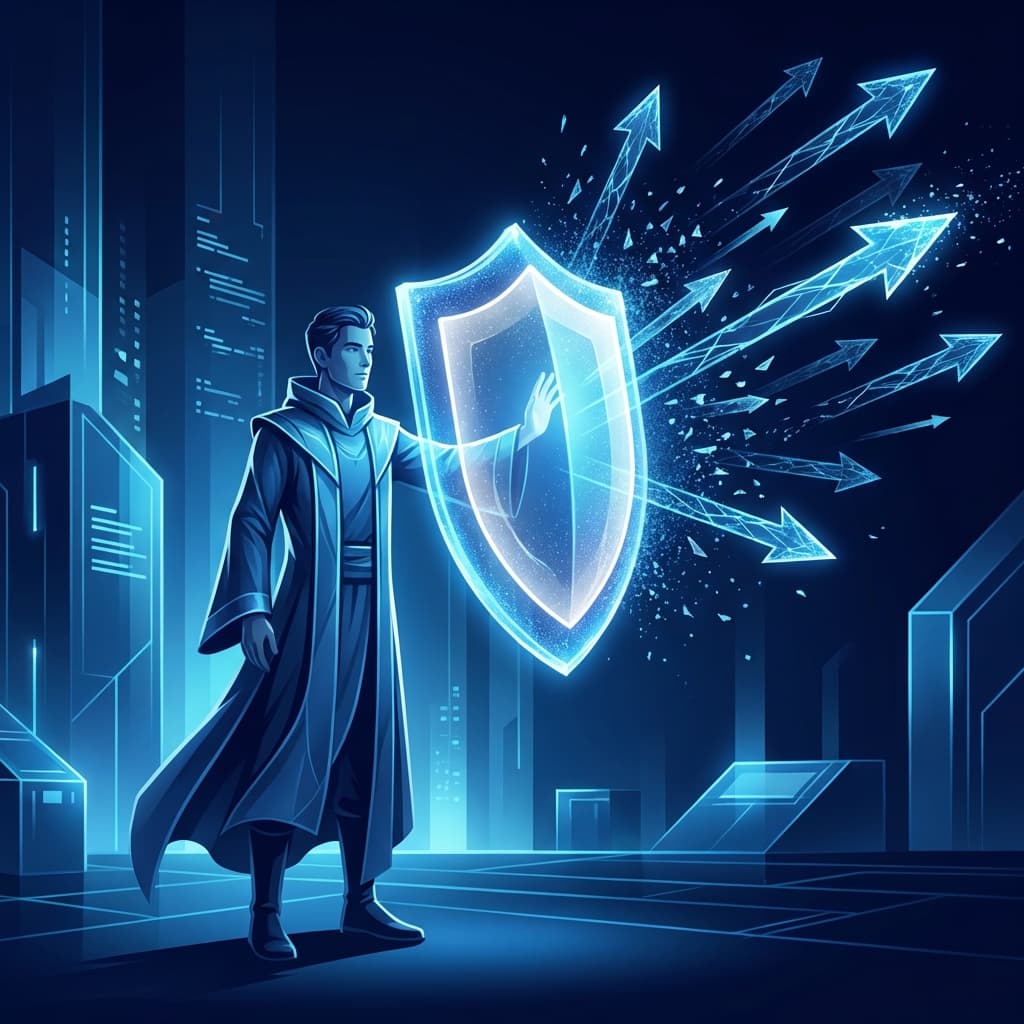
The shield is glowing. The arrows are falling. Let’s make sure we are standing behind the double lock.
Key Takeaways for the Visionary Individual:
- The "Email First" Rule: If you only have energy to do one thing today, turn on MFA for your Primary Email. Your email is the "Skeleton Key" that can reset all your other passwords. Secure it first.
- The Notification Pivot: Move from "SMS Codes" to "Authenticator Apps" (like Authy or Google Authenticator) or "Push Notifications." They are faster, more secure, and work even when you don't have cell service.
- The "Emergency Code" Vault: When you turn on MFA, most services give you a list of "Recovery Codes." Treat these with the same reverence you treat your social security card. Print them out and put them in a physical safe. They are your "Back Door" if you lose your phone.
- The Multi-Device Standard: Set up your MFA on multiple devices (like your phone and your tablet) if the service allows it. This ensures you’re never "Locked Out" of your own life because of a dead battery.
At ShShell.com, we break down the complex architecture of digital safety to help you lead with clarity and poise. Sovereignty is the destination. Multi-layered protection is the path. Let’s build the future together.