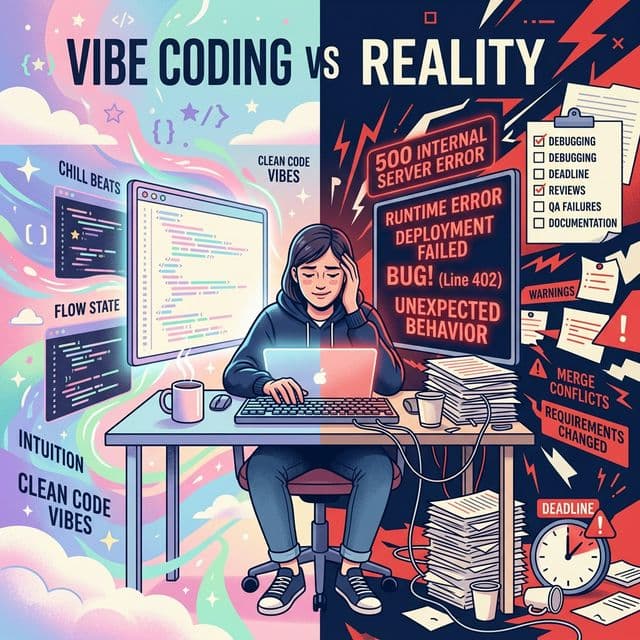
Vibe Coding vs. Reality: A Deep Dive for Non-Technical Founders on Building Scalable Applications in the AI Era
Explore the gap between AI-assisted 'vibe coding' and the reality of building robust, scalable, and secure production-grade software in 2026.
In the dynamic landscape of modern technology, a new term has entered the lexicon of ambitious non-technical founders: "vibe coding." The allure is potent: envision an application born from an idea, brought to life rapidly and affordably, with artificial intelligence shouldering much of the heavy lifting. The refrain is common: "I'm looking for a vibe-coder to build my app." "It should be fast and cheap." "AI can do most of it now, right?"
This sentiment, while understandable, often masks a profound misunderstanding of the complexities involved in creating robust, scalable, and secure software. As we stand in January 2026, the promise of near-instant, low-cost, minimal-engineering-involvement development is a powerful narrative, but it's one that often leaves crucial elements unspoken.
This blog post is not a condemnation of AI-assisted development. On the contrary, I use these tools daily and witness their transformative power firsthand. They have undeniably changed the paradigm of software creation. However, there remains a significant chasm between the widespread perception of what "vibe coding" delivers and the actual reality of building production-grade systems today.
My aim here is to bridge that gap. We will dissect the true strengths of AI-assisted development, explore its critical limitations, examine common failure modes, and provide a clear roadmap for non-technical founders to leverage these powerful tools effectively without falling into common traps. This is about equipping you with the knowledge to make informed decisions, ensuring your vision translates into a sustainable and successful product.
Understanding the "Vibe": Where AI-Assisted Development Shines
Let's begin by acknowledging the incredible advancements that fuel the "vibe coding" narrative. AI has dramatically democratized certain aspects of software development, empowering individuals and small teams in ways previously unimaginable.
1. Zero-to-One is Faster Than Ever: The Prototyping Revolution
The most undeniable strength of AI in development is its ability to accelerate the initial "zero-to-one" phase. What once required weeks of dedicated development effort can now be achieved in days, sometimes even hours. This speed is a game-changer for early-stage validation.
Examples of Accelerated Zero-to-One Development:
- Authentication Systems: Setting up user registration, login, password reset, and even multi-factor authentication (MFA) used to be a non-trivial task. AI tools can now scaffold these features in minutes, integrating with popular frameworks and identity providers. A developer can prompt an AI: "Generate a Python Flask app with user authentication using JWT tokens and a PostgreSQL database." The AI can provide a functional starting point, complete with database schemas and endpoint definitions.
- Admin Panels and CRUD Features: Creating a basic interface for managing data (Create, Read, Update, Delete) is a common requirement for almost any application. AI can rapidly generate boilerplate code for these interfaces. Imagine asking an AI: "Build an admin panel for a 'Products' entity with fields for name, description, price, and image URL in a React frontend connected to a Node.js API." The AI can generate components, API routes, and even basic database migrations.
- Basic APIs: For integrating with other services or providing data to frontends, simple REST or GraphQL APIs can be quickly drafted by AI. A prompt like: "Create a simple Express.js API endpoint to list and add books to a MongoDB database" can yield a working proof-of-concept almost instantly.
- Mobile and Web Scaffolding: Starting a new project with the correct directory structure, build tools, and basic navigation is often tedious. AI can provide the foundational "scaffolding" for React, Vue, Angular, React Native, or Flutter projects, allowing developers to jump straight into feature implementation.
This rapid prototyping capability significantly benefits startups and solo builders. Early validation improves because ideas become tangible quickly. You can put a clickable product in front of potential users or investors much sooner, gathering critical feedback and iterating at an unprecedented pace. This is genuine leverage.
2. Small Tools and Scripts are Practically Free Now
AI excels at solving bounded, well-defined problems. If you need a specific, isolated utility, AI can often generate it with minimal human intervention and at negligible cost.
Illustrative Examples:
- Data Cleanup Scripts: Imagine you have a CSV file with inconsistent date formats or missing entries. Prompting an AI: "Write a Python script to normalize date formats (YYYY-MM-DD) and fill missing values with 'N/A' in a CSV file called 'data.csv'" can produce a working script in seconds.
- Internal Dashboards: For a quick internal view of specific metrics, AI can generate simple dashboards. "Create a Streamlit app to display sales figures from a Pandas DataFrame, including a bar chart of monthly sales and a table of top-selling products."
- One-off Automations: Need to rename a thousand files based on a pattern? Or convert a directory of images to a different format? "Write a Bash script to rename all '.jpeg' files to '.jpg' in the current directory, adding a timestamp to each filename."
- Prototype for Investors: While not a production system, a simple, interactive prototype showcasing a core idea can be very effective for fundraising. AI can quickly assemble UI components and basic logic to demonstrate functionality.
This is not hype; it’s a current reality. Many non-developers can now create functional tools that address specific pain points, empowering departments beyond traditional IT. This democratizes problem-solving and boosts internal efficiency.
3. Websites and Marketing Sites are Easy and Fast
For certain types of web presence, particularly those where speed to market outweighs pixel-perfect bespoke design, AI delivers significant advantages.
Use Cases:
- Landing Pages: Need to test a new product idea with a quick landing page to capture emails? AI can generate HTML, CSS, and basic JavaScript forms.
- Marketing Sites: For informational websites or campaign-specific pages, AI can quickly assemble content blocks, image galleries, and contact forms.
- Content-Driven Websites: Blogs, simple portfolios, or event pages can be rapidly deployed.
While sophisticated branding, unique user experiences, and pixel-perfect design replication still demand the expertise of human designers, AI enables rapid deployment. If your goal is to get online quickly and gather initial data, AI is a powerful ally.
The Reality Check: Where the "Vibe" Breaks Down
While the benefits outlined above are significant, they represent only one side of the coin. The "vibe coding" narrative often glosses over the critical challenges and limitations that emerge when moving beyond prototypes and into the realm of production-grade software. This is where the most common failures occur, leading to frustration, escalating costs, and ultimately, abandoned projects.
1. Prototypes Do Not Scale: The Architecture Abyss
This is, without a doubt, the most prevalent and damaging illusion. A vibe-coded application, hastily assembled for a few users and light traffic, often collapses under the weight of real-world demands.
Common Scaling Failure Modes:
- Performance Issues: A simple database query that takes milliseconds for 10 users might take seconds for 10,000 users, leading to frozen UIs and frustrated customers. AI-generated code often prioritizes functionality over efficiency, using inefficient algorithms or making too many database calls. Without proper indexing, caching, or asynchronous processing, performance degrades rapidly.
- Data Inconsistencies and Corruption: In simple prototypes, data integrity might not be a major concern. In a production system, race conditions, improper transaction handling, or lack of validation can lead to corrupted data, costing businesses millions and eroding user trust. AI might generate code that writes directly to a database without proper error handling or atomic operations.
- Security Gaps: This is perhaps the most dangerous failure point. AI-generated code, if not reviewed and secured by an expert, can introduce critical vulnerabilities like SQL injection, cross-site scripting (XSS), insecure direct object references (IDOR), or misconfigured authentication. A vibe-coder might not understand the nuances of secure coding practices.
- Deployment and Infrastructure Problems: Getting a prototype running on a local machine is one thing; deploying it reliably to the cloud, managing servers (or serverless functions), setting up continuous integration/continuous deployment (CI/CD) pipelines, monitoring, logging, and backups is an entirely different beast. AI might give you application code, but it rarely provides a robust, production-ready infrastructure blueprint.
- Cost Explosions: What was "cheap" to build can become astronomically expensive to run and maintain if not designed efficiently. Inefficient code leads to higher CPU usage, more memory consumption, and larger database footprints, directly translating to higher cloud bills. A system not optimized for scaling can incur huge costs simply to keep up with demand.
Example Scenario: The "Event Ticketing App" Imagine a non-technical founder uses AI to quickly build an event ticketing app. It looks great, allows users to select seats, and processes payments. Launch day arrives for a popular concert, and 50,000 users try to buy tickets simultaneously.
- Failure: The database, which was fine for testing with 10 concurrent users, locks up. Payment gateway calls time out. Users get errors, duplicate tickets are issued, or worse, tickets are overbooked.
- Reason: The AI-generated code lacked proper database transaction management, optimistic locking for seat selection, queueing mechanisms for payment processing, and efficient indexing for concurrent reads/writes. The underlying infrastructure couldn't handle the load.
- Consequence: Massive financial loss, reputational damage, and a complete rebuild required.
If you browse vibe-coding communities or forums, you will inevitably see a recurring pattern of desperation: "I need a real developer now," "My app can’t scale," or "AI stopped being helpful." This isn't because AI is inherently bad; it's because architecture, robust system design, and anticipating failure are fundamental to building resilient software. AI can generate building blocks, but it doesn't automatically create a sound architectural blueprint.
2. "Cheap" Developers Are Not Cheap: The Experience Deficit
The idea of hiring a "cheap vibe-coder" often leads to a false economy. Professional developers do not simply "write code"; their value extends far beyond the lines of text they produce.
The Role of a Professional Developer (Beyond Coding):
- System Design: They envision the entire system, its components, how they interact, and how it will evolve over time. This includes choosing the right technologies, designing database schemas, defining API contracts, and planning for future features.
- Anticipating Edge Cases: What happens if a user enters invalid data? What if the network connection drops? What if a third-party API goes down? Experienced developers foresee these scenarios and build robust error handling and fallback mechanisms.
- Planning for Scale: They design with future growth in mind, considering how the application will perform with 10x or 100x the users, data, and features. This involves choosing scalable architectures (microservices, serverless), efficient data stores, and optimizing critical paths.
- Understanding Trade-offs: Every technical decision involves trade-offs (e.g., speed vs. cost, flexibility vs. complexity, security vs. convenience). Experienced developers understand these nuances and guide decisions that align with business goals.
- Security Best Practices: They implement security from the ground up, following industry standards, conducting threat modeling, and staying updated on vulnerabilities.
- Maintainability and Testability: Writing clean, well-documented, and testable code ensures that the application can be easily understood, debugged, and modified by other developers in the future, significantly reducing long-term costs.
A "cheap vibe-coder," often lacking this holistic understanding, might deliver something functional quickly. However, they are unlikely to deliver something resilient, secure, or easily maintainable. The hidden costs of their work emerge later: endless bug fixes, performance bottlenecks, security breaches, and ultimately, the need to rewrite significant portions of the application. There is no true shortcut here; quality engineering requires expertise.
3. Bigger Projects Still Take Time: The Illusion of Instantaneity
While AI unquestionably accelerates execution, it does not magically remove the need for deep thinking, planning, and iterative refinement. For any serious feature or larger project, a significant portion of the effort remains intellectual and human-driven.
Where Time Still Goes in AI-Assisted Development:
- Planning and Defining Constraints: Before any code is written (or generated), defining what needs to be built, for whom, and why is paramount. This involves user research, writing clear requirements, designing user flows, and sketching out wireframes. AI can't replace this critical initial phase.
- Reviewing Outputs: AI models, while sophisticated, are not infallible. They make mistakes, misunderstand context, and confidently produce incorrect or suboptimal code. Every line of AI-generated code still needs thorough human review for correctness, security, efficiency, and adherence to project standards.
- Testing Edge Cases: AI might generate code that handles the happy path, but it often struggles with the myriad of edge cases that define robust software. Comprehensive unit, integration, and end-to-end testing, often manually designed or guided by human intuition, remains crucial.
- Refactoring Bad Suggestions: Sometimes, the AI's output is technically correct but poorly structured, inefficient, or difficult to read. Refactoring this "vibe-code" into maintainable, idiomatic code can take more time than writing it from scratch.
- Integration with Legacy Systems: AI is fantastic for greenfield projects. Integrating new AI-generated features into existing, complex, legacy codebases with their own quirks and dependencies is a significant challenge that often requires deep human understanding of the existing system.
Design Example: User Onboarding Flow Let's say a founder asks an AI to design a user onboarding flow.
- Vibe-Code Output: AI generates screens for registration, email verification, and profile setup. Looks good on the surface.
- Reality Check (Human Input Needed):
- User Psychology: Is it too many steps? Should we offer social logins? What's the drop-off rate at each stage?
- Business Logic: What data must we collect immediately vs. later? How do we handle interrupted flows?
- Security: Are email verification tokens robust? Is data encrypted at rest and in transit?
- Error Handling: What happens if the email server is down? What if the user enters a non-existent country?
- Accessibility: Is the design usable for visually impaired users?
- Analytics: How will we track user progress through the funnel?
These are all considerations that require human judgment, empathy, and strategic thinking. AI accelerates the execution of known tasks, but it doesn't replace the deep critical thinking required to define and validate those tasks in the first place. Speed without judgment is expensive later, often leading to wasted development effort on features nobody needs, or features that are fundamentally flawed.
The Hard Truth and the Future
The current reality, as of January 2026, is that we are not yet in an era where anyone can instantly and cheaply build production-grade software using AI alone. The future may deliver smarter agents, better models, and deeper integrations that approach this ideal. But today, anyone promising that level of autonomy and perfection is selling hope, not engineering.
The journey from a vague idea to a successful, scalable, and maintainable product still requires a blend of vision, technical expertise, and disciplined execution.
How to Actually Get Better Results: Strategic AI Integration
Instead of viewing AI as a magic bullet or a replacement for skilled engineers, non-technical founders should understand how to strategically integrate AI into their development workflow to achieve genuinely better results.
1. Experience with AI Matters: Amplifying Skill, Not Replacing It
AI doesn't diminish the need for skill; it amplifies it. The most significant gains from AI tools are realized by developers who possess a strong foundational understanding of software engineering principles.
How Experience Amplifies AI's Value:
- System Design: Experienced developers can prompt AI with architectural patterns (e.g., "design a microservices architecture for an e-commerce platform"), then critically evaluate and refine the AI's suggestions, ensuring they fit the specific use case and scale requirements.
- Legacy Codebases: When integrating AI into existing, complex systems, experienced developers understand how to correctly interpret the existing code, identify areas for improvement, and guide AI to generate compatible and robust solutions without breaking existing functionality.
- Performance Constraints: A skilled developer can analyze AI-generated code for inefficiencies, identify bottlenecks, and use AI to refactor specific sections for better performance (e.g., "optimize this database query for large datasets" or "rewrite this loop for better Big O notation").
- Security Basics: Knowing fundamental security principles allows a developer to scrutinize AI-generated code for common vulnerabilities and prompt for secure alternatives (e.g., "ensure all user inputs are properly sanitized to prevent SQL injection").
- Understanding Trade-offs: An experienced engineer can assess AI's suggestions against various business and technical trade-offs, making informed decisions that align with the project's long-term goals.
Inexperienced users often hit walls faster because they lack the contextual knowledge to effectively prompt, evaluate, and correct AI outputs. Their workflows might initially improve, but the quality and longevity of their output can suffer significantly.
2. Tools Matter More Than Prompts: The Engineering Discipline
While good prompting is important, the true differentiator lies in the tools and discipline used around AI. This is the distinction between "vibe-coding" and "vibe-engineering."
Key Tools and Disciplines for "Vibe-Engineering":
- Intelligent IDEs (e.g., Cursor, GitHub Copilot X): These are not just code generators but intelligent assistants embedded within the development environment. They offer context-aware suggestions, refactoring capabilities, and integrated testing, allowing developers to leverage AI without leaving their workflow.
- Structured Agent Workflows: Instead of a single, monolithic prompt, breaking down complex tasks into smaller, sequential steps, each handled by an AI agent (or a series of prompts) with specific instructions, yields much better results.
- Agent 1 (Planner): Takes high-level user story, breaks it into technical tasks.
- Agent 2 (Coder): Generates code for each task.
- Agent 3 (Tester): Writes unit/integration tests for the generated code.
- Agent 4 (Reviewer): Critiques the code for security, efficiency, and style.
- Human: Oversees, orchestrates, and makes final decisions.
- Code Review and Quality Gates: Integrating AI into existing code review processes ensures that AI-generated code still passes through the same quality checks as human-written code. This might include static analysis tools (Linters), automated security scans, and peer review.
- Testing Frameworks: Leveraging AI to generate tests is powerful, but having a robust testing strategy (unit, integration, end-to-end) and framework (Jest, Pytest, Cypress) to execute and validate those tests is non-negotiable.
Visualizing the Difference:
- Vibe Coding Workflow: Idea -> Single Prompt -> Generated Code -> Manual Tweaks -> Deploy (often directly to production)
- Result: Fast, but fragile and prone to failure at scale.
- Vibe Engineering Workflow: Idea -> Requirements Gathering (Human) -> Architectural Design (Human + AI Assist) -> Task Breakdown (Human + AI Assist) -> Code Generation (AI) -> Code Review (Human + Automated Tools) -> Testing (Human + AI Generated Tests) -> CI/CD Pipeline -> Monitored Deployment
- Result: Slower initially, but robust, scalable, and maintainable.
Knowing which tools to use, how to integrate them into real systems, and maintaining a disciplined engineering approach is the true advantage in the AI era. It's about augmenting human capability, not replacing it.
Where I Fit In: Bridging the Gap for Your Business
My expertise lies precisely at the intersection of AI-assisted development and the practical realities of building production-grade systems. I understand the nuances of integrating cutting-edge AI tools into existing legacy codebases, designing for speed and quality, and navigating the inherent trade-offs.
I help businesses, from nascent startups to established enterprises, to:
- Choose the Right Tools: Guiding you through the vast array of AI development tools and helping you select the ones that best fit your team, technology stack, and business objectives.
- Set Up Workflows That Scale: Designing and implementing disciplined engineering workflows that effectively leverage AI for accelerated development while ensuring your applications are robust, secure, and scalable from day one.
- Avoid False Shortcuts: Identifying the tempting but ultimately detrimental "vibe coding" traps and providing strategies to build sustainably, minimizing technical debt and maximizing long-term value.
- Use AI Where It Actually Wins: Strategically deploying AI to augment your development efforts in areas where it truly excels (prototyping, boilerplate generation, code optimization) rather than where it introduces risk.
The ultimate goal is straightforward: ship faster, break less, and consistently outperform competitors who mistakenly rely on hype over sound engineering principles. I provide the clarity and execution needed to translate your vision into a successful and resilient product.
Final Thought: Judgment, Experience, and Discipline
"Vibe coding" is not a fallacy. It is a powerful, evolving force that has genuinely changed how we approach software development. However, it is not magic.
Used correctly—with discernment, experience, and a robust engineering discipline—AI acts as an incredible multiplier. It empowers developers, accelerates innovation, and reduces repetitive toil.
Used blindly—without critical review, architectural foresight, or a commitment to quality—it becomes a dangerous trap. It generates technical debt, introduces vulnerabilities, and creates applications destined for costly, painful failures.
The true winners in this new era will not be the fastest typers, the most aggressive prompt engineers, or the loudest AI advocates. They will be the ones who master the art of combining:
- Judgment: The ability to critically evaluate AI outputs, understand their limitations, and make informed decisions.
- Experience: The foundational knowledge of software engineering principles, system design, and security best practices.
- The Right Tools: Thoughtfully integrated AI assistants, robust testing frameworks, and disciplined workflow management.
- Real Engineering Discipline: A commitment to quality, maintainability, scalability, and security throughout the entire development lifecycle.
That is where the edge is today. That is how you build an application that not only launches quickly but also thrives and grows with your business.
Ready to build a scalable and impactful application? Contact me today to discuss how I can help your business leverage AI effectively and build the apps you need to succeed.