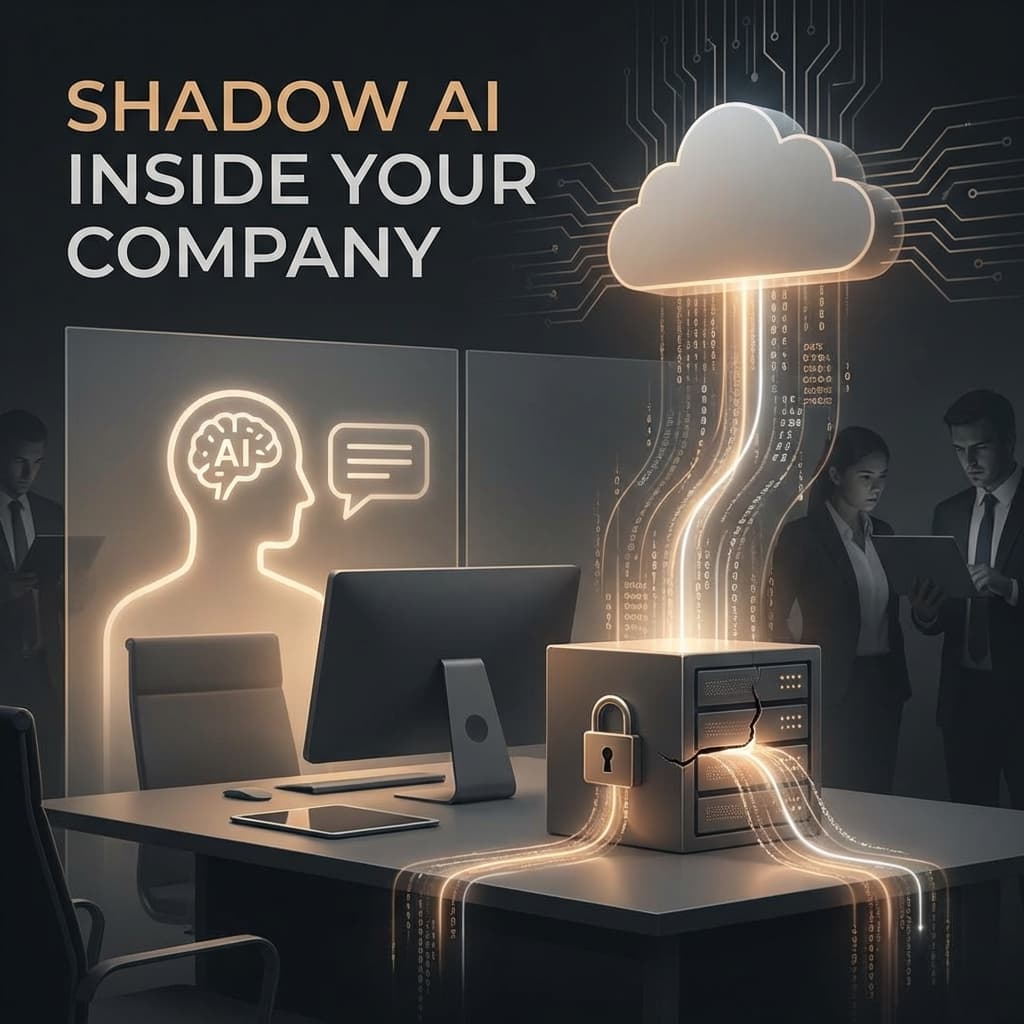
Shadow AI Inside Your Company: How People Really Use AI at Work (and What to Do About It)
The biggest risk to your company's data isn't a hacker—it's your most productive employee. Learn how to manage 'Shadow AI' by moving from restriction to empowerment with a lightweight AI policy and an approved stack.
In every modern office, there is a secret being kept.
It’s happening at the marketing manager’s desk, in the software engineer’s home office, and even in the boardroom. People are copy-pasting sensitive data—client contracts, private codebases, financial spreadsheets—into free, public AI chatbots.
They aren't doing it to be malicious. They are doing it because they are overwhelmed, and the AI is the only thing that helps them get their work done by 5:00 PM.
This is Shadow AI. And if you think your company doesn't have it, you're wrong. You just haven't found it yet.
Part 1: The Anatomy of the Leak
Shadow AI occurs when employees use AI tools that haven't been vetted or approved by the IT department.
The most common (and dangerous) behaviors include:
- The "Scrub-less" Paste: Copying a raw customer email containing PII (Personally Identifiable Information) into ChatGPT to ask for a polite reply.
- The "Personal Agent": Using a private subscription to a tool like Claude or Gemini to summarize internal "Company Confidential" meeting transcripts.
- The "Quick Fix": Running proprietary code through an AI model that stores the data for "training purposes."
The Risk: Once that data is in a public model’s training set, it could theoretically be "recalled" by the AI when talking to a competitor. More practically, it sits in a database outside of your company’s legal control, violating GDPR, SOC2, or HIPAA compliance.
Part 2: Why Bans Don't Work
The instinctive reaction of many CEOs is to "Block ChatGPT" on the company network.
This is a mistake for two reasons:
- Technical Futility: Employees will just use their personal phones or home laptops. You cannot block a thought process.
- Competitive Suicide: Your most productive employees are the ones using AI. If you block their "Superpower," they will either work slower or leave for a company that supports them.
The Goal is moving from "Block" to "Manage."
Part 3: The "Approved Stack" Template
To eliminate Shadow AI, you must provide a Safe Harbor. You need to give employees a stack that is faster and better than their personal tools, with the security they don't know they need.
The "Secure-by-Design" Stack Example:
- The Brain (Enterprise Tier): Provided access to ChatGPT Enterprise or Claude for Business. These tiers specifically state that your data is NOT used for training.
- The Coding Hub: Use Github Copilot with a managed enterprise license.
- The Internal Knowledge Base: A secure RAG system (like the ones we’ve discussed in previous blogs) that allows employees to query company docs without them leaving the server.
- The Sandbox: A private API endpoint that developers can use to build small automation scripts.
Part 4: A Lightweight Internal AI Policy
You don't need a 50-page legal document. You need a Code of Conduct that employees can actually remember.
The "Three Yeses and a No" Policy:
- YES: Use Approved Tools: You may use any tool listed in the internal "AI Catalog."
- YES: Scrub Before You Paste: If using a public tool for brainstorming, remove all names, prices, and proprietary logic.
- YES: Disclose Large-Scale Use: If an entire report was generated by AI, add a small footnote: "Drafted with assistance from AI."
- NO: Never Input Secret Keys: Never paste API keys, passwords, or raw source code into any AI that isn't hosted by the company.
Part 5: Managing the "Cultural" Transition
Shadow AI is essentially a trust issue. Employees hide their AI use because they are afraid of being seen as "lazy" or "cheating."
As a leader, you must break this stigma. Celebrate the "AI Wins." If an employee builds a script that saves 10 hours a week, don't ask why they weren't working harder; ask them to teach the rest of the team how they did it.
When you bring Shadow AI into the light, you don't just reduce risk—you increase the collective intelligence of your entire company.
Your Shadow AI Action Plan:
- The Survey: Send an anonymous survey to your team. Ask: "Which AI tools do you use for work, and what do they help you with?" (The results will surprise you).
- The Safe Harbor: Purchase an Enterprise license for one major LLM and give everyone a login. This immediately eliminates 80% of personal use.
- The Policy: Publish a simple, 1-page "AI Usage Guidelines" document.
- The Showcase: Run a monthly "AI Demo" where teams show off their (approved) workflows.
Shadow AI is a signal that your team wants to be more productive. Don't fight the signal—give them the tools to do it safely.