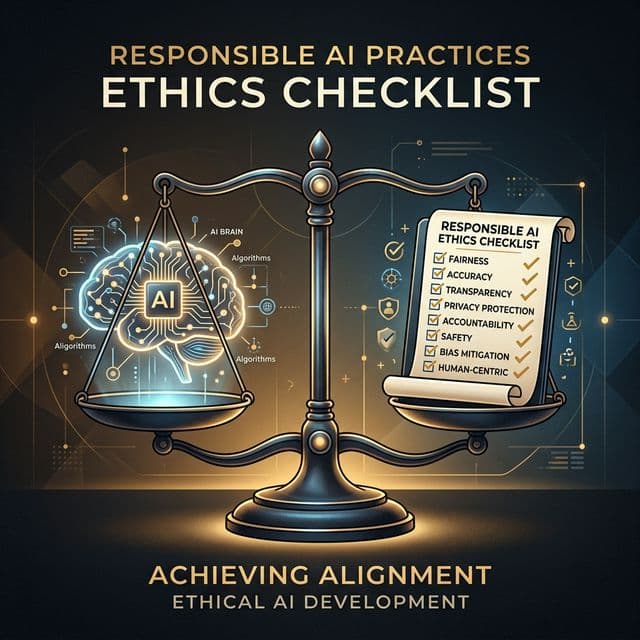
Do you understand AI? Use the following checklist to check your knowledge of Responsible AI
Artificial intelligence has transitioned from a specialized research field to a ubiquitous utility that powers the modern economy. We see its influence in every sector, from automated manufacturing to personalized medicine. However, as the deployment of these systems accelerates, the gap between usage and true understanding widens. This post aims to bridge that gap by providing a comprehensive framework for Responsible AI.
Understanding AI is no longer a luxury for specialized engineers. It is a fundamental requirement for anyone building, managing, or interacting with digital systems. We must move beyond the hype of magical outputs and look into the mechanics, risks, and governance required to maintain control. This is not about fear. It is about technical competence and ethical stewardship.
The following checklist structure is designed to challenge your assumptions. Each section provides a deep technical exploration of a critical AI pillar, followed by a diagnostic checklist. Use these checklists to determine where you stand in your journey toward technical and ethical mastery. By the end of this guide, you should have a clear roadmap for building AI systems that are safe, effective, and resilient.
Section 1: Mechanical Literacy and AI Foundations
To practice Responsible AI, one must first understand what the technology actually does at a fundamental level. Most modern AI is built upon large language models (LLMs) and other deep learning architectures. These systems are not thinking in the biological sense. They are complex mathematical instruments that calculate the probability of the next token in a sequence.
When an AI provides a coherent answer, it is performing a high dimensional pattern matching task. It has been trained on vast datasets to recognize relationships between words and concepts. This distinction is critical for professionals. If you treat AI as a sentient entity, you will overestimate its reasoning capabilities and underestimate its capacity for confident error.
Every professional should understand how an AI consumes information. Text is broken down into tokens, which are numerical representations of fragments of code or language. Each model has a finite context window. This is the amount of information it can remember during a single interaction. Understanding these limits is essential for building AI systems that function predictably. Large models today often feature context windows of 128k, 200k, or even 1 million tokens, but using this entire space does not guarantee recall or understanding. The "lost in the middle" phenomenon demonstrates that models often struggle to retrieve information buried in the center of a long context.
Furthermore, the mechanical cost of these operations is significant. Every token processed consumes compute resources and energy. As a systems architect, you must balance the need for detailed context with the economic and environmental costs of inference. Optimization techniques like KV caching, model distillation, and quantization are becoming standard tools in the kit of the responsible AI developer. By understanding these mechanical levers, you can build systems that are not only intelligent but also efficient and sustainable. This is a core component of mechanical literacy.
Section 1 Knowledge Checklist
- Do I understand that LLMs predict the next token based on probability, not logic?
- Can I explain the difference between a model's weights and its context window?
- Do I know how tokenization affects the cost and performance of my queries?
- Have I identified the specific training cut off for the models I use daily?
- Can I distinguish between generative AI and discriminative AI models?
Section 2: Mapping the Taxonomy of AI Risks
A core component of Responsible AI is the ability to anticipate and categorize potential failures. We often hear about AI risks in a general sense, but a senior professional must be more precise. We categorize these risks into operational, security, and alignment categories to better manage them.
The most common operational risk is hallucination. This occurs when a model generates plausible but false information. In a business context, hallucinations can lead to financial loss or legal liability. You must implement strategies to detect and mitigate these errors before they reach an end user. Bias is another critical risk. AI models inherit the prejudices present in their training data. Without active intervention, these systems can automate and scale discrimination in hiring, lending, or law enforcement.
Security in the age of AI introduces new vectors of attack. Prompt injection is a primary concern. This involves a malicious actor crafting an input that forces the model to ignore its safety instructions. If your system has access to external APIs or sensitive data, a successful prompt injection can lead to catastrophic data breaches. We must also consider data poisoning, where a model is trained on malicious or biased data to degrade its performance or create backdoors. These are not theoretical risks; they are active threats that require a defensive mindset.
Furthermore, we must consider AI misuse. This refers to the intentional application of AI for harmful purposes, such as generating misinformation or creating sophisticated phishing campaigns. As a builder, you are responsible for the downstream uses of your technology. Safety is not a feature you add at the end. It is a constraint that must be integrated into every layer of the architecture, from data collection to deployment. We must also address the risk of model inversion, where an attacker attempts to extract the weights or training data from a publicly exposed API. This requires robust rate limiting and anomalous query detection.
Section 2 Knowledge Checklist
- Have I identified the top three AI risks specific to my industry or role?
- Do I have a verification process to catch model hallucinations in production?
- Have I audited my training or fine tuning data for historical biases?
- Am I familiar with the mechanics of prompt injection and how to prevent it?
- Do I understand the difference between model safety and model security?
Section 3: Operationalizing AI Safety Protocols
Once you understand the risks, the next step is to implement AI safety protocols. Safety is not a static state. It is a continuous process of monitoring, testing, and refinement. In this section, we examine how to use AI safely in production environments where the stakes are high.
You should never expose a raw AI output directly to a user or a sensitive system. Instead, implement validation layers that check for safety violations, factual accuracy, and alignment with corporate policy. These guardrails act as a defensive perimeter. Common techniques include using a second, smaller model to audit the outputs of the primary model. You can also use regex filters or semantic analysis to catch prohibited content.
The most effective way to ensure safety is to keep a human in the loop for high stakes decisions. AI should act as a copilot or an advisor, not a final arbiter. For example, in code generation, the AI can suggest a solution, but a human engineer must review and test the code before it is deployed. This collaborative model leverages the speed of AI while maintaining the judgment and accountability of a human professional.
Section 3 Knowledge Checklist
- Are there automated guardrails between my model's output and my end users?
- Is there a "Human in the Loop" requirement for critical business decisions?
- Do I use secondary models to validate the safety of primary model outputs?
- Have I established a clear protocol for when an AI provides a low confidence response?
- Do I know how to use AI safely when dealing with personally identifiable information?
Section 4: Engineering for Responsible AI Systems
Building systems that are responsible by design requires more than just good intentions. It requires a rigorous engineering discipline. When we talk about building AI systems, we must include observability, testing, and documentation as first class citizens. The stochastic nature of generative models means that traditional software testing methods are often insufficient. You cannot simply check for an exact output. You must check for semantic intent and safety boundaries.
Observability is a cornerstone of this discipline. You cannot manage what you cannot measure. In traditional software, you monitor for errors and latency. In AI systems, you must also monitor for semantic drift and output quality. If the distribution of user queries changes, the model's performance might degrade in ways that traditional monitoring tools cannot detect. Implement logging for every prompt and response. Use vector databases to cluster outputs and identify patterns of failure. This proactive monitoring is essential for maintaining Responsible AI at scale.
Testing AI is inherently different from testing deterministic software. Since the output of a model can vary, you must use probabilistic testing frameworks. Create a golden dataset of queries with known good answers. Measure performance using metrics like accuracy, recall, and toxicity scores. Use model based evaluation where a stronger model grades the outputs of the model under test. This is often more effective than static keyword matching, as it can capture the semantic nuances of the response.
We should also implement "adversarial testing" or red teaming as part of the engineering pipeline. This involves intentionally trying to break the model with edge cases and malicious prompts. By automating these tests, you can catch regressions in safety or robustness before they affect your users. Finally, remember that documentation is not just for compliance. High quality model cards and system descriptions allow your team and your customers to understand exactly what the model can and cannot do. This transparency is the final piece of the engineering puzzle for Responsible AI. It builds the foundation for long term trust and reliability.
Section 4 Knowledge Checklist
- Have I integrated AI specific observability tools into my production stack?
- Do I use model based evaluation to score the quality of my AI outputs?
- Have I created a "golden dataset" for regression testing my prompts?
- Is my documentation for building AI systems complete with "model cards"?
- Do I monitor for semantic drift to detect when my model performance decays?
Section 5: Structural AI Governance and Accountability
Governance is the bridge between technical safety and organizational policy. Without AI governance, even the most technically sound system can fail if its usage is not aligned with the goals of the organization and the needs of society. It provides the framework for decision making and accountability across the entire lifecycle of the system.
Every organization using AI needs a clear set of internal policies. Who is authorized to deploy a new model? What datasets are prohibited for training due to privacy or copyright concerns? How are user reports of AI failure handled internally? These questions must be answered before you scale your AI initiatives. Governance also involves legal and compliance considerations. As regulations like the EU AI Act come into force, organizations must ensure that their systems are auditable and transparent.
Accountability is the most critical aspect of governance. When an AI system makes a mistake, the lines of responsibility must be clear. You must be able to trace a specific output back to the model version, the prompt, and the data inputs that generated it. This level of responsibility is what separates professionals from hobbyists in this field. It requires a commitment to owning the outcome, regardless of whether it was generated by a human or a machine.
Section 5 Knowledge Checklist
- Does my organization have a written policy for AI governance?
- Is there a designated individual responsible for AI safety and compliance?
- Can I trace a specific AI output back to its original model version and prompt?
- Have I performed an external audit or "red teaming" exercise in the last year?
- Do I have a remediation process for when an AI generates harmful or incorrect content?
Section 6: Applied Ethical AI in Design
The term ethics is often used vaguely, but in the context of Responsible AI, it has very concrete meanings. It refers to the design choices that prioritize human well being, fairness, and transparency. It is about asking whether we should build a system, not just whether we can. It requires a philosophical perspective integrated into the technical workflow.
AI models are mirrors of the data they consume. If the data contains historical biases, the model will replicate them. Mitigation requires active intervention at both the data and the model layers. You must audit your training sets for representation and diversity. You must also use algorithmic techniques to penalize biased outputs during the inference phase. Fairness is not a one time check. It is an ongoing commitment to social responsibility.
Transparency is equally vital. It involves being honest with users about when they are interacting with an AI and being open about the limitations of the system. If an AI is used for credit scoring or medical diagnosis, the users have a right to know how the decision was reached and how they can appeal it. Responsible AI requires a deep respect for data privacy, including techniques like differential privacy and secure storage protocols.
Section 6 Knowledge Checklist
- Have I audited my system for potential bias against specific demographics?
- Is my AI's decision making process explainable to a non technical user?
- Am I transparent with users about when they are interacting with an AI?
- Does my ethical AI framework include a right to appeal automated decisions?
- Have I implemented differential privacy or similar techniques for sensitive data?
Section 7: Future Integration and Autonomous Agents
As we look toward the next decade, the integration of AI into our daily lives will only deepen. We are moving from a world of chatbot interfaces to a world of autonomous agents that can perform complex tasks on our behalf. This shift brings new challenges for Responsible AI that go beyond simple text moderation or bias detection. It requires a fundamental rethinking of how we maintain control over distributed, autonomous systems.
Autonomous agents can set their own goals, choose their own tools, and interact with the world with minimal human intervention. While the productivity gains are immense, the risks are equally significant. How do we ensure that an agent remains aligned with its owner's intent over a long period? How do we prevent an agent from inadvertently causing harm while trying to achieve a seemingly benign goal? The solution lies in multi layered safety architectures where each agent is bounded by a set of immutable rules enforced by an external supervisor model.
As AI becomes more sophisticated, we must also be careful not to outsource our critical thinking to these systems. The automation bias is a well documented phenomenon where humans tend to trust automated systems even when they are obviously wrong. To combat this, we must design interfaces that encourage skepticism and active verification. The goal of building AI systems should be to empower humans, not to replace them. We need systems that are not just powerful, but also legible to the people who use them.
Section 7 Knowledge Checklist
- Am I prepared for the transition from passive chatbots to autonomous agentic systems?
- Do I have a supervisor model in place to monitor agent behavior in real time?
- Have I designed my AI interfaces to combat human automation bias?
- Do I understand the "alignment problem" as it pertains to long term agent goals?
- Am I active in the conversation regarding global standards for AI governance?
Section 8: The Comprehensive Responsible AI Checklist (Summary)
To summarize our journey, here is the definitive meta checklist to gauge your overall implementation of Responsible AI. Think of this as your high level roadmap for organizational excellence.
Fundamentals and Strategy
- Do I understand the probabilistic mechanics of my AI models?
- Is there a clear business case for every AI system I deploy?
- Does my strategy account for both the speed and the uncertainty of AI outputs?
Operational Risk and Safety
- Have I mapped my environment's unique AI risks?
- Are automated guardrails active in every production pipeline?
- Is "Human in the Loop" a core requirement for high stakes outputs?
Engineering and Governance
- Do I have full observability over my prompt/response lifecycle?
- Is there a written policy for AI governance within my organization?
- Are my models regularly red teamed by external security experts?
Ethics and Human Impact
- Am I transparent with users about AI involvement in their experience?
- Have I implemented active bias mitigation for all predictive models?
- Does my ethical AI framework prioritize human well being over raw optimization?
Section 9: Conclusion: A Call to Action for Professional Builders
The era of moving fast and breaking things is over for artificial intelligence. The stakes are too high, and the potential for harm is too great. We must replace the culture of hype with a culture of responsibility. This does not mean moving slowly. It means moving with precision, foresight, and a commitment to technical excellence.
As a builder, you have a unique responsibility. You are the architect of the systems that will shape the future of our society. Use the checklists provided in this guide as a starting point, but do not let them be the end. Stay curious, stay skeptical, and stay committed to the principles of Responsible AI. The technology will continue to evolve, and so must our safety frameworks. By embracing these challenges today, we can build a future where AI is a powerful engine for human progress and well being. The work starts now.