The One Password Mistake Almost Everyone Still Makes
We investigate the 'Skeleton Key' of digital vulnerability. Discover why reusing passwords is the single most common path to catastrophic data loss, and how to build a fortress of unique identities in the AI age.
The Skeleton Key: The Fatal Error of the Digital Self
Imagine you have a beautiful, secure home. You’ve invested in high-end locks, a sophisticated alarm system, and a heavy vault for your most precious heirlooms. You feel safe. But then, you take the key to that home and you make a thousand copies of it. You use that same key to lock your car, your office, your gym locker, your bicycle, and even the diary you keep your deepest thoughts in. You even go so far as to hand a copy of that key to a casual acquaintance who promises to "keep it safe" in exchange for a free cup of coffee.
In the physical world, we would call this behavior insanity. We would recognize that the moment any one of those locations is breached, or the moment that acquaintance loses the key, the security of every single part of your life is destroyed.
Yet, in the digital world, this is exactly what nearly everyone does.
This is the "Fatal Error of Password Reuse." It is the single most common mistake in the history of human-computer interaction, and it is the primary reason why "Data Breaches" have become such a catastrophic threat to our collective digital sovereignty.
As a visionary narrative storyteller, I want to take you inside the "Mind of the Breach." We are going to explore why we make this mistake, how it is weaponized by AI and hackers, and how to move from a world of "Skeleton Keys" to a world of "Sovereign Fortresses."
The Psychology of the "One Key" Mistake
The reason we reuse passwords is not because we are lazy; it’s because we are Human.
The human brain was not designed to remember 150 unique, complex, 16-character strings of random characters. We are wired for Memorable Meaning. We like names, dates, and patterns that resonate with our personal history.
When we find a password that works—one that meets the "At least one capital letter and one symbol" requirement—we feel a sense of relief. We’ve solved the problem. And because we have so many other things to worry about, we use that "Magic String" for every new service we sign up for. We prioritize the Convenience of the Present over the Security of the Future.
This is a "Temporal Mismatch." Our brains are optimizing for the 10 seconds of login time today, rather than the 10 years of identity security we are putting at risk.
The Weaponization of the Mistake: Credential Stuffing
To understand why this mistake is so fatal, you have to understand a technique called "Credential Stuffing."
When a small, insecure website (like a niche hobby forum or a local delivery service) is hacked, the bad guys aren't just looking for data from that site. They are looking for your email and password combination. Why? Because they know that you are likely using that same combination for your bank, your email, and your health portal.
They use AI-powered bots to take the list of leaked credentials and "stuff" them into thousands of other login pages across the web simultaneously. They are looking for the "Matches."
This is the "Big Picture" threat of the modern age. You can be the most security-conscious person in the world, but if you reuse your "Master Password" on one tiny, insecure site, you have essentially handed the keys to your entire life to a global network of criminals. A breach at a pizza shop can lead to a takeover of your retirement account.
The AI Multiplier: Why the Risk is Increasing
We are entering the Era of Algorithmic Cracking. In the past, hackers used "Brute Force"—trying every combination of letters and numbers. This was slow and often detectable.
Today, AI models have been trained on billions of leaked passwords. They "understand" how humans think. They know that if your password is "Summer!2024," and the site forces you to change it, you are 90% likely to change it to "Autumn!2024" or "Winter!2024."
The AI can predict your "Next Password" with terrifying accuracy. It can look at your social media profile, find your dog’s name and your birth year, and generate a list of the 1,000 most likely passwords you would use. By reusing a password, or even a pattern of passwords, you are giving the AI the "DNA" of your digital identity.
The Vision: Reclaiming the Fortress
So, how do we move forward? We cannot change the way the human brain works, so we must change the Architecture of Identity.
1. The Death of the "Brain-Memorized" Password
We must admit a hard truth: You should not know your own passwords.
If you can remember it, it’s probably too weak or too reused. The visionary path is to move all our identity management to a Password Manager. This is a digital vault that generates unique, random, 30-character strings for every single service. You only remember one "Master Key" (or use biometrics), and the manager handles the rest. This creates a "Cellular Security" model, where a breach on one site has zero impact on any other.
2. The Move to "Passkeys" (Passwordless Future)
The ultimate visionary goal is to Kill the Password entirely. We are seeing the rise of "Passkeys"—a new standard that uses your device’s own security (like FaceID or a fingerprint) to authenticate you.
In this world, there is no "Magic String" to type, and therefore no "Magic String" to steal or reuse. Your identity is tied to your physical possession of a device and your biological presence. This is the "End of the Skeleton Key" era.
3. Multifactor as a "Sacred Shield"
If you must use a password, it should always be accompanied by a Secondary Shield. 2FA (Two-Factor Authentication) is the safety net of the digital age. Even if a hacker uses your reused password to get to your bank’s gate, the secondary code on your phone stops them. It turns a "Fatal Error" into a "Near-Miss."
The Human Duty: Modeling the Future
As visionary leaders, we must model better "Cyber Hygiene." We must stop taking the "Convenient Path" and start taking the "Sovereign Path."
This means spending an afternoon doing a "Security Audit." It means changing those old, reused passwords. It means setting up a manager and turning on 2FA for everything that matters.
We are not just protecting our own data; we are building the "Herd Immunity" of the digital world. The fewer reused passwords there are in the system, the less profitable and less effective global hacking becomes. Each unique password you create is a strike against the global economy of cybercrime.
Conclusion: The Final Lock
The "One Key" mistake is the last vestige of our analog brains trying to survive in a digital reality. It is a habit that belongs to the past, but one that is actively destroying our future.
The "Big Picture" is simple: Your identity is the most valuable thing you own. Don't lock it with a key that fits every door in town.
Build your fortress. Use unique keys. And walk through the digital world with the confidence of someone who knows that their secrets are truly, uniquely their own.
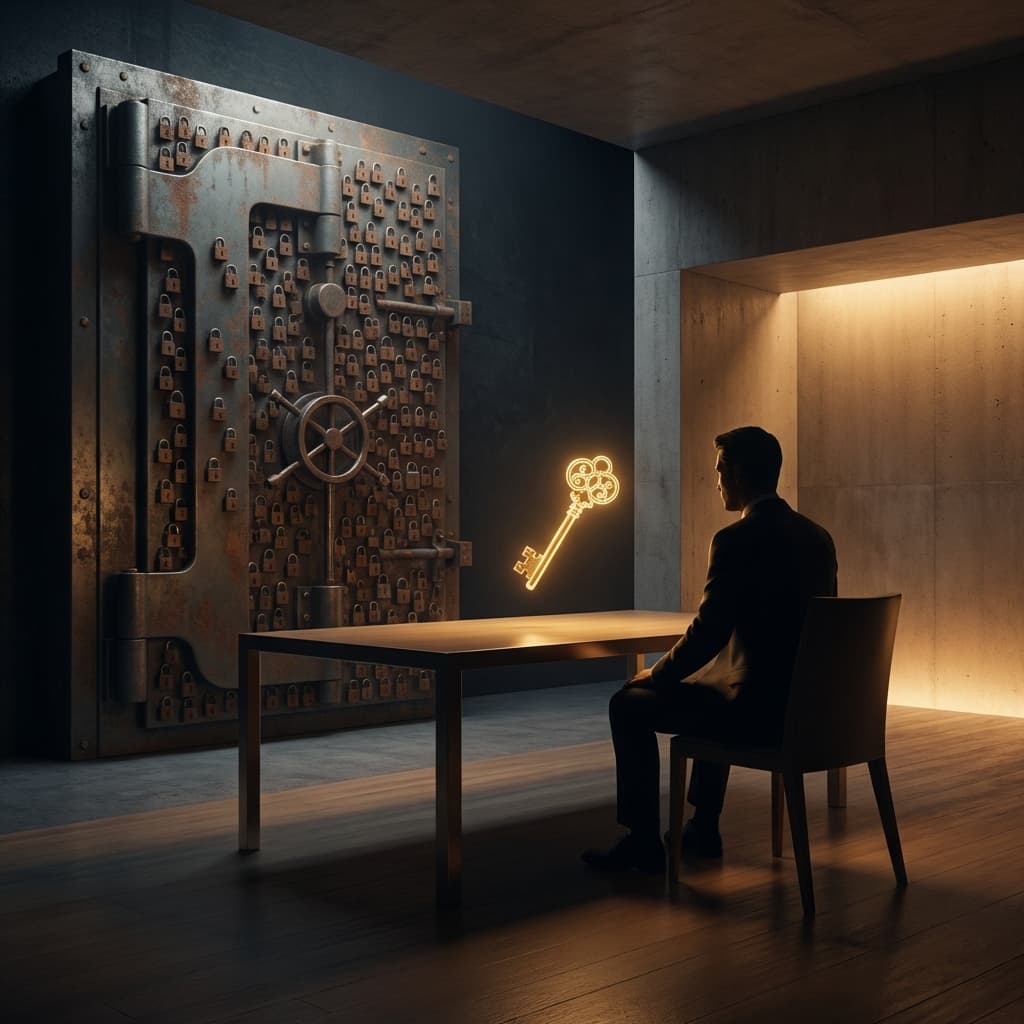
The gold key is shining. The vault is waiting. Let’s make sure it’s locked right.
Key Points for the Visionary Individual:
- The "One-Pass" Audit: Do you have a "Go-To" password? One that you use for your email, your Netflix, and that random shopping site? If so, change it on your Email first. Your email is the "Master Key" to your identity.
- The Manager Move: If you aren't using a password manager, download one today (e.g., Bitwarden, 1Password). Start by moving just your 5 most important accounts. Experience the freedom of not having to remember a thing.
- The 2FA Sweep: Go into your primary bank, email, and social media accounts. Search for "Security" or "2FA." Turn it on. It takes 60 seconds and reduces your risk of a takeover by 99%.
- The Pattern Test: If you use "NameYear!" patterns, realize that AI knows exactly what you're doing. Shift to "Passphrases"—random strings of 4 or 5 unrelated words (like Purple-Mountain-Bicycle-Laptop-Coffee). They are easier to remember but much harder for AI to crack.
At ShShell.com, we break down the invisible risks of the high-tech world to help you lead with clarity and sovereignty. Information is the material, but awareness is the power. Let’s lead the way to a more secure future.