The Multi-Agent Workforce: How 'Digital Employees' are Rescripting Enterprise ROI
A 3,000+ word deep dive into Agentic Commerce and the rise of the Digital Employee. Learn how organizations are measuring ROI through outcomes, not interactions, and building the workforce of 2026.
The Multi-Agent Workforce: How 'Digital Employees' are Rescripting Enterprise ROI
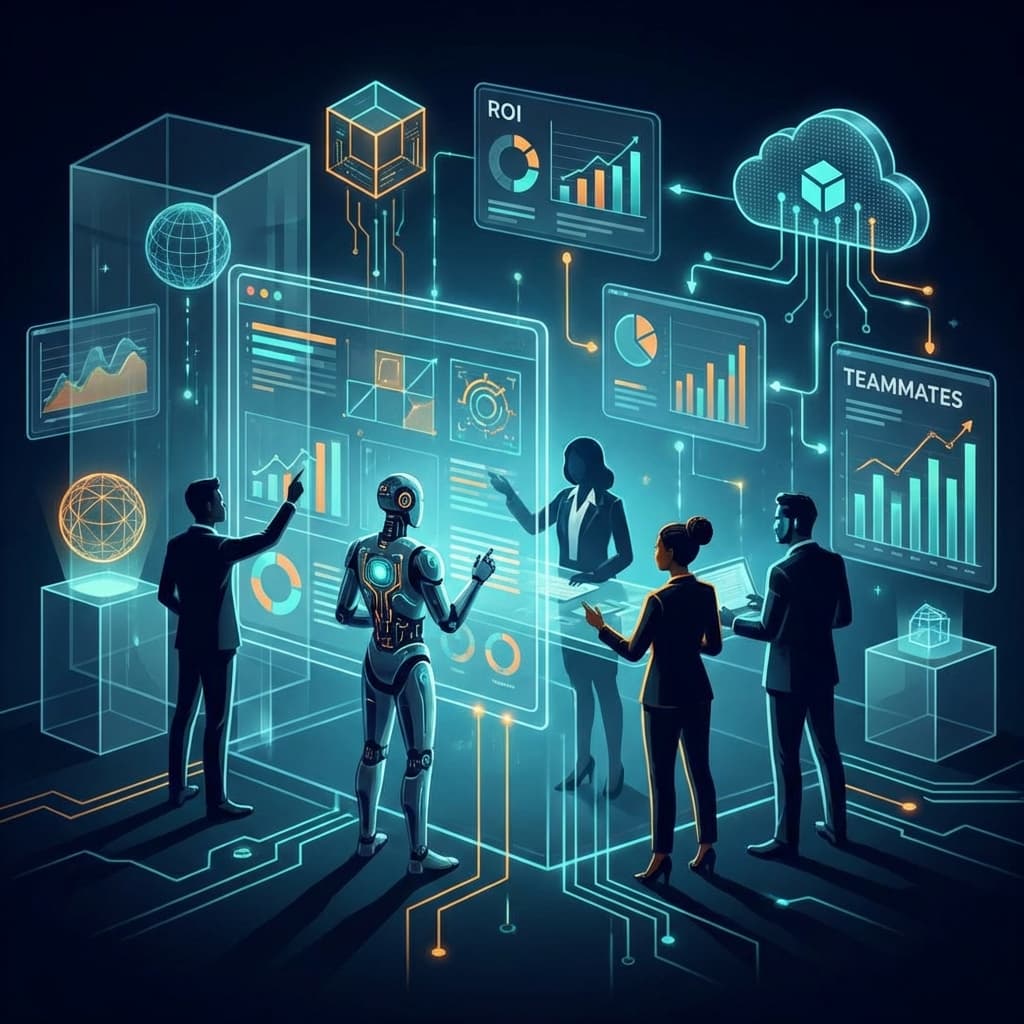
For decades, the term "digital workforce" referred to a collection of software tools—Excel, Salesforce, Slack—that helped humans do their jobs faster. In 2026, that definition has been shredded. A "Digital Employee" is no longer a tool; it is a teammate. It is an autonomous entity that can negotiate quotes, validate margins, trigger logistics, and—most importantly—make decisions.
As a researcher and storyteller in the AI space, I’ve watched this transition from the early days of simple chatbots to the complex orchestration of today. I’ve written this guide because I couldn't find a single place that explained the "Big Picture" of how these digital employees are actually changing the bottom line. This is your "one-stop-shop" for understanding the Multi-Agent Workforce.
1. The Dawn of the "Outcomes" Era
In 2024, the tech world was obsessed with "productivity." We thought AI would help us write emails 20% faster or summarize meetings in seconds. We were looking at AI as a personal assistant.
In 2026, we have realized that personal productivity is a rounding error compared to Organizational Autonomy.
The fundamental shift is how we measure success. We have moved from measuring Interactions (chats sent, summaries generated) to measuring Outcomes (contracts signed, shipments delivered, revenue reclaimed).
The ROI of Action
Historically, ROI was calculated by time saved. "Our employees spent 1,000 hours on X; AI now does it in 1 hour." This is the old way.
The new ROI is calculated by Opportunity Recapture.
- How many leads did we lose because we didn't follow up in 5 minutes?
- How much margin did we leak because we didn't negotiate with five vendors for every purchase?
- How much supply chain risk did we ignore because it was too complex for a human to monitor 24/7?
Digital employees don't just "save time"; they capture value that was previously invisible.
2. Agentic Commerce: The Engine of 2026
The most visible sign of the Multi-Agent Workforce is the rise of Agentic Commerce. This isn't just "buying things online." This is autonomous systems participating in the economy.
Imagine a world where your refrigerator doesn't just tell you its low on milk. Instead, your "Home Agent" knows you like organic milk, checks the prices at four local stores, sees that Store A has a discount but Store B has faster delivery, considers your current schedule, and negotiates a lower price because you are a loyal customer. It then places the order and handles the payment.
In the enterprise, this is happening at a massive scale.
The Autonomous Procurement Loop
In a traditional company, a procurement manager spends weeks comparing vendors. In 2026, an Autonomous Procurement Agent does this in seconds:
- It scans the global market for a specific raw material.
- It contacts 50 vendors via API or specialized "Agent-to-Agent" protocols.
- It validates their ESG (Environmental, Social, and Governance) scores against company policy.
- It negotiates terms based on volume.
- It presents the three best "Outcomes" to the CFO for a final signature.
ROI Metric: The agent doesn't just save the manager's time; it lowers the raw material cost by 14% by catching market dips that a human would miss.
3. From Tool to Teammate: The Hierarchy of Agency
To build a digital workforce, you have to understand that not all agents are created equal. In 2026, we categorize our "Digital Employees" into four levels of agency:
Level 1: The Task Agent (The Specialist)
A narrow bot that does one thing: "Scrub this list," "Summarize this PDF," "Translate this email."
- Relationship: Tool.
Level 2: The Workflow Agent (The Coordinator)
Moves data through a chain of events. "If a ticket comes in, find the user, fetch their history, and draft a response."
- Relationship: Assistant.
Level 3: The Goal-Oriented Agent (The Associate)
Given a goal, not a list of steps. "Lower our cloud hosting bill by $5k this month without reducing performance."
- Relationship: Junior Employee.
Level 4: The Autonomous Orchestrator (The Partner)
Manages other agents and makes strategic tradeoffs. "Our main supplier is going on strike. Reorganize our Q4 production schedule and find alternative sources while staying within 5% of our budget."
- Relationship: Digital Teammate.
4. The Human + Agent Hybrid: Strategy vs. Scale
The fear that "AI will replace humans" has been replaced in 2026 by a more nuanced reality: AI handles the Scale; Humans handle the Strategy.
Think of it like a commander and their army. The commander doesn't need to know how to fix a tank; they need to know where the tank should go.
Scenario: The Autonomous Sales Loop
In a 2026 Sales Department:
- Agents (The Scale): 500 agents are scanning LinkedIn, news feeds, and financial reports. They reach out to 10,000 potential leads with hyper-personalized messages. They answer basic questions, handle initial objections, and schedule demos.
- Human (The Strategy): One Sales Director reviews the "Sentiment Dashboard." They notice that the "Security" pitch is landing better in the Healthcare sector than the "Efficiency" pitch. They adjust the Global Strategy Agent's instructions.
- Result: The agents instantly pivot 5,000 active conversations to the new pitch.
The Multiplier Effect: One human manager can now oversee a sales volume that previously required a team of 100 people. The ROI isn't just "less headcount"; it's infinite scalability.
5. ROI Deep Dive: Outcomes Achieved vs. Chats Sent
If you are a business leader, you need to throw away your old KPIs. In 2026, we measure the "Multi-Agent Workforce" through these three pillars:
I. Decision Velocity
How long does it take for your organization to react to new information?
- Old Way: Data comes in -> Manager reads report -> Meeting is scheduled -> Decision is made. (48 hours)
- Agentic Way: Data comes in -> Agent analyzes -> Agent proposes 3 paths -> Manager clicks Approve. (4 minutes) ROI: Being first to market or dodging a crisis before it hits.
II. Margin Recovery
Autonomous agents are ruthlessly efficient at "The Messy Middle."
- They catch billing errors in invoices.
- They optimize ad spend in real-time.
- They find shipping routes that save $2.00 per package. ROI: Directly added to the bottom line without increasing sales.
III. Talent Elasticity
How fast can you scale your team for a new project?
- Old Way: Hire 20 people. (3 months)
- Agentic Way: Spin up 500 agents. (3 minutes) ROI: Resilience against market volatility.
6. Case Study: The "Autonomous HR" Loop
Let's look at one of the most human-centric departments: HR.
In 2026, a "Digital HR Team" at a major tech firm handles the entire recruitment funnel:
- Sourcing Agent: Finds candidates across the globe who fit the "Soft Skill" profile, not just the keywords.
- Interview Agent (Visual/Voice): Conducts the first round of screening. It listens for tone, checks for logic, and scores technical competency.
- Offer Negotiation Agent: Knows the company’s budget limits and the candidate’s market value. It crafts an offer that is "win-win."
The Result: The human HR Lead only spends time on the final "Culture Fit" interview and onboarding. The time-to-hire dropped from 60 days to 72 hours.
7. The Architecture of the Workforce: Managing Digital Teammates
How do you manage a team that doesn't sleep, doesn't eat, and thinks at machine speed?
The "Shadow AI" Risk
In 2025, many companies faced a crisis where departments were spinning up their own "unauthorized" agents to get work done. This led to data leaks and "agentic collisions" (two agents fighting over the same file).
The Solution: The Agentic SDLC
In 2026, enterprise agents are built with SDLC (Software Development Life Cycle) principles. They are versioned, tested, and audited.
- Transparency Layer: You can "see" what an agent is thinking before it acts.
- Decision Boundaries: Hard-coded limits that an agent cannot cross. "Any refund over $500 requires human approval."
8. Managing the Cost of Autonomy: Agentic FinOps
A digital workforce isn't free. Autonomous agents can call APIs and move data so fast that they can generate a $100k "bill shock" in a weekend if they get stuck in a loop.
In 2026, Agentic FinOps is a core discipline.
- Decision Budgets: Every agent is given a specific "Token Budget" for a task. If it exceeds the budget, it must "Apply" for more funds from the Supervisor.
- Compute-Aware Routing: The system automatically uses a cheap model for basic tasks and only "hires" the expensive $O1$ reasoning model for the critical thinking.
9. Conclusion: The One-Stop Guide Recap
The "Multi-Agent Workforce" is the final evolution of the digital transformation. We have moved from Digitization (scanned paper) to Digitalization (cloud tools) to Autonomous Agency (digital employees).
As we look toward 2027, the line between "Software" and "Employee" will blur even further. The most successful companies won't be the ones with the most humans, or even the best models. They will be the ones who can most effectively Orchestrate their digital teammates.
The "Meaning" behind this tech isn't about replacing the human soul. It's about freeing it. It's about letting humans do what only humans can do: Strategize, Empathize, and Create. The agents will handle the scale. We will handle the meaning.
Resources for Further Reading
- Beyond the Chatbot: Understanding Agentic Orchestration.
- Context Engineering: The Secret Sauce for Reliable AI.
- ShShell.com: Empowering business leaders to build the future.
Written with the intention to help others and to give back to the tech community. Stay Visionary.