Building Agentic Control Planes: Practical Patterns for Multi-Agent Orchestration in Production
Why one agent is never enough. Explore the architectural blueprints for building complex, multi-agent systems that can plan, reason, and execute at scale. Learn about the Orchestrator, the Worker, and the Supervisor patterns.
Building Agentic Control Planes: Practical Patterns for Multi-Agent Orchestration in Production
In the early days of AI (which, in this fast-forward world, was about eighteen months ago), we were obsessed with the "Chatbot." We wanted an oracle where we could type a question and get a brilliant answer. But as we moved from toys to tools, we realized that an oracle is a poor employee. An oracle tells you what to do; it doesn't actually do it.
To build systems that actually move the needle for a business, we had to move beyond the single model and start building Agentic Control Planes.
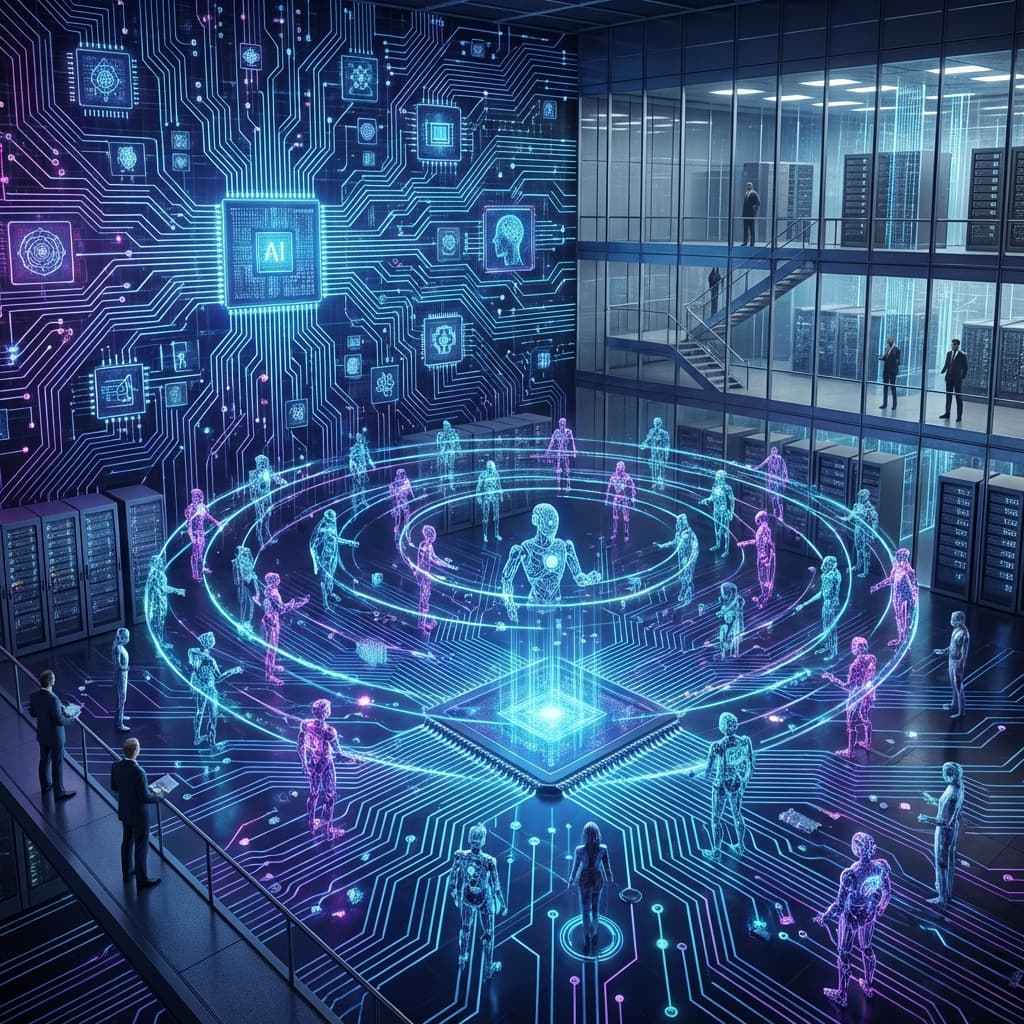
If an AI agent is a single digital worker, an Agentic Control Plane is the entire management structure, the communication protocols, and the operational guardrails that allow a fleet of agents to work together. It is the difference between a lone freelancer and a coordinated special forces team.
In this guide, we will dismantle the architecture of multi-agent systems. We will look at the patterns that work in production, the "Magic" of emergent collaboration, and the hard-won engineering lessons of keeping agents from descending into digital chaos.
The Fall of the Monolithic Agent
When developers first start building with agents, they usually try the "God Agent" pattern. They take a powerful model (like GPT-4 or Claude 3.5), give it a massive set of tools, and a prompt that says: "You are an expert who can do everything."
In production, the God Agent fails for three reasons:
- Hallucination Density: The more tools and instructions you give a single agent, the more likely it is to get confused. Its internal "attention" is stretched too thin.
- Context Exhaustion: Every tool definition and instruction eats up tokens. Eventually, the agent has no room left to actually "think" about the problem.
- Untestability: How do you run a unit test on a system that is supposed to do "everything"?
The solution is Modular Agency. Instead of one agent that does everything poorly, you build five agents that do one thing perfectly.
1. The Core Patterns of Orchestration
Building a multi-agent system is essentially an exercise in distributed systems design. You need to decide how work is assigned, how information is shared, and who has the final say.
A. The Manager-Worker Pattern
This is the most common and intuitive pattern. You have one "Orchestrator" agent that receives the high-level goal from the human. The Orchestrator breaks that goal into smaller tasks and assigns them to "Worker" agents who are specialists in specific domains (e.g., SEO, Python, Database).
The Magic: The Orchestrator doesn't need to know how to write SQL; it just needs to know that "The SQL Specialist" is the right person for the job.
graph TD
    User["Human User"] -- "Goal" --> Manager["Orchestrator Agent"]
    Manager -- "Task 1" --> Worker1["Coder Agent"]
    Manager -- "Task 2" --> Worker2["Researcher Agent"]
    Manager -- "Task 3" --> Worker3["Reviewer Agent"]

    Worker1 --> Manager
    Worker2 --> Manager
    Worker3 --> Manager

    Manager -- "Final Answer" --> User
B. The Supervisor Loop
In production, you can't trust an agent to be its own judge. The Supervisor pattern introduces a separate agent whose only job is to evaluate the output of another.
If the "Researcher Agent" provides a report, the "Supervisor Agent" checks it for factual accuracy. If it fails, the Supervisor sends it back to the Researcher with specific feedback. This creates a "Self-Correcting Loop" that drastically reduces hallucination rates.
C. The Blackboard Pattern
Inspired by classic AI systems from the 1970s, the Blackboard pattern involves a shared data store (the "Blackboard"). Agents observe the Blackboard, and if they see a piece of information they can act on, they do so and post their results back.
This is highly effective for asynchronous, discovery-based tasks where you don't know the exact sequence of steps in advance.
2. Managing the Shared State: The "Digital Memory"
In a multi-agent system, the "State" is everything. If the "Coder Agent" changes a variable, but the "Tester Agent" doesn't know about the change, the system breaks.
Short-term Memory (Context)
This is the conversation history currently in the model's window. In a orchestrated system, we must be careful what we share. If we send the entire history of Agent A to Agent B, we are wasting tokens.
Pro Tip: Use a "Summarizer Agent" to condense the work of one agent before passing the baton to the next.
Long-term Memory (Vector DBs)
When agents need to remember things across different sessions—like a user's preferences or the history of a specific codebase—they use specialized databases. This is the foundation of "Institutional Knowledge" for your AI fleet.
3. Communication Protocols: How Agents "Talk"
We often forget that when agents collaborate, they are just sending strings of text to each other. If those strings are unstructured, the system becomes fragile.
To build production-grade control planes, we move from "Natural Language" to "Structured Intents."
Instead of Agent A saying: "Hey, can you look at this code?", it sends a JSON payload:
{
  "intent": "CODE_REVIEW",
  "priority": "HIGH",
  "payload": {
    "file": "auth.py",
    "diff": "+ import oath2..."
  }
}
This allow us (the humans) to build hard-coded logic around the agents. We can log these events, trigger alerts, and build dashboards showing exactly how the agents are collaborating.
4. The "Meaning" of the Control Plane: Stability in the Storm
Why go through all this trouble? Why not just wait for the models to get better?
Because Reliability is a System Property, not a Model Property.
Even if we get a "GPT-6" that is 100x smarter than today's models, it will still have a non-zero failure rate. The Control Plane is the infrastructure that catches those failures. It provides:
- Retries: If an agent hits a rate limit or a timeout, the orchestrator handles the retry.
- Fallback: If the "Premium" model fails, the system can switch to a "Local" model to maintain service.
- Human-in-the-Loop (HITL): If the confidence score of an agent's plan is below a certain threshold (e.g., 70%), the control plane pauses and asks for human intervention.
5. Visualizing the Orchestration Lifecycle
graph TD
    Input["Human Input"] --> Parser["Intent Parser"]
    Parser --> Planner["Agentic Planner"]
    Planner -- "Static DAG" --> Execute["Executor Fleet"]
    Execute -- "Outcome" --> Judge["Supervisor Agent"]

    Judge -- "Reject" --> Planner
    Judge -- "Approve" --> Output["Final Result"]

    style Judge fill:#f96,stroke:#333
    style Planner fill:#9cf,stroke:#333
The Vision: Emergent Intelligence
The most exciting part of building multi-agent systems is seeing Emergent Intelligence. This happens when the collective output of the fleet is significantly greater than the sum of its parts.
You see a group of agents debating a technical design, finding flaws in each other's reasoning, and arriving at a solution that none of the individual models could have generated on their own. This is the "Magic" of orchestration. We are building a digital "Brain" where the individual agents are the neurons.
The Engineering Challenge: "Day 2" Operations
Once your agentic control plane is live, you face new challenges:
- Agentic Drift: How do you know if your agents' performance is degrading after a model update?
- Traceability: When something goes wrong, can you trace the "Thought Path" through five different agents? (Tools like LangFuse and Phoenix are becoming essential here).
- Cost Blowout: A multi-agent loop can accidentally burn through hundreds of dollars in tokens if it gets stuck in an infinite "critique cycle." You need "Circuit Breakers."
Final Thoughts: Designing for Autonomy
We are moving away from building software that is a "Sequence of Commands" and toward software that is a "Society of Agents."
To succeed in this era, you have to think like a Director. You are casting the right agents for the right roles, setting the stage (the environment and tools), and defining the script (the protocols).
The Agentic Control Plane is the theatre where the future of work will be performed. And as the architects of that theatre, our job is to ensure the performance is safe, reliable, and—eventually—beyond our own capabilities.