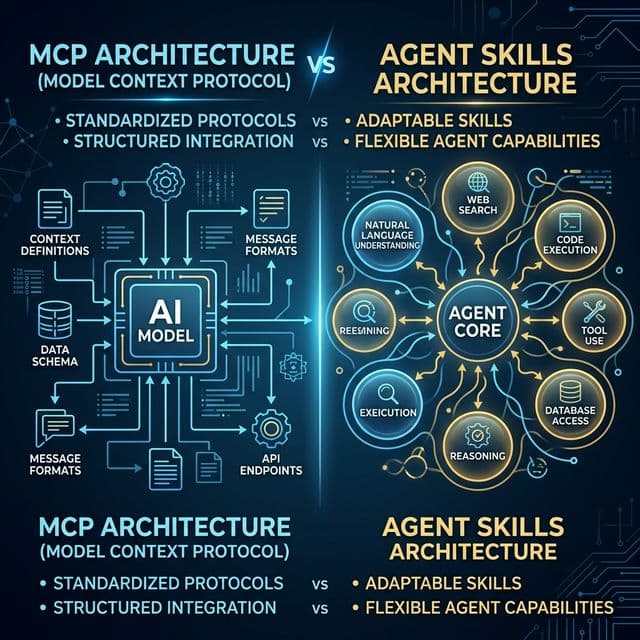
MCP Is Effectively Dead. Agent Skills Are Replacing It.
Why the Model Context Protocol (MCP) is being replaced by deterministic Agent Skills for production AI systems.
For a brief period in late 2024 and early 2025, the Model Context Protocol (MCP) looked like the undisputed future of AI integration. It promised a world where tools and models could speak a universal language, allowing for seamless, dynamic discovery.
That period is over.
The industry is moving away from the "magic" of dynamic tool discovery and toward a more disciplined, engineering-first approach: Agent Skills. The reasons are structural, not hype-driven. Even Anthropic, the creator of MCP, has implicitly acknowledged these limitations through revised guidance and a shift toward structured workflows.
This article explains why MCP failed in practice, why agent skills are winning, and how real developers are responding to this architectural correction.
What MCP Tried to Be
MCP promised a clean, standardized interface between tools and Large Language Models (LLMs).
In Theory:
- Tools expose schemas: Every tool provides a JSON schema describing its purpose and inputs.
- Models discover and call: The LLM scans the available tools at runtime and decides which one to invoke.
- Standardization: Everything stays interoperable, regardless of the model or the underlying tool.
In Practice:
MCP added a layer of abstraction without actually reducing complexity. It pushed the critical responsibility of orchestration onto the model itself. As developers moved from simple demos to production systems, they realized that breaking the "handoff" between code and model was a recipe for fragility.
Why MCP Breaks Down in Real Projects
Building a system is different from building a demo. Here are the four structural pillars that caused MCP to collapse under the weight of production requirements.
1. Tool Discovery Does Not Scale
MCP assumes the model can reason about dozens or even hundreds of tools at runtime. This fails when:
- Context Windows are Constrained: Every tool schema consumes tokens.
- Overlapping Responsibilities: If you have
get_user_by_emailandsearch_customer, the model often gets confused. - Reasoning Overhead: The model spends expensive tokens figuring out what to do instead of actually doing it.
2. Control Flow Is Implicit and Fragile
With MCP, the model decides the sequence of events. In a production environment, this is unacceptable. Engineers need deterministic execution, explicit branching, and auditable logic. MCP hides the "brain" of the application inside a black box, making it impossible to guarantee that a specific sequence (e.g., Auth -> Fetch -> Update -> Notify) will always happen correctly.
3. Debugging Is a Nightmare
When an MCP-based system fails, identifying the root cause is painful:
- Was the JSON schema slightly off?
- Did the model misunderstand the tool's purpose?
- Did the tool fail internally?
- Did the model hallucinate a parameter?
This lack of observability is the antithesis of modern software engineering.
4. Performance and Cost Overhead
MCP encourages repeated reasoning. Every single turn, the model has to re-evaluate its toolset. Agent skills, by design, reduce this overhead by moving the "decision" part of the process into the code, where it is faster, cheaper, and more reliable.
Anthropic's Implicit Pivot
Anthropic hasn't explicitly declared MCP "dead"—they don't need to. Their actions speak louder than blog posts. Recently, we’ve seen a massive shift in their documentation and tooling toward:
- Agent Patterns: Favoring specific, goal-oriented architectures.
- Structured Workflows: Moving away from dynamic tool discovery.
- External Orchestration: Emphasizing frameworks like LangGraph that provide a "skeleton" for the model to work within.
This is a clear admission that the model should be a worker, not an architect.
The Replacement: Agent Skills
Agent skills invert the MCP model. Instead of the model deciding the flow, the system architecture decides the capabilities, and the model executes them.
A Skill is a scoped capability with explicit inputs, known side effects, and intentional triggers.
The Problem: MCP-Style (Implicit)
# The model has to figure out the sequence
tools = [get_user, update_user, send_email, log_event]

response = model.run(
    prompt="Update the user's email to new@example.com",
    tools=tools
)
Issues: No guarantees on order, hard to test, high reasoning cost.
The Solution: Agent Skills (Explicit)
def update_user_email_skill(user_id: str, new_email: str):
    user = get_user(user_id)
    if user.email == new_email:
        return "No change needed"

    update_user(user_id, new_email)
    send_email(new_email, "Email updated")
    log_event("email_updated", user_id)

    return "Email updated successfully"

# The model just invokes the skill
model.invoke(
    skill="update_user_email",
    args={"user_id": "123", "new_email": "new@example.com"}
)
Benefits: Deterministic, testable, observable, and significantly cheaper.
Expert Perspectives
The community's most prominent voices have been sounding the alarm on over-abstracted AI protocols for months.
Maximilian Schwarzmüller: The Complexity Trap
Maximilian highlights that abstractions like MCP look clean in a YouTube tutorial but implode under real application logic. He emphasizes developer-owned logic and predictable flows.
Theo (t3.gg): Code Controls Behavior
Theo is more blunt: "Let models generate content. Let code control behavior." He has repeatedly criticized "magic" tool calling and model-driven application logic. Agent skills align perfectly with his "boring is better" approach to software engineering.
Why Agent Skills Are the End State
Agent skills match how engineers already think: Functions, APIs, and Services.
They integrate cleanly with orchestration frameworks like LangGraph, Temporal, or AWS Step Functions. Most importantly, Agent Skills survive model changes. If you swap GPT-4o for Claude 3.5 Sonnet, your skills remain the same. With MCP, you might have to re-tune your entire tool-discovery prompt.
The Real Lesson
MCP failed because it tried to make models into architects. Models are not architects; they are workers.
Agent skills respect this boundary. They provide the model with a precise set of high-leverage tools while keeping the blueprint of the application in the hands of the developer. That is why the ecosystem has moved on, and why your next AI project should favor skills over protocols.
Final Thought: If your AI system requires the model to decide how your application works, you are building on sand. If your system uses models as skilled operators inside a well-defined structure, you are building something that will last.