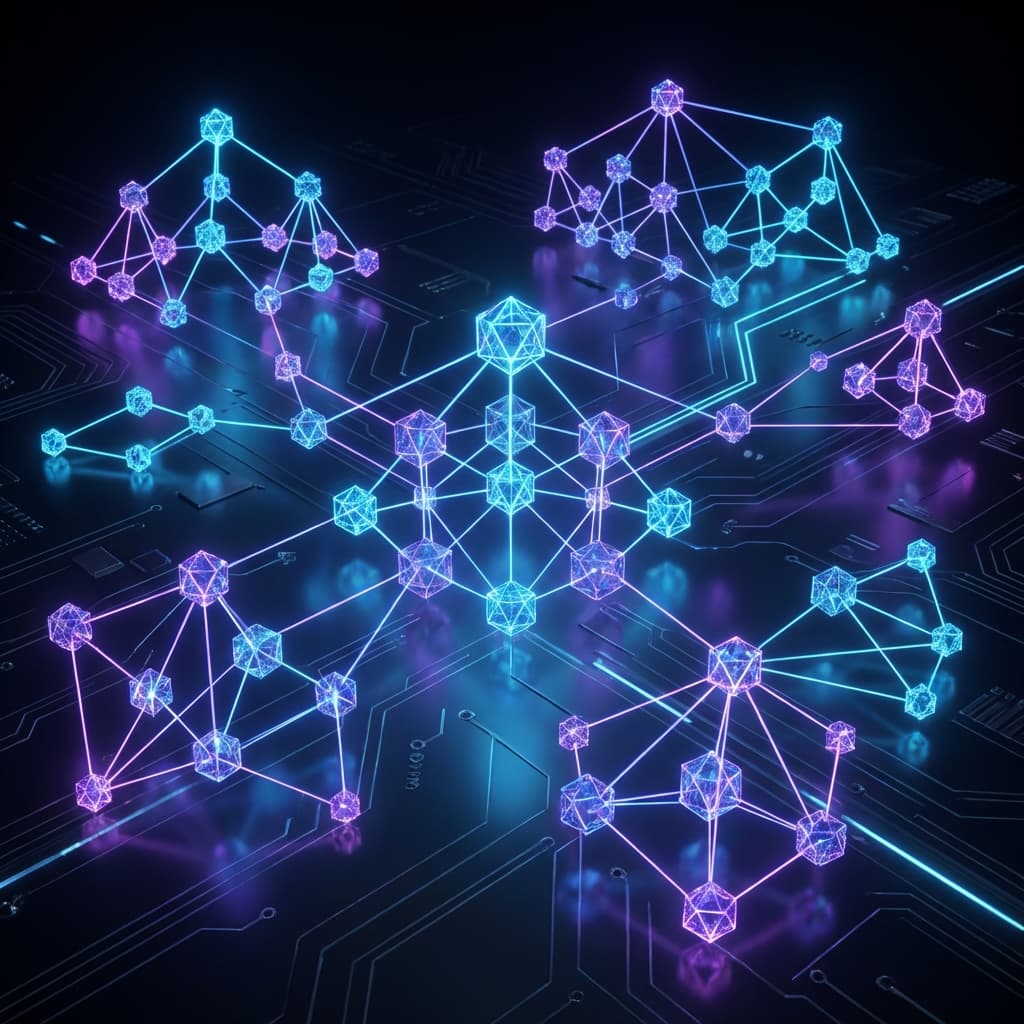
The Formal Definition of Graph RAG: Beyond Semantic Similarity
Define the core architecture of Graph RAG. Learn how it integrates structured knowledge graphs with large language models to provide precise, explainable, and contextually rich answers.
The Formal Definition of Graph RAG: Beyond Semantic Similarity
We have spent the first two modules understanding the problem (Vector RAG limits) and the material (Knowledge Graphs). Now, we arrive at the core of the course: What exactly is Graph RAG?
Graph Retrieval-Augmented Generation (Graph RAG) is not just "RAG with a database." It is a paradigm shift in how an AI agent accesses memory. In this lesson, we will build a formal technical definition of Graph RAG, explore its dual-engine nature, and understand how it solves the "Context Hole" that plagues traditional systems.
1. The 3-Layer Definition
At its simplest, Graph RAG is an AI architecture that uses a Knowledge Graph to organize information and a Large Language Model to interpret it.
Formally, we can define it in three layers:
- The Structural Layer: A curated network of entities and relationships (The Graph).
- The Retrieval Layer: A traversal engine that follows paths and expands neighborhoods of relevant nodes.
- The Generative Layer: An LLM that synthesizes the retrieved "Sub-graph" into a human-readable answer.
The Equation:
Graph RAG = (Knowledge Graph Traversal) + (Grounded LLM Prompting)
2. The "Two Engines" of Intelligence
A Graph RAG system is a hybrid of two fundamentally different types of AI:
Engine 1: The Symbolic Engine (The Graph)
This is Deterministic. It works like a computer program. If "Sudeep" is connected to "London" by a "LIVES_IN" edge, the symbolic engine knows this with 100% certainty. There is no "Likelihood" or "Probability" here. It is a fact.
Engine 2: The Neural Engine (The LLM)
This is Probabilistic. It is a pattern matcher. It understands how to turn a complex question like "Who is the leader of the UK office?" into a search for the node London and the edge LEADS.
The Syngery: The Neural engine "Translates" the user's intent into a Symbolic query. The Symbolic engine "Retrieves" the perfect facts. The Neural engine "Explains" them back to the user.
3. The Retrieval Flow: From Query to Sub-graph
How does it actually work in practice?
- Entity Linking: The system identifies the entities in the user's query (e.g., "Project Titan").
- Neighborhood Expansion: The system doesn't just look at "Project Titan." it looks at everything 2 hops away. It finds the "Team," the "Budget," and the "Issues."
- Sub-graph Construction: The system pulls this "Mini-web" of related facts out of the main database.
- Serialization: The system turns this web into a structured text format (like JSON or a list of sentences) and feeds it to the LLM.
graph TD
    User[Natural Language Query] -->|Parsing| Entities[Identify Entities]
    Entities -->|Lookup| KG[(Knowledge Graph)]
    KG -->|Traverse 2-Hops| Subgraph[Construct Result Subgraph]
    Subgraph -->|Serialize| Context[Prompt Context]
    Context -->|Generation| LLM[LLM Response]

    style KG fill:#4285F4,color:#fff
    style LLM fill:#34A853,color:#fff
4. Why it's "Explainable AI" (XAI)
One of the greatest fears about AI is the "Black Box." You ask a question, and it gives an answer, but you don't know why.
Graph RAG is natively explainable. Because the retrieval is based on a graph traversal, the system can literally show you the map it followed.
- Agent: "I believe Sudeep is in London because the
Sudeepnode is connected to theLondonnode by aVISITEDedge, which was extracted fromDocument_123."
This level of Traceability is required for healthcare, finance, and legal applications.
5. Summary and Exercises
Graph RAG is the marriage of Determinstic Structure and Probabilistic Interpretation.
- It replaces "Similarity Search" with "Relationship Navigation."
- It uses a 3-layer architecture: Structure, Retrieval, Generation.
- It provides a "Symbolic Grounding" that yields 100% explainability.
Exercises
- The "Mercury" Case: Revisit the "Mercury" example from Module 2. How would a Graph RAG system handle the query "Is Mercury hot?" versus "Did Mercury win a Grammy?" Describe the different nodes it would land on.
- Architecture Map: Draw a flowchart of the 4 steps of retrieval (Entity Linking -> Expansion -> Sub-graph -> Serialization). Which step do you think is the hardest for an AI to get right?
- Explainability Drill: If an agent tells you "The server is down due to a cable leak," what are the 3 pieces of "Graph Evidence" it must provide to prove its statement? (e.g.,
(Server) --[:DEPENDS_ON]--> (Cable), etc.)
In the next lesson, we will see exactly How Graph RAG Extends Classic RAG and how to combine them for the ultimate hybrid system.