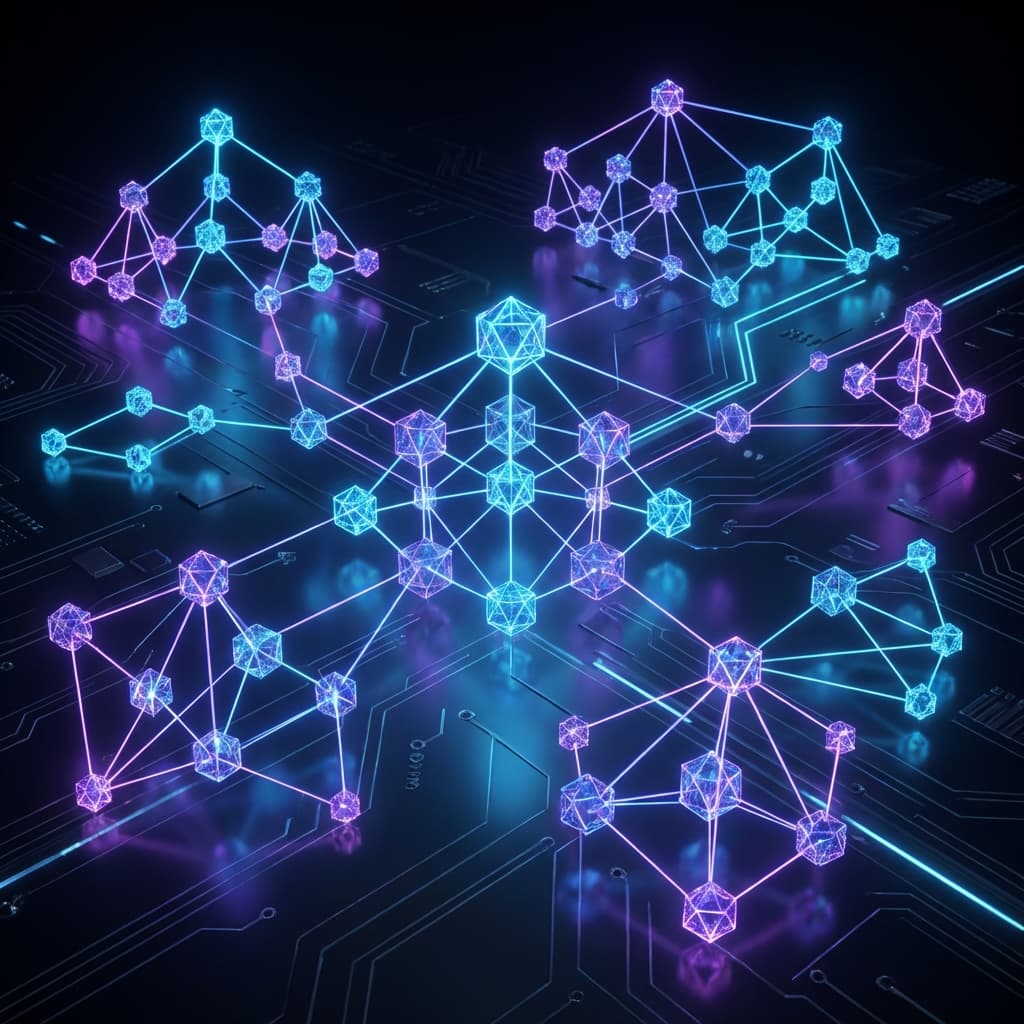
Graph Thinking for AI Systems: The Mental Leap
Shift your perspective from tabular to topological. Master 'Graph Thinking'—the essential mindset for designing agentic systems that understand complex systems, dependencies, and evolving data.
Graph Thinking for AI Systems: The Mental Leap
We have covered the data, the atoms, and the "Why." Now, we must cover the "How you think."
Building a Graph RAG system is not just a coding task; it is a Shift in Perspective. Most developers are trained in Tabular Thinking (Rows and Columns) or Hierarchical Thinking (Folders and Trees). But to build competitive AI agents, you must adopt Graph Thinking.
In this final lesson of Module 2, we will explore what it means to view the world through a graph lens. We will learn how to identify "Hidden Communities" in your data, how to model "Evolving Relationships," and why a Graph-First approach is the only way to build an agent that can handle Transitive Logic.
1. Tabular vs. Topological Thinking
The Tabular Mindset (The "List" View):
In a tabular mindset, you see an employee as a row in a database.
- Name: Sudeep
- Dept: Engineering
- Salary: X
The Topological Mindset (The "Connection" View):
In a graph mindset, "Sudeep" is a node at the center of a constellation of relationships.
- Relationship 1:
WORKED_WITH->Jane - Relationship 2:
CONTRIBUTED_TO->Project A - Relationship 3:
ATTENDED->Meeting B - Relationship 4:
VOTED_FOR->Policy C
The Difference: Tabular thinking asks "What properties does Sudeep have?". Graph thinking asks "What is Sudeep connected to, and how does that influence the system?"
2. Transitive Logic: The Graph's Secret Weapon
Transitive logic is the idea that if A -> B and B -> C, then A -> C (under certain conditions).
Traditional RAG has No Transitive Logic. It can retrieve A. It can retrieve B. But it doesn't "Know" that A is related to C.
Graph Thinking enables you to design systems that "Follow the Chain":
A(Server) depends onB(Power Supply).B(Power Supply) depends onC(Regional Grid).- Inference: If the Regional Grid fails, the Server fails.
When you design your Knowledge Graph, you aren't just storing facts; you are storing Rules of Inference.
Visualizing the Process
graph TD
    Start[Input] --> Process[Processing]
    Process --> Decision{Check}
    Decision -->|Success| End[Complete]
    Decision -->|Retry| Process
3. Modeling "Evolving" Truths
In a SQL database, updating a relationship often requires a complex migration or a "Soft Delete."
In a graph, relationships are "Cheap." You can add a new edge type ([:HAD_PREVIOUS_ROLE]) without touching any other part of your data. This allows your Graph RAG system to maintain a Temporal History.
Graph-First Design: Instead of just storing "Current State," store the "Movement" of the data. This allows an AI agent to answer: "How has our relationship with Supplier X changed over the last three years?"
4. Identifying "Hidden Communities" (Graph Topology)
One of the most powerful concepts in Graph Thinking is Community Detection.
Even if you don't define a relationship, a graph can reveal that a group of 50 documents are all "Related" because they all point to the same set of 5 entities.
- You didn't tell the AI they were a group.
- The Graph Topology told the AI they were a community.
This is how Graph RAG generates Executive Summaries. It doesn't just summarize 5 chunks; it summarizes a Community of Nodes.
5. Summary and Exercises
Graph Thinking is the move from "What is it?" to "How is it connected?".
| Shift | From (Traditional) | To (Graph RAG) |
|---|---|---|
| Logic | Keyword / Semantic overlap | Paths and Hops |
| Scale | Searching deeper in the pile | Walking wider in the web |
| Context | Single-hop snippet | Multi-hop subgraph |
| Truth | Statistical probability | Logical verification |
Exercises
- Topology Brainstorm: Think of your favorite TV show. Who is the "Central Node" (the person with the most connections)? Now, remove that node. What happens to the "Community"? This is how you identify "Single Points of Failure" in a knowledge graph.
- Transitivity Map: "A is friends with B. B is friends with C." Does this mean A is friends with C? Sometimes yes, sometimes no. How would you label the
FRIEND_OFedge to indicate "Strength" or "Trust"? - The "Web" View: Open your LinkedIn feed. Look at one post. Don't look at the text—look at the "Tags," the "Likes," and the "Mutual Connections." That is the Graph Metadata. How much of the post's value comes from that metadata versus the actual text?
Congratulations! You have completed Module 2: Foundations of Knowledge Representation. You are no longer thinking in lists; you are thinking in webs.
In Module 3: What Is Graph RAG?, we will finally put it all together and build the formal definition of the architecture that is taking over the AI world.