Meta-Graph Architectures: Graphs of Graphs
Coordinate multiple intelligences. Learn how to architect a 'Meta-Graph' that manages specialized sub-graphs (Legal, Finance, Tech) and routes queries to the correct domain of knowledge.
Meta-Graph Architectures: Graphs of Graphs
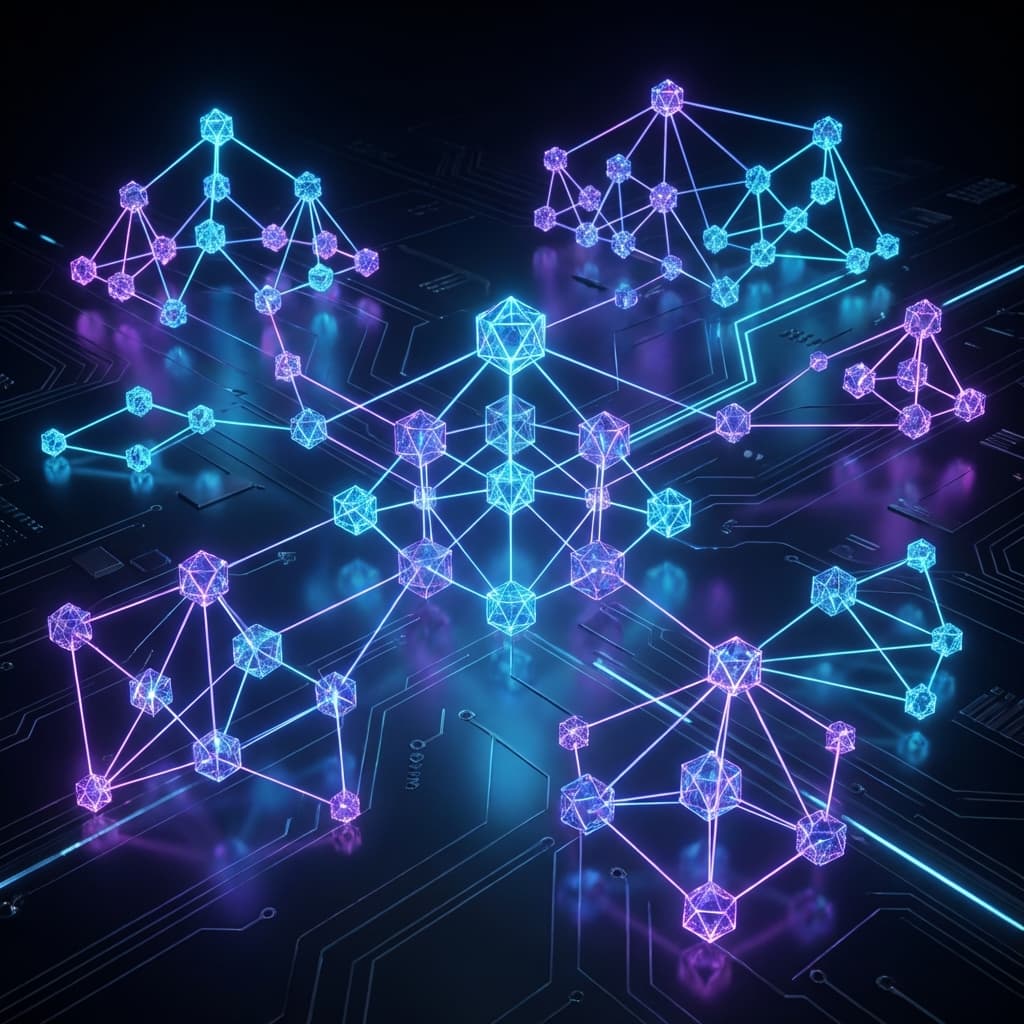
As your enterprise knowledge base grows, a single "Everything Graph" can become messy and unperformant. A doctor shouldn't have to search through "Architecture Schematics" to find a "Patient History." Professional Graph RAG systems use Meta-Graph Architectures. These are systems of Specialized Sub-graphs coordinated by a "Supreme Controller."
In this lesson, we will look at Graph Federations. We will learn how to build a Meta-Index that decides which sub-graph (Legal, Finance, Eng) contains the relevant answer. We will see how to implement Cross-Graph Links (e.g., linking a "Payment" node in Finance to a "Contract" node in Legal) and how to manage the reasoning complexity of a multi-graph search.
1. The Strategy of Specialization
Instead of one giant database, you have:
- Graph A: Domain = Healthcare. (Entities = Disease, Drug, Patient).
- Graph B: Domain = Operations. (Entities = Hospital, Staff, Inventory).
The Meta-Router: When a user asks "Which hospital has the drug for Disease X?", the AI agent identifies that it needs Both Graphs. It retrieves the drug from A and the inventory from B.
2. Cross-Graph "Bridge" Nodes
A bridge node exists in two graphs and acts as the "Glue."
- Example: The node
(Company_ACME)exists in both the Financial Graph and the Supply Chain Graph.
During a "Meta-Query," the system "Handoffs" the reasoning from one database to another using the Company_ACME ID. This allows for infinite scalability, as you can add new specialized domains without rebuilding your existing knowledge base.
3. The "Meta-Schema"
The Meta-Graph doesn't store "Facts." It stores Descriptions of Graphs.
(Legal_Graph {description: "Contracts, Law, Litigation", url: "..."})(Finance_Graph {description: "Payments, Budgets, Stocks", url: "..."})
The AI "Consults" the Meta-Schema first to find out "Who should I ask?".
graph TD
    User --> R[Meta-Router Agent]
    R -->|Consult| MS[(Meta-Schema)]
    MS -->|Target: Legal| G1[(Legal Graph)]
    MS -->|Target: Tech| G2[(Tech Graph)]
    G1 & G2 -->|Sub-Results| R
    R -->|Final Synth| Ans[Intelligent Answer]

    style MS fill:#f44336,color:#fff
    style G1 fill:#4285F4,color:#fff
    style G2 fill:#34A853,color:#fff
4. Implementation: A Basic Meta-Router (Pseudo-code)
def meta_retrieve(query):
    # 1. Ask the 'Manager Agent' which graph to use
    targets = manager_agent.classify_query(query)
    # Returns ['Legal', 'Finance']

    all_context = []

    # 2. Query each targeted graph separately
    for t in targets:
        graph = get_graph_for_domain(t)
        all_context += graph.retrieve(query)

    return summarize_cross_domain(all_context, query)
5. Summary and Exercises
Meta-graphs are the architecture of Large-Scale Intelligence.
- Domain Specialization keeps individual graphs clean and fast.
- Bridge Nodes allow for logical connectivity across different databases.
- Meta-Routing prevents "Irrelevant searches" in unrelated domains.
- Federation: You can scale your system by adding specialized "Brains" as nodes in the meta-graph.
Exercises
- Federation Design: You are building a system for a "University." List 4 specialized sub-graphs you would create. (e.g., Admissions, Research, Alumni, Maintenance).
- The "Bridge" Task: Name a node that would act as a bridge between the "Admissions" graph and the "Financial Aid" graph. (Hint: The 'Student' node!).
- Visualization: Draw a large circle (Meta-Router). Surround it with 3 small circles (Sub-graphs). Draw lines connecting them to the center.
In the next lesson, we will look at hybrid storage: Semi-Structured Retrieval: Blending SQL and Graph.