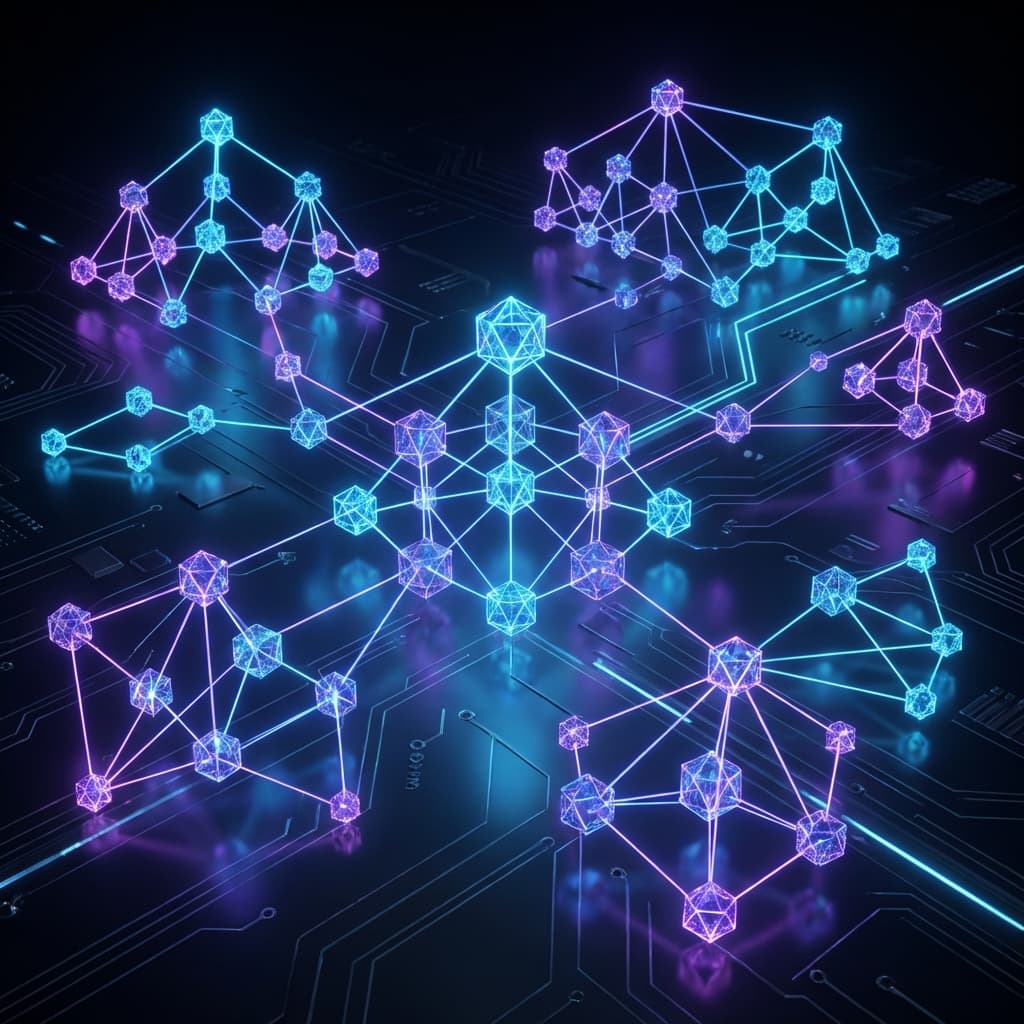
Community Detection: Contextual Clustering
Find the hidden tribes in your data. Learn how to use the Leiden and Louvain algorithms to group your Knowledge Graph into semantic communities for automated hierarchical summarization.
Community Detection: Contextual Clustering
In our raw data, everything is a mess of connections. But inside that mess, there are Islands of Meaning. A group of people who only talk about "Legal Compliance." A set of servers that only handle "Billing Traffic." Finding these groups manually is impossible. Finding them mathematically is the science of Community Detection.
In this lesson, we will explore why we "Cluster" our graph. We will learn how algorithms like Louvain and Leiden find the "Natural Boundaries" between different departments or topics. We will see how these clusters allow us to build a Hierarchical Graph RAG system that can summarize entire domains without reading every single node.
1. What is a "Community" in Graph Theory?
A community is a group of nodes where the density of internal edges is much higher than the density of external edges.
- Example: In a university graph, "Biology Majors" form a community because they all take the same 10 classes together, and only rarely attend "History" classes.
RAG Benefit: By identifying the "Biology" community, we create a Context Boundary. If a user asks about "Cell membranes," the agent can focus its search inside that specific community cluster, ignoring the noise of the rest of the university.
2. The Louvain vs. Leiden Debate
Louvain Algorithm:
The classic choice. It is fast and efficient at finding hierarchical structures. It works by "Moving" nodes into communities that increase the overall "Modularity" (the measure of cluster strength).
Leiden Algorithm:
The modern choice. It fixes a mathematical flaw in Louvain where the community structure could become "Fragmented" or disconnected. Leiden is considered the Gold Standard for modern Graph RAG (including Microsoft's GraphRAG).
3. The "Community Node" Pattern
Once the algorithm finishes, every node gets a community_id property.
(Sudeep {community: 42})(ProjectX {community: 42})
The "Meta-Node" Strategy: For every community ID, we create a new Meta-Node in the graph. We link all the member nodes to this Meta-Node. Now, to "Summarize the Community," the AI only has to look at one node—the cluster leader.
graph TD
    subgraph "Community 42: Finance"
    F1[Fact 1] --- F2[Fact 2]
    F2 --- F3[Fact 3]
    end

    subgraph "Community 99: Engineering"
    E1[Fact A] --- E2[Fact B]
    E2 --- E3[Fact C]
    end

    F2 -- weak link -- E1

    C1((Meta-Node: Finance)) --- F1
    C2((Meta-Node: Eng)) --- E1

    style C1 fill:#34A853,color:#fff
    style C2 fill:#4285F4,color:#fff
4. Implementation: Finding Tribes with Louvain in Cypher
// 1. Project the Graph
CALL gds.graph.project('socialGraph', 'Person', 'KNOWS')

// 2. Run Louvain Community Detection
CALL gds.louvain.write('socialGraph', {
  writeProperty: 'community'
})

// 3. Query the 'Tribe'
MATCH (p:Person)
WHERE p.community = 42
RETURN p.name;
// This returns everyone in the 'Finance' tribe.
5. Summary and Exercises
Communities are the "Folder Structure" of your Knowledge Graph.
- Density of edges is the metric for grouping.
- Leiden/Louvain find these groups automatically.
- Modularity measures how "Good" your clustering is.
- Meta-Nodes provide a high-level summary point for RAG agents.
Exercises
- Clustering Scenario: You have a graph of "Programming Languages." What communities would you expect to see? (e.g., The "Web Tribe", The "Systems Tribe", The "Data Science Tribe").
- The "Bridge" Problem: If a person belongs to two different communities (e.g., they are a Doctor who is also a Pilot), how would a standard community algorithm handle them? (Hint: They usually force them into one, but "Overlapping" algorithms exist!).
- Visualization: Draw a 10-node graph with 2 distinct communities and 1 "Bridge" link between them.
In the next lesson, we will look at how to find what's missing: Link Prediction: Guessing the Missing Facts.