What the Average User Should Expect From Future Privacy Rules
We reveal the 'Blueprint of the Future.' Discover how upcoming global regulations will shift the burden of protection from the individual to the system, and why the next decade will be the era of 'Automated Sovereignty.'
The Blueprint of the Future: Navigating the Era of Automated Sovereignty
For the last three decades, we have been living in the "Wild West" of the digital age.
It has been an era of "Move Fast and Break Things," where the burden of privacy was placed squarely on the shoulders of the individual user. We were expected to read 50-page legal documents, navigate complex "Cookie Settings," and somehow keep track of our data as it flowed through a global maze of servers. In this world, the user was a lone settler trying to defend their home with a single, manual lock against an army of automated, global extraction machines.
But the winds are changing. We are entering the "Era of the Rule of Law" for the digital world.
The next decade will see a profound shift in how we think about privacy. It will move from being a "User Responsibility" to a "Systemic Requirement." We are moving toward a future where privacy is not something you have to "do," but something that is "done for you" by the very architecture of the world you live in.
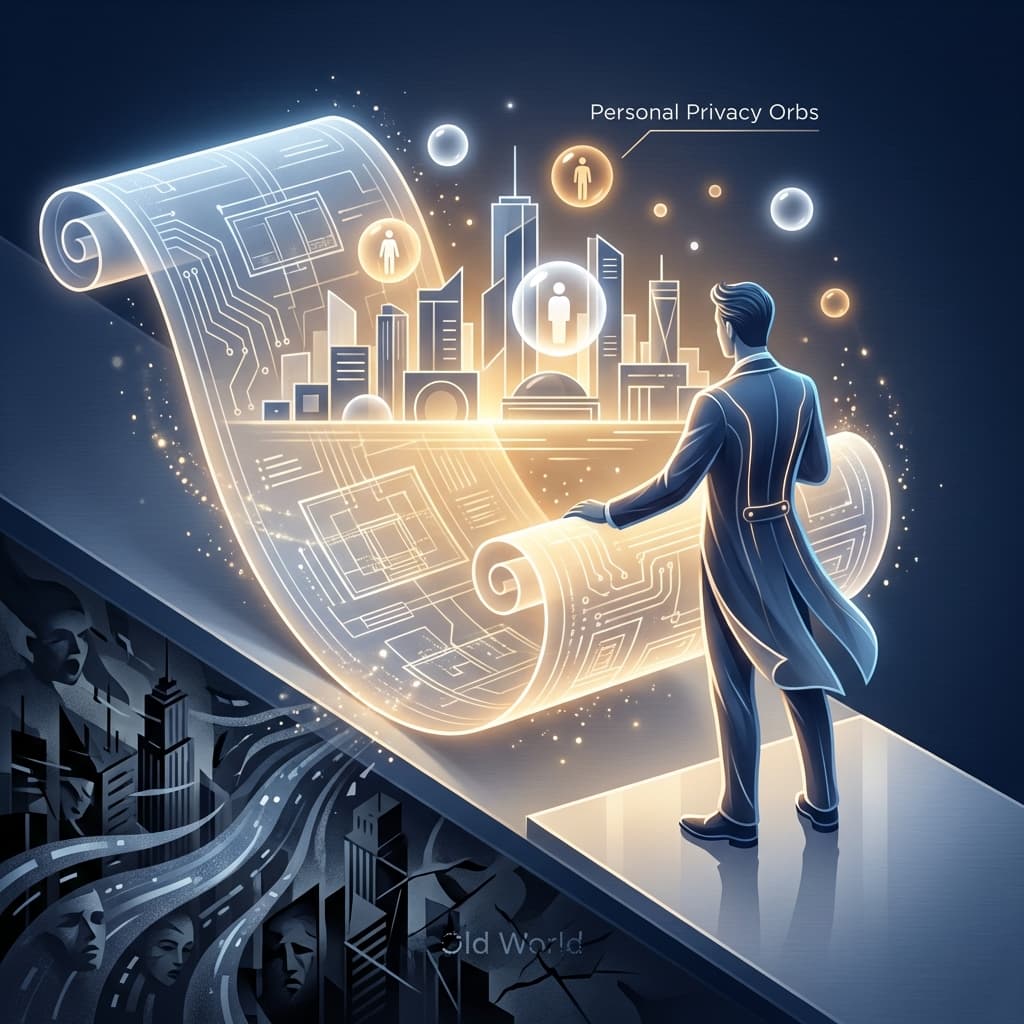
As a visionary narrative storyteller, I want to unroll the "Blueprint of the Future." We are going to explore the three major shifts in upcoming privacy rules, the concept of the "Personal Privacy Orb," and how you can prepare for a more sovereign digital existence.
The Three Shifts of Future Regulation
What will the next generation of privacy laws (like the EU AI Act and the second-wave state laws in the US) actually look like for you?
1. From "Consent" to "Fiduciary Duty"
The "Accept" button is dying. Future rules will stop asking for your "Consent" for every tiny data point because they recognize that "Informed Consent" is impossible in the face of complex AI.
Instead, regulations will move toward a "Digital Fiduciary" model. This means that companies that handle your data will have a legal obligation to act in your best interest—much like a doctor or a lawyer. They won't just be allowed to do whatever the "Terms of Service" say; they will be prohibited from using your data in ways that are demonstrably harmful or manipulative to you. The burden shifts from you to monitor them, to them to protect you.
2. The Mandate of "Interoperable Portability"
Currently, your data is "Locked" inside the silos of Big Tech. If you want to move from one social network to another, or from one healthcare provider to another, your "Digital History" is often lost.
Future rules will mandate Total Interoperability. You will own your "Portable Data Profile"—a digital suitcase that contains your history, your preferences, and your connections. You will be able to plug this suitcase into any service you choose, and just as easily unplug it and move on. This creates a "Fluid Market of the Self," where companies must compete for your trust rather than holding your data hostage.
3. The "Zero-Knowledge" Standard
We are seeing the rise of laws that favor "Privacy-Preserving Computation." Instead of regulating how companies use your data, these rules will encourage companies to use technologies that allow them to get the "Insights" they need without ever seeing the "Raw Data."
Technologies like "Federated Learning" and "Differential Privacy" will become the legal standard. In this future, the "Average User" won't notice anything different, but behind the scenes, the machine will be processing "Mathematical Masks" instead of "Personal Secrets." The "Old World" of data leaks will become a historical curiosity.
The "Personal Privacy Orb": Automated Sovereignty
The most visionary part of the blueprint is the move toward "Automated Privacy."
In the "Old World," your privacy was like a manual shield you had to carry. In the "Future World," your privacy will be like an Orb of Light that surrounds you automatically.
Imagine an "AI Privacy Agent" that lives on your device. This agent knows your preferences better than any company. When you enter a "New Digital Space" (a website, a smart store, a virtual world), your Agent negotiates the privacy terms in milliseconds on your behalf.
- "My user allows location tracking only for navigation, never for ads."
- "My user's health data is strictly zero-knowledge."
- "This service is known for data breaches; provide a one-time-use virtual identity."
You don't have to click anything. You don't have to read anything. Your Sovereignty is Automated. The rules of the future are not meant for you to read; they are meant for your Agent to enforce.
Preparing for the Transition: The Human Role
While the systems will become more automated, the Vision must still come from us. We are the ones who define the values that our "Privacy Agents" will enforce.
To prepare for the future, we must:
- Support the "Producers of Trust." Don't just look for the "Cheapest" service; look for the "Most Sovereign" one. Use and pay for the services that are already implementing these future-facing protocols.
- Understand the "High Ground." Recognize that your data is a valuable asset. Don't be "Average"; be "Exceptional" by being the one who demands the blueprint now.
- Educate the Next Generation. We are the "Transition Generation." We remember the Wild West, and we are building the Future. We must teach those who come after us that privacy is a "Universal Right," not a "Technical Option."
Conclusion: The Horizon of Serenity
The digital world has been a place of chaos for long enough. We are finally building the "Architecture of Peace."
The "Big Picture" is that we are moving toward a world where you can enjoy the magic of AI, the connectivity of the global web, and the convenience of a tailored life, all without the "Nagging Fear" of betrayal.
Let us embrace the new blueprint. Let us look forward to a world of "Automated Sovereignty," where our "Privacy Orbs" are strong, our "Data Suitcases" are full, and our identities are finally, truly, our own.
The blueprint is unrolled. The lines are glowing. The future is waiting. Let’s lead the way to a more serene digital existence.
Key Takeaways for the Visionary Individual:
- The "Agent" Mindset: Start thinking of your browser or your phone not as a "Window to the Web," but as your "Privacy Agent." Use tools that already offer some level of "Negotiation" (like Apple's "Ask App Not to Track" or Brave's "Shields").
- The "Portability" Practice: This week, see if you can "Download Your Data" from one major platform (like Google or Facebook). See what’s in there. This is your "Digital Suitcase." Get used to the idea that this belongs to you, not the platform.
- The "Fiduciary" Filter: When you read a news story about a data breach, ask: "Did this company fulfill its 'Fiduciary Duty' to its users?" Start judging companies based on this new standard of care.
- The "Early Adopter" Role: Support the pioneers of "Zero-Knowledge" tech. Use services that advertise "On-Device Learning" or "Privacy-Preserving Analytics." You are the "Market Signal" that tells the law-makers what the future should look like.
At ShShell.com, we break down the complex blueprints of the high-tech future to help you lead with clarity and poise. Information is the soil. Sovereignty is the harvest. Let’s lead the way together.