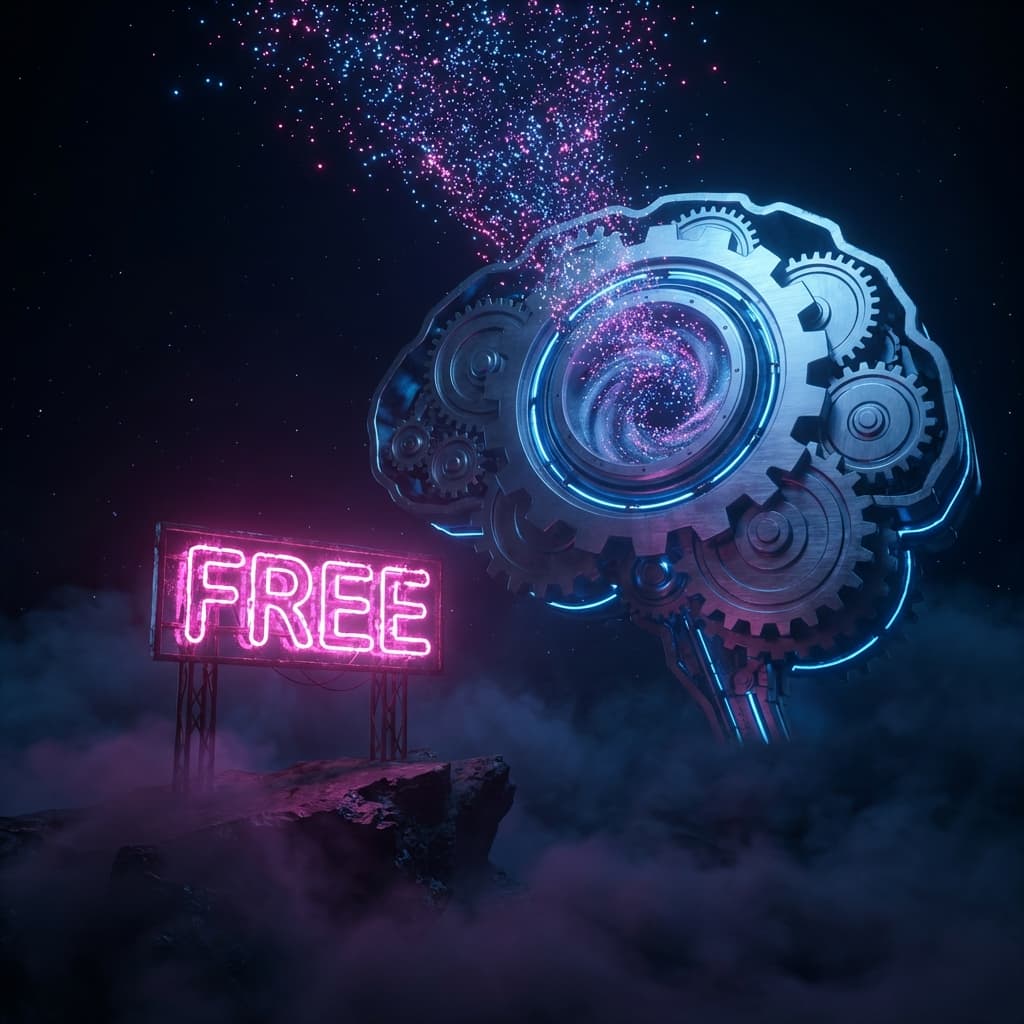
The Hidden Cost of Free AI Tools: Your Personal Data
In an era where every powerful AI tool seems to be 'free,' we explore the silent transaction taking place behind the screen. Does the convenience of zero-cost AI come at the price of our digital sovereignty?
The Price of "Free": Navigating the New Digital Frontier
We live in an age of miracles. With a few keystrokes, we can generate stunning art, write complex code, or have deep philosophical conversations with a machine that seems to understand us perfectly. And for many of us, the most miraculous part of this experience is the price tag: $0.00.
From the viral chatbots that everyone is using to the image generators that take social media by storm, the current wave of Artificial Intelligence feels like a gift. But in the world of high technology, there is an old adage that has never been more relevant than it is today: "If you aren't paying for the product, you are the product."
When we use "free" AI tools, we aren't just consumers; we are the silent partners in a massive, invisible transaction. We are trading the most valuable resource of the 21st century—our personal data—for a few moments of convenience or wonder.
The Mirage of Zero Cost
The illusion of "free" is one of the most powerful tools in the tech industry’s arsenal. It lowers the barrier to entry, encourages mass adoption, and allows a technology to scale at a speed that was once impossible. But to a visionary thinker, the word "free" should be a signal to look deeper.
Building and running a modern AI model is incredibly expensive. It requires thousands of high-end GPUs, massive amounts of electricity, and teams of the world’s most specialized engineers. These costs aren't being swallowed as an act of charity by Big Tech. They are being financed by the data you provide every time you interact with the tool.
Every query you type, every photo you upload, and every feedback click you provide is recycled. It is used to train the next generation of models, to build more detailed emotional profiles of users, and to create predictive engines that can anticipate human behavior with uncanny accuracy. The "free" tool is essentially a massive data-collection sensor, disguised as a helpful assistant.
The Content of Your Conversations: Why It’s More Than Just Text
When you use a free chatbot, you might think you’re just asking a question about a dinner recipe or a work email. But to the AI, you are revealing the internal landscape of your thoughts.
Unlike a search engine, which tracks what you are looking for, an AI assistant tracks how you think. It captures your tone, your vocabulary, your specific anxieties, and your unique problem-solving style. This data is far more intimate than a credit card number. It is a map of your consciousness.
When this data is aggregated across millions of users, it becomes the most powerful psychological tool ever created. It allows companies to understand the collective mood of a nation, the specific vulnerabilities of a demographic, and the "trigger points" that can be used to influence everything from purchasing decisions to political opinions. The "cost" of the free tool isn't just your data; it’s the potential for your very preferences to be engineered by the entities that own the models.
The Training Ground: Your Life as Raw Material
In the world of AI, data is the new oil. But unlike oil, which must be extracted from the earth through expensive machinery, digital data is provided voluntarily by us. Each time we use a free AI tool to "enhance" a photo or "rephrase" a paragraph, we are acting as unpaid laborers in the world’s largest research lab.
Your "free" interaction helps the machine learn how to be more human. It learns the nuances of sarcasm, the subtle shifts in emotional tone, and the way humans handle complex ethical dilemmas. While this lead to better technology for everyone, it also means that your unique creative spark—the way you specifically phrase a thought or compose a photo—is being absorbed into a collective "average" that the company then sells back to the world as a subscription service.
This is the creative trade-off of the AI era. We are using tools to save time today, but we may be giving away the very things that make our future work unique and valuable.
The Long-Term Impact: The Erosion of the "Private Self"
Perhaps the most significant "hidden cost" is the slow, almost unnoticeable erosion of the private self. When we know that everything we say or do in a digital space is being recorded and analyzed to "improve the experience," we begin to change. We start to perform. We become more conscious of how we are being perceived by the algorithm.
A visionary future for humanity requires a space where we can be messy, inconsistent, and private. We need a "Digital Backyard" where we can play with ideas without them being permanently logged into our "User Profile." The dominance of free AI tools threatens to turn our entire digital existence into a "Front Porch"—a place where we are always being observed and where our data is always being harvested for someone else’s benefit.
Moving Toward a "Value-First" Model
So, if "free" is a mirage, what is the path forward for the tech-conscious leader? The answer lies in the transition to a Value-First Model.
We are seeing the rise of AI platforms that charge a fair price for their service in exchange for a Privacy Guarantee. In this model, you are no longer the product; you are the customer. The company’s incentive is to serve your interests, not to harvest your patterns.
Paying for AI is, in many ways, an act of Digital Self-Defense. It creates a clear boundary: "I am paying you to be my tool, not to be my biographer."
1. The Power of the Paid Version
Many major AI providers offer "Team" or "Privacy-First" tiers. For a business leader, the cost of these subscriptions is negligible compared to the value of ensuring that company secrets and employee patterns aren't being used to train a public model.
2. Local AI: The Future of Sovereignty
One of the most exciting visionary trends is the development of "Local AI"—models that run entirely on your own hardware. In this world, the AI is like a book in your library. It is "smart," but it has no "tether" to a central server. Your data stays in your room, on your machine, under your control. This is the ultimate "Privacy-First" solution.
3. Intentional Usage
If you must use a free tool, do so with a "Public-First" Mindset. Assume that anything you enter into a free AI tool will eventually be public. Use it for general tasks, for creative brainstorming on non-sensitive topics, and for learning. But keep the "Intimate Self" offline.
Conclusion: Reclaiming the Value of "You"
The "Hidden Cost of Free" is only a problem if we don't know we’re paying it. By pulling back the curtain on the data-for-service transaction, we can make better choices about which tools we invite into our lives and our businesses.
AI has the potential to be the most empowering technology in human history. But true empowerment requires ownership. As we build our digital futures, let us be willing to pay the price for our tools so that we don't have to pay with our sovereignty.
We are not just "Users." We are the architects of the next age. And a visionary architect knows that the cheapest materials often lead to the most expensive repairs. Let’s invest in ourselves, in our privacy, and in an AI future that respects the true value of the human being.
Key Takeaways for the Action-Oriented User:
- The "Product" Test: The next time an AI tool is offered for free, ask yourself: "How is this being paid for?" If the answer isn't clear, assume it’s your data.
- The Private Playground: Reserve your most sensitive work and your most intimate thoughts for local tools or paid platforms with clear privacy-protection clauses.
- Read the "Meaning," Not Just the "Legalese": Don't get lost in 50-page privacy policies. Look for one simple sentence: "We do not use your data to train our models." If it’s not there, they probably do.
- Support the Alternatives: Be willing to pay for software. Supporting a "User-First" business model is the only way to ensure those models survive.
Note: This article is part of our series on Digital Sovereignty. At ShShell.com, we help you understand the invisible forces shaping our tech so you can lead with confidence.