When Convenience Becomes Surveillance
We explore the thin, shimmering line between helpful technology and pervasive monitoring. Discover how our desire for a frictionless life is creating a 'Soft Panopticon,' and how to reclaim your space in the age of omnipresent sensing.
The Gilded Watch: Navigating the Era of Pervasive Sensing
In the great theater of human history, surveillance has almost always been synonymous with Coercion.
It was the secret police in the shadows, the barbed wire at the border, and the heavy, unblinking eyes of the state. It was something imposed upon us from above, a tool of control that we instinctively resisted. We recognized it by its coldness, its friction, and its threat.
But in the early 21st century, we have triggered a profound mutation in the nature of monitoring. We have moved from the era of "Hard Surveillance" to the era of "Soft Surveillance."
Today, the devices that watch us are not cold or threatening; they are luxuriously comfortable. They are the "Smart Speakers" that play our favorite music, the "Fitness Trackers" that count our steps, and the "AI Assistants" that organize our lives. We don't resist these eyes; we invite them into our bedrooms, our kitchens, and our most private thoughts. We pay for the privilege of being watched because that watchfulness provides us with incredible Convenience.
As a visionary narrative storyteller, I want to explore the "Big Picture" of this transition. We are going to look at how convenience has become the Trojan Horse of the surveillance age, the hidden psychological cost of living in a "Soft Panopticon," and how we can build a future that is high-tech without being high-exposure.
The Frictionless Trap: Why We Say "Yes" to the Eyes
The fundamental currency of the modern world is not money; it is Attention and Effort.
Life is complex. We are constantly overwhelmed by choices, chores, and the "Small Frictions" of existence. To find a light switch, to type a text, to remember a shopping list—these are all tiny taxations on our mental energy.
"Convenience Technology" promises to eliminate these taxes. It offers a "Frictionless Life" where the environment responds to our intent before we even speak.
- The door unlocks because it "Recognizes" your gait.
- The thermostat adjusts because it "Senses" your body temperature.
- The music starts because it "Knows" your mood.
But there is a visionary "Immutable Truth" at the heart of this: Optimization requires Observation. For a system to be perfectly convenient for you, it must perfectly understand you. And to perfectly understand you, it must monitor you continuously.
When we choose convenience, we are making a "Micro-Trade." We trade a data point (our location, our voice, our heartbeat) for a second of saved time. Individually, these trades feel insignificant. But collectively, they create a world where every square inch of our private space is converted into a stream of sensory data.
The "Soft Panopticon": The Psychological Weight of Sensing
In the 18th century, philosopher Jeremy Bentham designed the "Panopticon"—a prison where a single guard could watch every prisoner, but the prisoners never knew exactly when they were being watched. This created a sense of "Omnipresent Observation" that forced the prisoners to regulate their own behavior at all times.
We are now building a Social Panopticon.
1. The Death of the "Unobserved Moment"
Human creativity and psychological health require moments of total privacy—times when we are completely unobserved, free to be weird, messy, and inconsistent without judgment. This is the "Backstage" of our lives.
But when our homes are filled with smart sensors, there is no backstage. Even if no human is watching the data, the Machine is Watching. We are beginning to feel a subtle, subconscious pressure to "Perform" for the sensors. We become more self-conscious in our own homes. We lose the ability to truly "let go," because deep down, we know that every movement is being converted into a data point in a permanent record.
2. The Predictive Cage
Surveillance for convenience is not just about recording the past; it is about Simulating the Future.
If the system senses that you are stressed (via your heart rate and your voice tone), it might suggest a specific product or a specific news story to "help." This feels helpful in the moment, but it is actually a form of Choice Architecture. You are being guided toward an outcome that the machine has decided is best for you.
Living in a perfectly convenient world means living in a world where your choices are increasingly pre-digested. You lose the "Muscle" of decision-making. You become a "Subject of the Suggestions" rather than a "Director of the Intent."
3. The Erosion of the Social Fabric
As surveillance becomes the price of convenience, we begin to treat Trust as a Technical Protocol rather than a human relationship.
We don't trust our neighbors to watch our homes; we trust a 24/7 cloud-connected camera. We don't trust our own bodies to tell us when we’re tired; we trust a sleep-tracking algorithm. This moves the center of our "Authority" from our internal wisdom to an external machine. We become "Data-Dependent," unable to navigate the world without the constant input of our sensory infrastructure.
Reclaiming the "Hard Edge": Toward Sovereign Convenience
So, if we want the convenience but we fear the surveillance, how do we move forward? The answer is to move from "Passive Exposure" to "Sovereign Sensing."
1. The "Local-First" Mandate
We must demand that the "Intelligence" of our devices happens At the Edge.
If a smart speaker needs to hear me, the processing should happen on a chip inside the speaker, not on a server in another country. The "Convenience" (turning on the light) happens, but the "Surveillance" (sending my voice to the cloud) never occurs. This is "Privacy-by-Architecture." We should only buy devices that have a "Hard-Wired" promise of local data sovereignty.
2. The "Analog Override" as a Right
In a visionary high-tech future, everything that is "Smart" must also have a "Dumb" mode.
You should be able to walk through your house without a single sensor being active if you choose. We must resist the trend of "Forced Connectivity," where a product refuses to work unless it is "Streaming its Observations." True convenience includes the convenience of being Invisible.
3. The "Glass Sensor" Transparency
Every device that senses the world should have a physical "Privacy Signal."
Imagine a smart camera with a physical shutter that clicks shut, or a smart microphone with a glowing red light that is hardware-cut from the power supply. We need visual, physical proof of our privacy. We must move past "Software Toggles" (which can be hacked or bypassed) to "Physical Realities."
The Human Duty: Choosing the "Healthy Friction"
To lead a sovereign life, we must occasionally embrace Friction.
- Get up and flip the switch.
- Write your list on a piece of paper.
- Take off the watch for the weekend.
These acts of "Analog Friction" remind us that we are the masters of our environment, not the other way around. They preserve the "Inner Sanctuary" that surveillance is trying to map.
Conclusion: The Comfort of the Unknown
Convenience is a beautiful tool, but it is a terrible master.
The "Big Picture" of the digital age is that we are the ones who define the boundaries. We are the ones who decide where the "Magic" stops and the "Surveillance" begins.
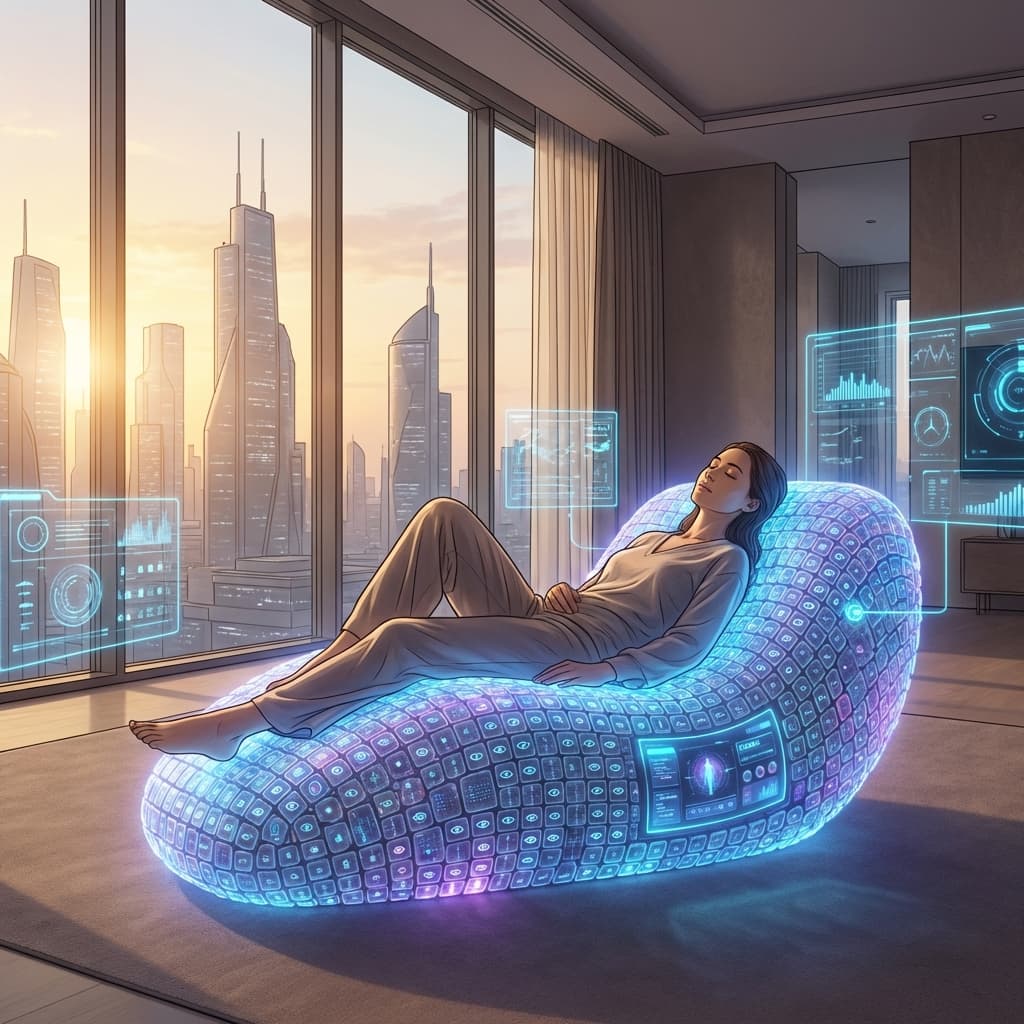
Let us build homes that are smart, efficient, and responsive. But let us also make sure they are Private. Let’s ensure that our "Smart Chairs" are places of rest, not places of analysis. And let’s remember that the most "Convenient" thing of all is the freedom to be ourselves, unobserved and un-modeled, in the sanctuary of our own hearts.
The watch is beautiful. The chair is soft. But you are the one who decides who is allowed to see you in the light.
Key Takeaways for the Visionary Individual:
- The "Cloud Leak" Audit: This week, look at every "Smart" device in your home. Ask: "Which of these is sending my data to the internet right now?" For the ones that are, ask: "Is the convenience really worth the open door?"
- The "Mute" Habit: Use the physical mute buttons on your smart speakers. Don't trust the software. Make it a habit to "Turn off the Ears" when you aren't using them.
- Support the "Edge" Pioneers: Seek out and pay for products that advertise "On-Device Processing." These are the companies building the future of sovereign convenience.
- The "Analog Sanctuary": Designate one room in your house—preferably the bedroom—as a "Sensor-Free Zone." No smart speakers, no cameras, no trackers. This is your "Backstage." Protect it with your life.
At ShShell.com, we help you master the "Big Picture" of the sensory age. Information is the tool, but sovereignty is the power. Let’s lead the way to a more human future.