The AI Supercycle: Why 90% of Funding is Now Flowing to the 'Big Three'
An in-depth analysis of the 2026 VC landscape, the trillion-dollar infrastructure boom, and the shift from stateless LLMs to hyper-personalized stateful agents.
The early months of 2026 have delivered a shock to the system of global venture capital. For years, the narrative of the "Generative AI boom" was one of democratic disruption—thousands of startups blooming in every niche from legal tech to code auto-completion. But as we cross the first quarter of 2026, that narrative has been replaced by a startling, almost gravity-defying consolidation.
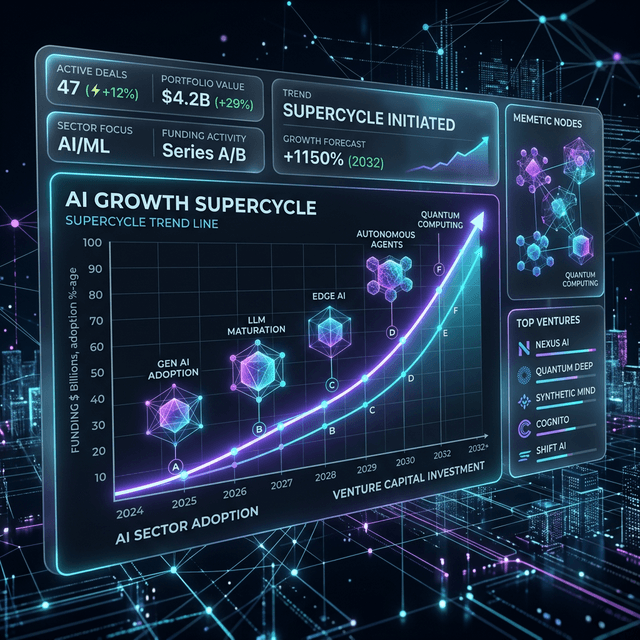
In February 2026 alone, an unprecedented 90% of all global venture capital directed toward the AI sector flowed into just three entities: OpenAI, Anthropic, and Waymo.
This isn't just a trend; it is the "AI Supercycle" reaching its apex. It is a structural reconfiguration of the global economy, where the costs of the frontier have become so high that the "long tail" of startups is being starved of oxygen, while the giants are being fueled with the equivalent of national GDPs. But beneath the raw financial numbers lies a technical revolution that explains why this money is moving: the transition from stateless, ephemeral chatbots to "Stateful Agents" with perfect, persistent memory.
The Concentration Paradox: $170 Billion for the Few
To understand the scale of what we are witnessing, we must look at the raw data. In February, while the total venture funding for all non-AI sectors remained stagnant, AI startups captured $170 billion out of a total $189 billion deployed. However, the distribution of that $170 billion was lopsided to a degree never before seen in financial history.
The $110 billion "Series G" round for OpenAI (which we reported earlier this week) was the cornerstone. When combined with Anthropic’s $40 billion "Stability Round" and Waymo’s $20 billion "Physicality Influx," the remaining thousands of startups were left to fight over the remaining 10% of the pie.
Why is this happening?
For the first time in the history of Silicon Valley, the "Picks and Shovels" phase has outgrown the venture capital model itself. The infrastructure required to train a 100-trillion parameter model—the standard for 2026—requires more than just clever engineers and a few GPU clusters. It requires dedicated nuclear power agreements, custom-designed sub-sea cooling systems, and proprietary silicon that costs $10 billion just for the first tape-out.
Investors are no longer betting on "who can build the best wrapper." They are betting on "who can afford the electricity to remain in the game." This has created a "frontier gap" so wide that it has become unbridgeable for new entrants. Unless you have $50 billion in liquid capital, you are not building a foundation model in 2026. You are, at best, building a satellite in the orbit of a Supra-State Corporation.
The Infrastructure Eruption: $650 Billion in 'Real' Assets
While the VC numbers are staggering, they are dwarfed by the capital expenditure (CapEx) of the "Big Three" and their hyperscale partners. Microsoft, Alphabet, Meta, and Amazon are projected to spend a combined $650 billion on AI-related infrastructure in 2026—a 58% increase over the record-breaking spending of 2025.
We are seeing a move away from "speculative software" and toward "asset-backed AI." Financial institutions are now treating H1000 and B2000 GPU racks as high-quality collateral, similar to real estate or gold. In 2026, the value of a company like OpenAI is no longer just its weights or its user base; it is the physical ownership of the most concentrated computing power on Earth.
This "Infrastructure Eruption" has led to the birth of the "GPU Bond." Hedge funds are now financing the purchase of mass-scale compute for startups, taking a direct cut of the inference revenue as interest. It is a new form of rent-seeking that favors the existing giants who have the scale to guarantee that revenue.
Beyond the Context Window: The Rise of the Stateful Agent
If the "Supercycle" is the engine, Advanced Memory is the fuel. For the first three years of the AI boom (2022–2025), we lived in a state of "digital dementia." Every time you started a new chat with an AI, you were meeting a stranger. You had to re-explain your preferences, your coding style, your business goals, and your personal history.
2026 is the year LLMs finally developed a "Long-Term Memory."
The market has shifted away from the "Stateless Search" model toward "Stateful Agency." This is the technical breakthrough that justifies the massive valuations. An AI that remembers your every decision from the last three years is not just a tool; it is an extension of your cognitive identity.
Technical Implementation: The Memory Hierarchy
In 2026, the leading AI memory architectures have moved beyond the simple "Context Window" (which has now reached a plateau of around 10 million tokens). Instead, systems like Claude and ChatGPT now utilize a three-tier memory hierarchy:
- Working Memory (Context): The immediate, sub-second recall of the current task. In 2026, this is used for "thinking steps" and immediate reasoning.
- Episodic Memory (The Diary): A compressed, latent-state representation of every interaction you have ever had with the AI. It doesn't store every word; it stores the meaning and the decisions.
- Semantic Memory (The Knowledge Base): The AI’s ability to "learn" new facts from you and integrate them into its internal world model, moving them out of the fragile context window and into a permanent, searchable memory graph.
Startup solutions like Mem0 and open-source frameworks have forced the hand of the giants. By demonstrating that a "layered memory system" could achieve 26% higher accuracy than a standard context-expansion approach while saving 90% in token costs, they paved the way for the feature we see today.
The Economic Moat of User Memory
This shift to "Stateful AI" has created the most powerful economic moat in the history of the software industry. In the old days (2024), you could switch from ChatGPT to Claude in five minutes. All you had to do was copy-paste your prompt.
In 2026, switching is nearly impossible.
If your "Claude Memory" contains three years of your project history, your personal writing style, your family’s schedule, and your company’s internal architectural diagrams, switching to a new AI means suffering an immediate "digital lobotomy." You lose the "perfect recall" that has become essential to your productivity.
This is the "Memory Trap," and it is why VCs are so eager to fund the companies that win the memory race. The first company to capture a user's "Lifetime Context" effectively owns that user for the rest of their career.
Local vs. Cloud: The Privacy Battlefield
As memory becomes the product, the battle over where that memory lives has intensified. In early 2026, we are seeing a divergence in philosophy between the Big Three:
- OpenAI (Cloud Convergence): OpenAI’s memory is deep, centralized, and designed for maximum synergy with their "Data Agents." It is hyper-efficient but requires users to trust OpenAI with their entire digital biography.
- Anthropic (Client-Side Persistence): Following the "Government Purge" controversy, Anthropic has doubled down on client-side memory tools. Their system allows users to store their "Memory Directories" on their own infrastructure, giving them the ability to "delete" or "pause" recall at a hardware level.
- The Edge Revolution: Apple and Nvidia are pushing for "Local Memory Graphs," where your 100GB personal AI history lives on your local device, and the LLM in the cloud merely "queries" your local state through an encrypted bridge.
This isn't just a technical debate; it is an existential one. In 2026, your AI memory is essentially a "Digital Twin." Whoever controls the server where that twin lives has a level of power that exceeds traditional government surveillance.
The Supra-State Corporation and the 2027 Horizon
As we look toward the end of 2026, the trajectory is clear. The "AI Supercycle" is creating a new class of entity: the Supra-State Corporation. These companies—OpenAI, Anthropic, and potentially a Musk-led xAI platform—are moving beyond the influence of traditional market regulators.
With a combined valuation that now approaches the GDP of the United Kingdom, and with "Memory Features" that give them deep psychological hooks into the global population, these companies are becoming the primary infrastructure of human thought.
The "Year of Proof" is here. In 2026, investors are no longer asking if the tech works. They are asking how much of a person’s life can be captured within an AI’s memory bank. If the answer is "everything," then the $110 billion funding rounds we saw this week might actually be underpriced.
Conclusion: The End of the Stateless Human
We are the last generation that will remember what it was like to be "stateless" in our interactions with technology. By the end of this supercycle, every significant act of work, every creative endeavor, and every personal milestone will be recorded, indexed, and recalled by our personal AI agents.
The 90% funding concentration is simply the market recognizing that the "Memory Era" has begun. Fortune favors those who can remember everything. For the rest of the startup world, the message is clear: if you aren't building a memory, you're just a ghost in the machine.
Key Takeaways for 2026:
- Consolidation is Final: The "Frontier Gap" is now an unbridgeable moat.
- Infrastructure is Asset-Backed: Computing power is the new gold standard.
- Statefulness is the Product: Stateless chatbots are obsolete; memory-driven agents are the future.
- Lock-in is Psychological: Switching costs are no longer about data formats; they are about personal history.
- The Rise of Digital Twins: Your AI memory is becoming your most valuable asset—and your most significant liability.