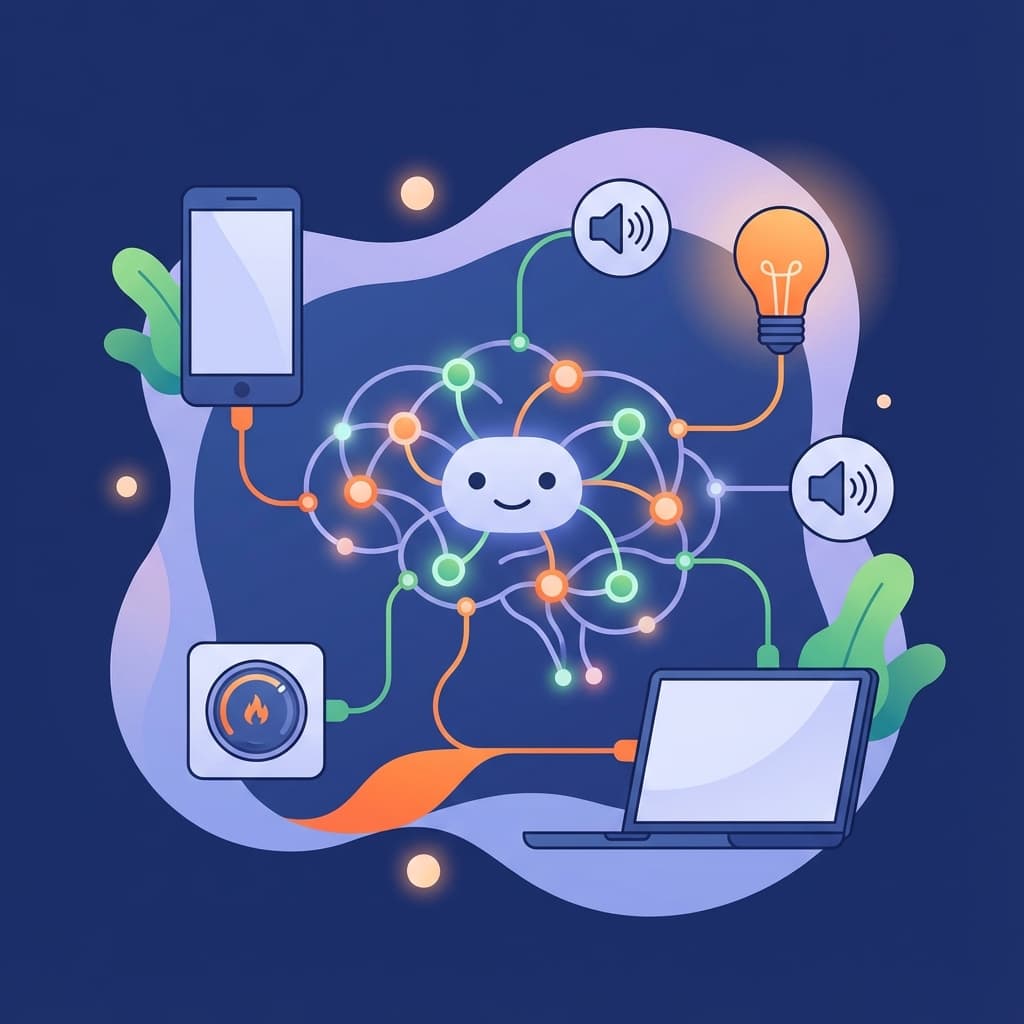
AI-Powered Assistants: From Talking Speakers to Digital Agents
Explore the evolution of Siri, Alexa, and ChatGPT. Learn how voice and chat assistants understand your words and how they are becoming autonomous 'Agents' that can do tasks for you.
Talking to Machines: The Rise of the Digital Assistant
For a long time, talking to a computer felt like a chore. You had to memorize specific commands: "Siri, set timer for ten minutes" or "Alexa, play 80s music." If you deviated slightly from the script, the assistant would reply with the dreaded: "I'm sorry, I didn't understand that."
In 2026, we have crossed a "Generative Threshold." We no longer talk at our devices; we have conversations with them. In this lesson, we are going to explore the three layers of technology that allow a machine to understand your voice and, more importantly, to act on your behalf.
1. The Three Layers of a Voice Assistant
When you say, "Hey Google, what's a good recipe for tonight and add the ingredients to my shopping list," a complex three-stage process happens in milliseconds.
Layer 1: Automatic Speech Recognition (ASR) - "The Ears"
This is the process of turning sound waves into text.
- The Challenge: People have accents, they mutter, and they talk in noisy rooms.
- The AI Solution: The AI uses a "Spectrogram" to visualize your voice as frequencies. It identifies the "Phonemes" (the distinct sounds of a language) and maps them to the most likely words.
Layer 2: Natural Language Understanding (NLU) - "The Brain"
This is where the AI tries to figure out what you mean.
- The Transition: Older systems looked for "Intent Keywords" (e.g., "Add," "Shopping List").
- Modern Systems: Use Large Language Models to understand nuance. If you say, "I'm feeling like some spicy pasta tonight, make sure I have what I need," the AI understands that you want a recipe and you want to check your inventory/shopping list.
Layer 3: Text-to-Speech (TTS) - "The Voice"
Once the AI has an answer, it needs to say it back to you.
- Old TTS: Sounded robotic because it just "clamped" recorded words together.
- Modern AI (Neural TTS): Generates the waveform of a voice from scratch. It knows how to use "Prosody"—the rhythm, stress, and intonation of speech. It knows to raise the pitch at the end of a question or to sound empathetic if you tell it you’re having a bad day.
graph LR
    A[User Voice] --> B[ASR: Sound to Text]
    B --> C[NLU: Meaning/Intent]
    C --> D[Action: Logic/API Call]
    D --> E[TTS: Text to Natural Voice]
    E --> F[Friendly AI Response]
2. The Shift from "Speakers" to "Agents"
The traditional voice assistant was a Reactive Tool. It waited for a command and gave a simple output.
The modern assistant is an Autonomous Agent.
- Action-Oriented: Instead of just telling you the weather, an Agent might say: "It's going to rain during your afternoon walk. I've moved your outdoor meeting to a Zoom call and updated your calendar. Is that okay?"
- Tool Use: Agents can "reach out" into other apps. They can log into your bank, order your groceries, or book a flight. They aren't just "Search Engines with a voice"—they are "Do-ers."
3. Smart Home Integration: The "Center" of the House
AI assistants have become the conductors of the "Smart Home" orchestra. Through protocols like Matter and AI-driven logic, your home can now anticipate your needs:
- Predictive Lighting: Dimming the lights when you start a movie without being asked.
- Safety: A smart assistant "hearing" a smoke alarm or glass breaking and alerted your phone immediately.
- Energy Efficiency: Coordinating your smart blinds and AC to keep the house cool while using the least amount of solar power.
4. The Privacy Paradox: "Is it Always Listening?"
This is the number one concern for users. To work, a voice assistant must be "Awake" enough to hear its "Wake Word" (like "Alexa" or "Hey Siri").
How it Works Privately
Most modern devices use a Local Buffer.
- The device has a very small, low-power chip that only listens for the "Wake Word."
- It does not record or send anything to the cloud until it hears that specific sound pattern.
- Once it hears the word, the ring glows, and the recording begins.
The 2026 Standard
Privacy-focused AI is moving toward Local Inference. This means the AI "Brain" is actually inside your phone or your speaker, not in a giant data center. Your voice never leaves your house, making the system both faster and more secure.
5. From Chatbots to Companions
Beyond the "Smart Speaker," we are seeing the rise of Emotional AI.
- Personalization: The AI remembers your preferences, your family members' names, and your long-term goals.
- Learning Your Style: If you prefer short, direct answers, the AI adapts. If you like to brainstorm and explore ideas, it becomes more "Chatty."
Summary: A More Human Interface
The "Graphical User Interface" (buttons and menus) was the story of the 1990s. The "Touch Interface" (swiping) was the story of the 2010s.
The "Natural Language Interface" (talking and chatting) is the story of the 2020s. We are finally entering an era where we don't have to learn how to speak "Computer"; the computer has finally learned how to speak "Human."
In the next lesson, we will look at how this intelligence helps us move through the physical world in Navigation, Maps, and Travel Planning.
Exercise: Agent Training
Let's test the "Intelligence" of your current assistant (your phone or a smart speaker).
- Ask a Simple Question: "What's the weather?"
- Follow Up with Context: "What about this weekend in Paris?" (Notice if it remembers you're talking about weather).
- Try a Complex Task: "Find a recipe for gluten-free muffins and set a reminder to buy the ingredients when I'm at the grocery store."
Reflect: At which step did the AI succeed, and at which step (if any) did it fail? This helps you understand the current "Boundaries" of your digital assistant.