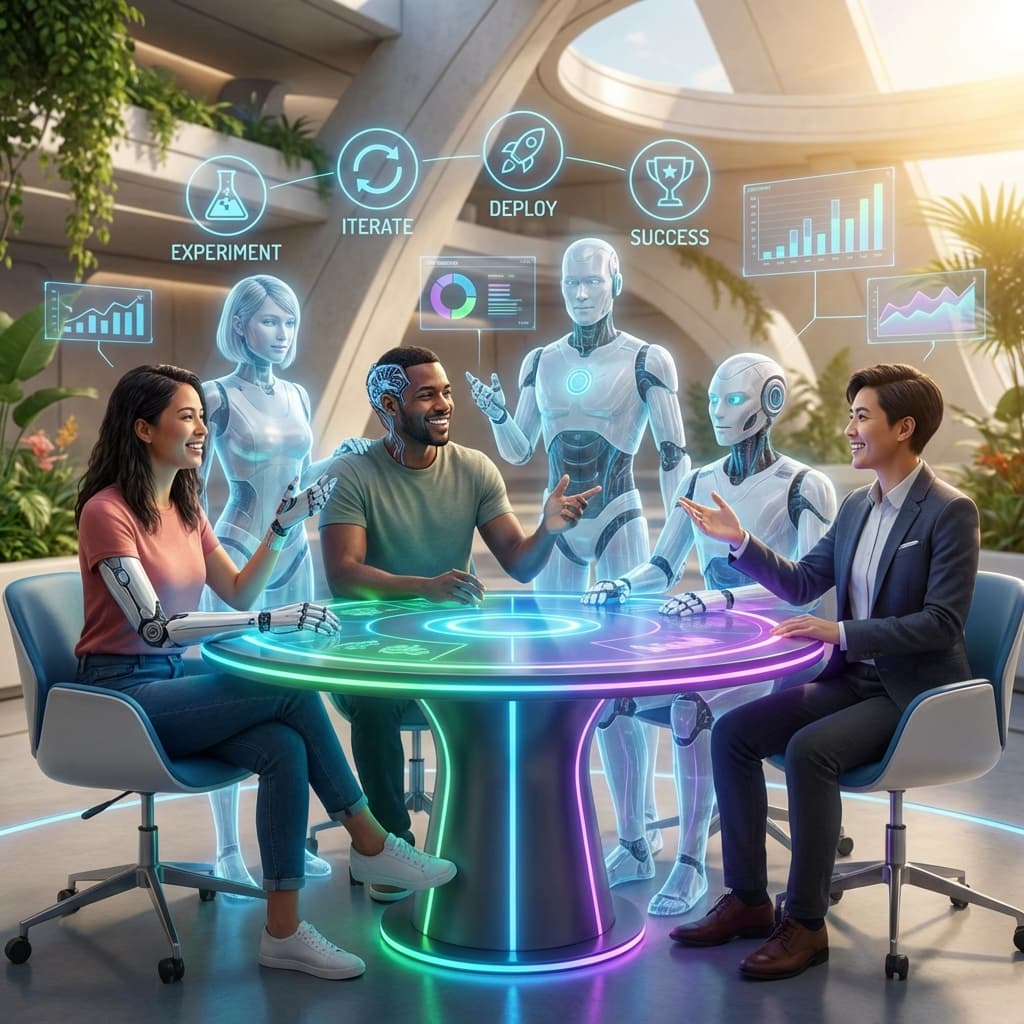
Organizing the AI-First Startup: Team Topologies, Processes, and Culture for Rapid Experimentation
Organizing the AI-First Startup: Team Topologies, Processes, and Culture for Rapid Experimentation
For decades, the blueprint for a successful startup was well-defined. You hired a Product Manager, a handful of Full-Stack Engineers, a Designer, and eventually, a Marketing team. You organized them into "Squads" or "Tribes," following the Spotify model or some variation of it. You ran two-week sprints, pointed your tickets, and had a demo every Friday.
This model was built for a world where the bottleneck was Human Output.
In the AI era, the bottleneck has shifted. We are moving from a world of "Scarcity of Code" to a world of "Abundance of Hypothesis." When an agentic workforce (Article 1) can generate features faster than a human can even think of them, the traditional organization chart becomes a drag. It’s too slow, too hierarchical, and too focused on "Execution" rather than "Discovery."
To build a category-defining company in 2026, you don't just need AI in your product; you need AI in your DNA. You need to reorganize your entire company around the speed of an agent.
The Death of the 2-Week Sprint
The "Sprint" was designed to give predictable cadence to human work. But an AI agent doesn't need a cadence; it needs a Loop.
In an AI-First startup, the two-week cycle is replaced by the Ten-Minute Cycle.
- Minute 1: Generate a hypothesis.
- Minute 5: Agent builds a functional MVP in a sandbox.
- Minute 10: Real-world user metrics (or high-fidelity simulations) tell you if it works.
If your organizational processes are still optimized for two-week blocks of planning, you are effectively driving a Ferrari in a school zone. You are throttling your own innovation.
1. Team Topologies: The "Full-Stack AI Engineer"
The division between "Data Scientist," "Backend Engineer," and "Frontend Engineer" is crumbling. In an AI-First startup, we are seeing the rise of the "Vertical Generalist."
This is an engineer who doesn't just write code; they Design the System that Writes Code.
- They don't build a single UI; they build the "UI Generator" that adapts to the user (Article 8).
- They don't write a single SQL query; they architect the "Knowledge Graph" that feeds the AI (Article 6).
The "Pod" Structure for the 2020s
The new organizational unit isn't a squad of 8 humans. It is a "Hub" consisting of:
- 1 Lead Architect (Human): The visionary who defines the intent and the guardrails.
- 1 UX/Product Strategist (Human): The individual who understands the human psychology and the business "Why."
- A Fleet of Specialized AI Agents: Handling the "What" and the "How."
This Hub has the output of a 50-person department from the 2010s.
2. Culture: From "High Stakes" to "High Velocity"
Traditional corporate culture is often built on Risk Aversion. We reward people for being "Right."
In an AI-First culture, you must reward people for Learning Fast. Because the cost of "Being Wrong" has dropped to near-zero (thanks to AI-driven prototyping and low-cost experimentation), the only real failure is moving too slow.
The "Prompt-First" Mindset
In every meeting, the question shouldn't be "Can we build this?", but "How can we prompt the system to build this for us?" Every internal process—from hiring to billing (Article 5) to security audits (Article 7)—should be treated as an engineering task for agents. If a human is doing a repetitive task for more than thirty minutes, it is a "Bug" in the organizational culture.
3. Communication: The "Institutional LLM"
The biggest friction in any startup is Knowledge Silos. One person knows the sales context; another knows the technical debt.
AI-First startups use an Internal Knowledge Agent as their primary communication layer.
- Every Slack message, every PR comment, and every meeting transcript is fed into a fine-tuned internal model (Article 9).
- The AI becomes the "Collective Memory" of the company.
- When a new person joins, they don't have to "Get up to speed"; they just ask the Company AI, which has a 100% accurate, real-time map of every decision ever made.
4. Visualizing the AI-First Org Chart
graph TD
    CEO["CEO (Vision & Ethics)"] --> Core["Master Control Plane Agent"]

    subgraph "The Hubs"
        Dev["Product Hub (Human Leads + Agent Fleet)"]
        Sales["Growth Hub (Human Leads + Agent Fleet)"]
        Ops["Reliability Hub (Human Leads + Agent Fleet)"]
    end

    Core --> Dev
    Core --> Sales
    Core --> Ops

    Dev -.-> Knowledge["Institutional Memory Graph"]
    Sales -.-> Knowledge
    Ops -.-> Knowledge

    style Core fill:#f96,stroke:#333
    style Knowledge fill:#9cf,stroke:#333
The Meaning: Reclaiming Human Creativity
There is a common fear that AI will turn startups into cold, robotic factories. In reality, it does the opposite.
By automating the "Boring" parts of a startup—the project management, the boilerplate code, the repetitive QA, the basic market research—we are finally allowing humans to do what they were born for: Creativity, Empathy, and Philosophy.
Startup founders in the AI era will spend less time on spreadsheets and more time on the "Meaning" of their product. They will spend more time talking to users and less time managing Jira.
We are finally shedding the "Industrial" skin of the software industry and returning to the "Craft" of solving human problems.
The Vision: The Single-Person Unicorn
We are rapidly approaching the day of the Single-Person Unicorn.
A solo founder, backed by a sophisticated agentic control plane, will be able to build, scale, and maintain a billion-dollar service. This isn't just about efficiency; it's about the democratization of entrepreneurship.
The barrier to entry for building a world-changing company is no longer "Capital" or "Hiring." It is Clarity of Intent.
Final Thoughts: The Infinite Experiment
The journey of an AI-First startup is an infinite experiment. There is no "Done." There is only the continuous evolution of the partnership between human vision and machine intelligence.
If you are a founder today, don't just build an "AI Startup." Build an AI-Native Culture.
Reorganize your teams. Rethink your cycles. Redefine your value.
The future belongs to the agile, the automated, and the visionary. And for the first time in history, the only limit to your success is the scale of your own imagination.