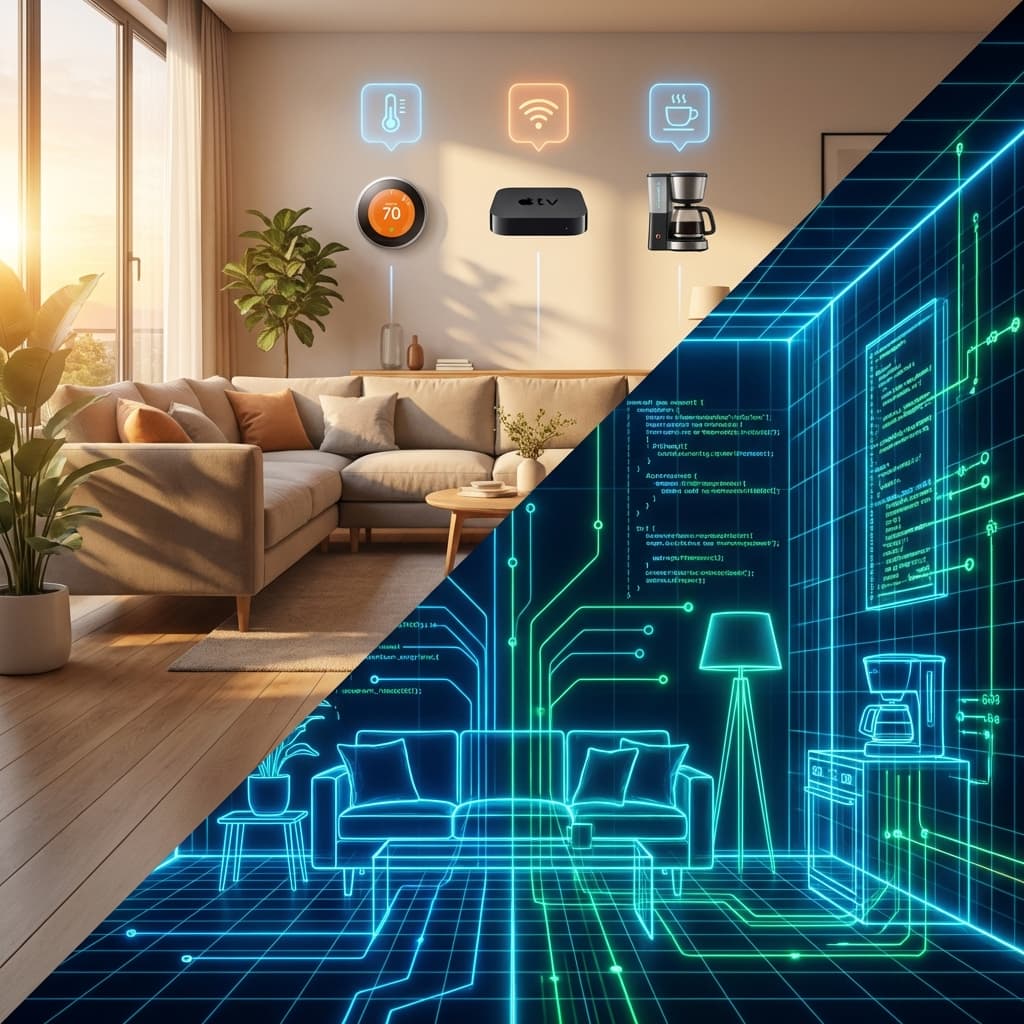
AI in Daily Life: Convenience vs. Privacy
We navigate the delicate balance of the modern age. Explore how AI brings unparalleled convenience to our homes and routines, and the invisible trade-offs we make in the name of a smarter life.
The Invisible Hand: Balancing Ease and Essence in the AI Era
In the early mornings of the 21st century, a new kind of magic began to unfold in our homes. With a simple voice command, the lights soften, the coffee begins to brew, and a curated selection of news and music fills the air. It feels as if the home itself has woken up, ready to support us, anticipate our needs, and smooth over the friction of daily existence.
This is the promise of AI in our daily lives: The Era of Frictionless Living.
We have fallen in love with convenience. We love that our phones know when we need to leave for the airport, that our streaming services find the perfect movie for a Friday night, and that our thermostats learn exactly how we like our rooms to feel at 3:00 PM on a Sunday. But as this "Invisible Hand" of AI becomes more deeply woven into the fabric of our routines, a quiet question begins to echo: What are we giving up in exchange for this ease?
The Allure of the Seamless Life
Humans are biologically wired to seek convenience. Our ancestors survived by conserving energy and finding the most efficient ways to achieve their goals. In the modern world, AI has become the ultimate tool for this ancient drive.
AI in daily life isn't just about robots and self-driving cars; it’s about the thousands of micro-efficiencies we now take for granted. It’s the predictive text that saves us thousands of keystrokes a year. It’s the spam filter that keeps our digital workspace clean. It’s the face-recognition that allows us to unlock our entire digital lives with a single look.
These conveniences are not just "nice to have." For many of us, they have become essential. They free up our mental bandwidth, allowing us to focus on our careers, our families, and our creative passions. In a visionary sense, AI is acting as a "Digital Exoskeleton," amplifying our ability to manage the complexity of modern life.
The Shadow of the Data Matrix
However, every seamless experience is powered by an immense amount of data. For your smart home to greet you correctly, it must know when you arrive. For your fitness tracker to suggest a workout, it must monitor your heartbeat and your sleep. For your shopping app to recommend a product, it must analyze your past desires.
This is where the trade-off begins. We are moving toward a world where Privacy is the Currency of Convenience.
To build the "Data Matrix" required for a smart life, we are essentially allowing cameras, microphones, and sensors into the most private corners of our existence. We are trading the "Sanctity of the Unobserved" for the "Comfort of the Known."
In this new reality, our homes are no longer just shelters; they are data hubs. Our cars are no longer just transport; they are mobile sensors. Every convenience we enjoy is a two-way street: the service flows to us, and the data flows from us.
The Myth of the "Nothing to Hide"
A common response to these concerns is, "I have nothing to hide, so why should I care about privacy?"
But privacy isn't about hiding bad behavior; it’s about protecting the space where we grow. It’s about the freedom to be vulnerable, to be weird, to be inconsistent, and to be truly ourselves without the pressure of a permanent audience.
When AI monitors our daily lives, it creates a "Social Pressure from the Algorithm." If we know that our health insurance might one day see our grocery habits, or that our employer might see our late-night browsing patterns, we begin to self-censor. We lose the "Psychological Safety" that is the foundation of innovation and personal happiness.
Privacy is like oxygen—you don't notice it until it’s gone, but once it’s missing, you can think of nothing else.
Navigating the Middle Path: A Vision for the Future
The answer isn't to retreat into a pre-digital past. We cannot turn off the magic of AI, nor should we want to. The path forward is to build a "Privacy-First Convenience" model.
As visionary leaders and users, we should advocate for a future where the AI can be smart without being invasive. This involves several key technological and philosophical shifts:
1. The Rise of "Local Intelligence"
We are entering the era of the Sovereign Device. In this future, the AI that manages your home or your health lives entirely on your own hardware. It "knows" you, but it doesn't "report" on you. Your data stays in your physical space, and only the results of the AI’s work are used to connect you to the wider world.
2. Contextual Consent
We need to move past "All-or-Nothing" privacy policies. A smart lightbulb shouldn't need access to your contacts. A mapping app shouldn't need to know who you talk to. We should demand Granular Privacy, where we can choose exactly which conveniences are worth which data points.
3. The Ethical Algorithm
The next generation of AI developers must be trained as "Digital Ethicists." They must build tools that are designed to protect the user's dignity as much as they are designed to provide a service. Success should not be measured just by "User Engagement," but by "User Empowerment."
The Human Duty: Staying the Conductor
In this symphony of convenience, the most important role belongs to you. You are the conductor.
If we allow the AI to make all our choices, we aren't just gaining convenience; we are losing our Agency. The "Big Picture" of AI is that it should be a tool that helps us achieve our vision of a good life, not a guide that tells us what that vision should be.
To stay the conductor, you must occasionally choose the "Analog Path." Walk without a GPS. Buy a book from a physical store. Spend an afternoon in a room with no sensors. These moments of "Data Fasting" are essential for maintaining your perspective and your sovereignty.
Conclusion: The Wisdom to Balance
The journey of the 21st century is one of finding the balance between the Magic of the Machine and the Sanctity of the Human.
AI can make our lives easier, but only we can make them meaningful. Convenience can save us time, but only privacy can save our essence. As we continue to build our smart homes and our digital routines, let us do so with our eyes wide open. Let us welcome the invisible guest, but let us also remember to lock the door to our soul.
We can have a life that is both smart and private. It just requires us to be as visionary as the tools we use.
Key Takeaways for the Conscious User:
- Audit Your "Smartness": Look around your home. For each smart device, ask: "Is the convenience this provides worth the data it collects?"
- Practice "Data Fasting": Set one day a week (or even one hour a day) where you intentionally disconnect from all tracking devices. Reconnect with the analog world.
- Demand Better Models: Support companies that prioritize local processing and transparent data policies. Your wallet is your most powerful tool for change.
- Keep Your "Why" Human: Use AI to handle the chores, but never let it handle the choices. The "Big Picture" of your life belongs to you alone.
At ShShell.com, we are dedicated to helping you master the technology of the future while protecting the values of the past. Join us in building a smarter, safer world.