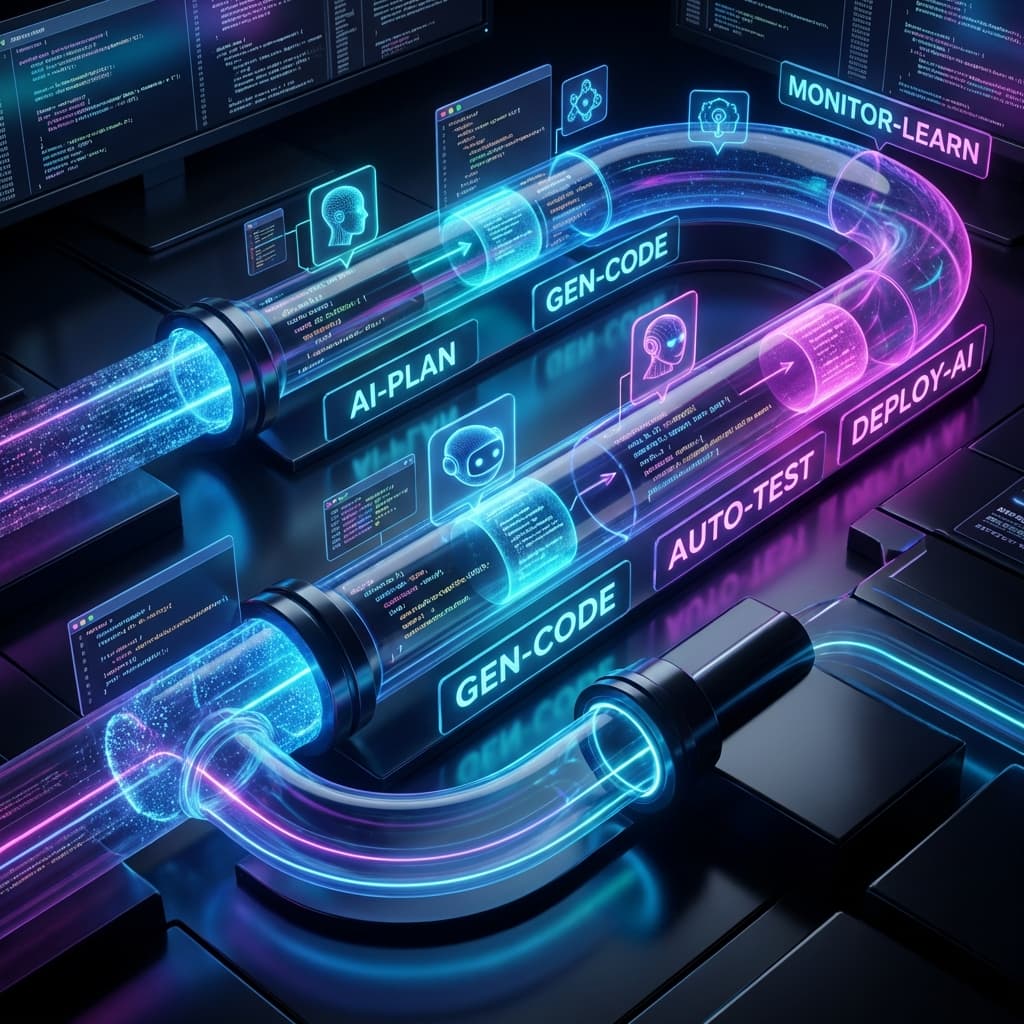
From Autocomplete to Ownership: How AI Agents Will Reshape the Software Development Lifecycle
From Autocomplete to Ownership: How AI Agents Will Reshape the Software Development Lifecycle
There is a quiet shift happening in the basements and high-rise offices of Silicon Valley, and it has nothing to do with the latest JavaScript framework or a new cloud provider. It is a shift in the very nature of what it means to "build software."
For the last forty years, the Software Development Lifecycle (SDLC) has been a human-centric industrial process. Humans gather requirements, humans write code, humans test that code, and humans monitor it in production. We have built tools to make this faster—compilers, IDEs, CI/CD pipelines—but at every gate, there was a human hand on the lever.
Then came the "Autocomplete" era. Tools like GitHub Copilot and ChatGPT entered the scene, acting as a high-powered bicycle for the mind. They could suggest the next line of code or explain a regex pattern, but they were fundamentally reactive. They waited for the human to type. They were "Co-pilots."
But the bicycle is becoming a self-driving car. We are entering the era of AI Agents.
An agent doesn't wait for you to type. An agent looks at a Jira ticket, understands the business context, creates a feature branch, writes the code, runs the tests, fixes the linting errors, and pings you for a final review. This is the move from Autocomplete to Ownership.
In this guide, we are going to explore how this shift will fundamentally dismantle and rebuild the SDLC as we know it. We will look at the "Magic" of autonomous engineering and the "Meaning" of what human developers become in this new world.
The Death of the "Typing" Developer
If you ask a layperson what a software engineer does, they will say, "They type code into a computer."
For a long time, this was true. The bottleneck of software production was the physical act of translating human logic into syntax that a machine could understand. We spent years learning the difference between a semicolon and a colon, the nuances of memory management, and the incantations of CSS.
In the era of Agentic Ownership, syntax is no longer the bottleneck.
When an AI agent can generate 1,000 lines of functional, tested code in under thirty seconds, the value of a human "typist" drops to zero. The developer of the near future is not a writer; they are an Editor and an Architect.
Imagine a World where:
- Planning is done by agents analyzing user feedback and technical debt.
- Execution is done by agents spinning up ephemeral environments to test hypotheses.
- Deployment is handled by agents that monitor real-time user metrics and roll back code before a human even sees the alert.
This isn't science fiction. It's the architecture of the next decade.
1. The Planning Phase: From User Stories to System Blueprints
In the traditional SDLC, the planning phase is often the most frustrating. It involves endless meetings, ambiguous requirements, and the inevitable "telephone game" where a product manager's dream becomes a developer's nightmare.
AI agents are rewriting this script. An agent can ingest ten years of Slack history, three internal wikis, and a thousand GitHub issues to understand the intent of a feature.
The Agentic Planner
Rather than a human sitting down to write a technical design document (TDD), they will prompt an agent: "We need to add multi-tenancy to our billing system. Look at our current schema, our Stripe integration, and our security policies. Propose three possible architectures."
The agent doesn't just give you text. It gives you:
- Mermaid Diagrams showing the data flow.
- Complexity Analysis estimating how many legacy systems will be affected.
- Risk Assessments pointing out potential race conditions.
The human's job here is to choose the path. You are no longer the one drawing the blueprint; you are the city planner reviewing it.
2. The Execution Phase: The "Ghost in the Machine"
This is where the most dramatic changes occur. In the "Copilot" era, you were the driver. In the "Agent" era, you are the manager.
Consider the "Small Feature" workflow. Today, a developer takes a ticket, creates a branch, writes code, pushes it, and waits for CI. This might take four hours.
With an AI Agent:
- The agent sees a "Bug" ticket: "The login button is misaligned on Safari."
- The agent spawns a headless Safari browser.
- It takes a screenshot, identifies the CSS clash, and creates a fix.
- It runs a visual regression test to ensure it didn't break Chrome.
- It opens a Pull Request (PR) with a clear explanation of what it did.
The human developer sees a notification: "Agent fixed safari-login-bug. Confidence score: 98%. Review?"
The "Loop" Architecture
Agents work in loops. They observe the environment, think about the next step, act, and then observe again. This "Reasoning Loop" allows them to solve problems that simple autocomplete tools can't touch. They don't just guess the next token; they attempt to reach a goal.
graph LR
    Goal["Goal: Fix Bug"] --> Agent["AI Agent"]
    Agent -- "Observe" --> Code["Current Codebase"]
    Code -- "Analyze" --> Plan["Formulate Hypothesis"]
    Plan -- "Act" --> Edit["Apply Code Change"]
    Edit -- "Verify" --> Test["Run Test Suite"]
    Test -- "Output" --> Agent
    Agent -- "Done" --> PR["Submit Pull Request"]
3. The Quality Assurance (QA) Phase: Continuous Self-Healing
QA has always been the "uncool" sibling of development. It’s the gatekeeper that everyone wants to bypass. AI agents are turning QA from a gatekeeper into a gardener.
Traditional testing is "static." You write a test for x, and it checks x. If the UI changes slightly, the test breaks.
Autonomous QA agents are "dynamic." They don't just check if a button exists; they "try" to use the application like a human would. They can conduct exploratory testing, finding edge cases that a human would never think to write a script for.
"I notice that if I click the 'Submit' button three times while the network is at 3G speeds, the database gets a duplicate entry. Here is the fix for that race condition."
This is the transition from Manual Testing to Automated Testing to Autonomous Healing.
4. The Maintenance Phase: Protecting the Production Citadel
The most stressful part of being a developer is the "on-call" rotation. Getting a PagerDuty alert at 3 AM is the price we pay for the systems we build.
AI agents are the first line of defense that never sleeps. An agentic control plane can:
- Detect a spike in 500 errors.
- Correlate it with the last three deployments.
- Analyze the logs and identify a memory leak in a new microservice.
- Automatically scale the cluster to buy time.
- Roll back the specific deployment responsible.
- Send a summary to the team: "I detected a memory leak in the 'Billing' service. I've rolled it back to version 1.2.4 and increased the pod limit. See you in the morning."
This is Ownership. The agent isn't just a tool; it's a stakeholder in the uptime of your service.
The Human Meaning: What Do We Become?
Whenever I talk about this, the first question is always: "Will I have a job in 2030?"
The answer is yes, but it won't be the job you were trained for. The transition is similar to how the role of a "Chess Player" changed with the advent of AI. We don't try to beat the computer at calculation anymore; we use the computer to explore the depths of the game that were previously unreachable.
The Rise of the "Staff Engineer" Experience for Everyone
In the past, to reach the level of "Staff Engineer" or "Architect," you had to spend a decade mastering the low-level details of systems. You had to earn your stripes in the "Typing" era.
AI agents are a Force Multiplier. They allow a junior developer with strong logical foundations to have the output of a ten-person team. They allow a senior engineer to focus on the things that actually matter:
- Security Boundaries: Ensuring the agents don't hallucinate a backdoor.
- Ethics and Bias: Monitoring the outcomes of AI-driven decisions.
- Product Intuition: Figuring out what to build, not just how to build it.
- Systemic Resilience: Designing the guardrails within which the agents operate.
The "Meaning" of a developer moves from "Builder" to "Gardener." You cultivate the environment, you plant the seeds of intent, and you prune the hallucinations.
The "Magic" of the Agentic Future
Imagine a startup founded by two people. In the 2010s, they would need to hire five engineers to build their MVP. In the 2026s, they will hire one engineer and "hire" ten AI agents.
This isn't about doing the same amount of work with fewer people. It's about doing infinitely more work with the same amount of people.
We are going to see:
- Legacy Code Migrations that used to take years (like moving from COBOL to Java) happening in a weekend.
- Hyper-Personalized Software: Apps that rewrite their own UI and backend based on how you specifically use them.
- Perfect Security: Agents that are constantly "red-teaming" their own code, finding and patching vulnerabilities before they are even registered as CVEs.
That is the magic. We are removing the friction between "Thought" and "Executed Product."
The Challenges: The Guardrails of Ownership
We cannot ignore the risks. Giving an AI "Ownership" of a codebase is a terrifying proposition if not done correctly.
- Hallucinated Logic: An agent might write code that looks perfect but has a subtle logical flaw that only appears at scale.
- Autonomous Sprawl: If agents are creating features autonomously, how do we prevent the codebase from becoming an unoptimized, bloated mess?
- The "Black Box" Problem: If an agent rewrote 40% of the codebase overnight, how does a human team debug it if the agent itself goes offline or fails?
To solve this, we need Agentic Observability. We need tools that don't just log what the code did, but what the agent was thinking when it wrote the code. We need a "Chain of Thought" for every commit.
Final Thoughts: Embracing the Agentic Wave
We are standing at the shoreline of the biggest shift in human productivity since the steam engine. The Software Development Lifecycle is no longer a set of steps for humans to follow; it is an ecosystem for humans and AI to co-evolve.
If you are a developer today, don't fear the agent. Study it. Learn how to define intent so clearly that an agent can execute it. Learn how to be the "Editor-in-Chief" of a thousand-agent newsroom.
The future of software isn't just "Written by AI." It is Driven by Intent. And the humans who master the art of Intent will be the ones who build the next version of our world.