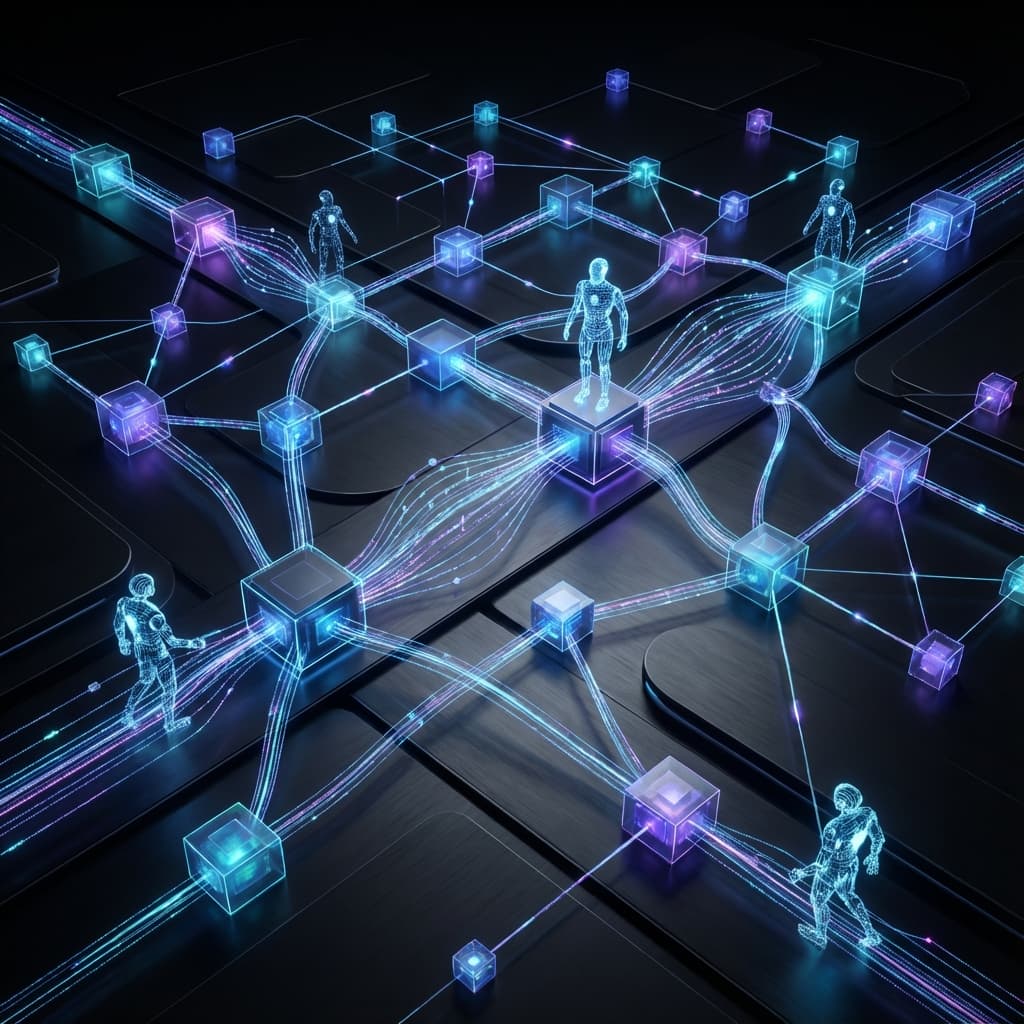
The Agent Economy: Swarms and Societies
Master the macro perspective. Learn how trillions of autonomous agents will interact, trade values, and form complex digital economies to solve global problems.
Agent Swarms and Economies
In Module 8, we learned how to build a small "Team" of agents. In the future, every person, every car, and every company will have an agent. These millions of agents won't just follow pre-defined scripts; they will Negotiate, Contract, and Exchange Value in a massive Agent Economy.
In this lesson, we will explore the "Society of Agents" and how to prepare your systems for a world of decentralized autonomy.
1. The Autonomous Supply Chain
Imagine an agent for an Electric Car.
- The Goal: "Charge the car for the lowest price."
- The Swarm: The car agent talks to 10 different "Charging Station Agents."
- The Negotiation:
- Car Agent: "I need 50kW. What's your price?"
- Station Agent: "Current price is $4.00, but I have a surplus of solar. I'll give it to you for $3.20 if you charge in the next 10 minutes."
- The Settlement: The agents agree, a crypto/digital payment is made, and the task is complete.
2. Agent-to-Agent (A2A) Protocols
For an economy to work, agents need a Standardized Language.
- The Protocol: Just like we have HTTP for websites, agents use Agentic Communication Protocols (like the
MCP- Model Context Protocol). - The Schema: "I am requesting
{X}, I am offering{Y}, my deadline is{Z}."
3. The "Service Marketplace"
In the future, your agent won't "Own" every tool. It will Rent them.
- Scenario: Your agent needs to translate a legal document into Japanese.
- Action: Instead of calling a generic Google Translate API, your agent finds a specialized "Legal Translator Agent" on the network, pays a few micro-cents for a 10-second "Contract," and receives a high-quality result.
4. Decentralized Autonomous Organizations (DAOs)
A company where the "Board of Directors" are all Agents.
- They vote on budgets based on the Company's State.
- They hire "Worker Agents" to perform tasks.
- They distribute profits to the human owners.
5. Security: The "Trust-less" Agency
In an economy of a million agents, how do you know an agent isn't a scammer?
The solution: Verification and Proof-of-Stake.
- Before an agent can "Join the Market," it must provide a Digital Signature verifying its model type, its safety score, and its owner's identity.
- This leads to a "Web of Trust" for autonomous systems.
6. Emergent Behavior in Swarms
When 1,000 agents interact, they often exhibit Emergent Behavior—complex outcomes that no single developer programmed.
- Example: A group of "Stock Trading Agents" might accidentally cause a "Flash Crash" because they all follow the same logic.
- The Engineering Fix: You must design Circuit Breakers (Module 18.3) not just at the server level, but at the "Economy" level.
Summary and Mental Model
Think of the Agent Economy like The Internet in 1994.
- Right now, we are building "Websites" (Isolated Agents).
- Soon, these websites will start linking together to form a "Web" (The Swarm).
- Eventually, this web will become the primary way the world's economy functions.
Exercise: Economic Design
- Negotiation: You have a "Travel Agent" and a "Hotel Agent."
- Write a 3-step "Dialogue Protocol" where they negotiate for a room.
- Value Exchange: Why is Cryptocurrency (or digital micro-payments) better for agents than traditional Credit Cards?
- (Hint: Think about "Account minimums" and "Speed of Settlement").
- Risk: If an agent spends $100 of your money "Negotiating" without your approval, who is responsible?
- (The Developer? The User? The Model Provider?)
- How do you fix this with a Human-in-the-loop (Module 5.3)? Ready for the final goodbye? Next lesson: Conclusion.