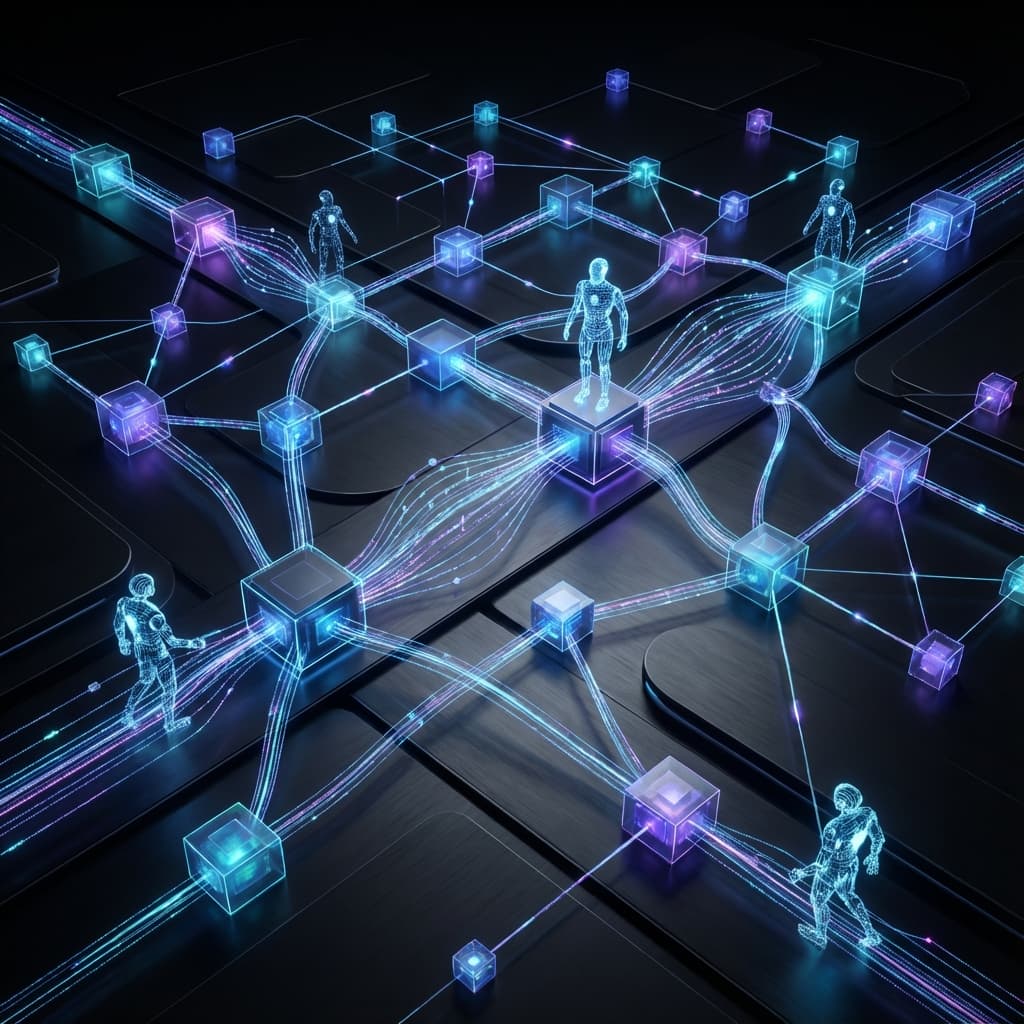
The Next Leap: Embodied Agents and Robotics
Cross the bridge from digital to physical. Learn how the reasoning engines you've built are beginning to inhabit physical bodies and the unique challenges of real-world agency.
Embodied Agents and Robotics
For the last 19 modules, we have worked in the Digital Realm—editing code, browsing the web, and summarizing text. But the ultimate evolution of an agent is Embodiment: taking the "Brain" (LLM/LangGraph) and putting it into a "Body" (Robot arm, Drone, or Humanoid).
In this lesson, we will look at how the principles of digital agency translate to the physical world.
1. The "Physical" Toolset
In a digital agent, a tool is send_email(). In an embodied agent, a tool is move_joint(x, y, z) or grasp_object().
The Loop:
- Sensors (Vision/Tactile): The agent "Sees" a cup on the table.
- Reasoning: "I need to pick up the cup to clear the table."
- Action (Actuators): The agent calls the
grasptool.
The Challenge: In the real world, a tool call can't be "Undone." If you drop the cup, it is broken. This requires a much higher level of Safety Guardrails (Module 3.4).
2. From Tokens to Trajectories
Digital agents think in Words. Physical agents think in Physics.
- The Modern Approach: Many embodied agents now use LLMs to write code (e.g., Python scripts for a robot controller) rather than trying to control the robot's motors directly.
- Why? LLMs are better at "High-Level Planning" ("How do I tidy the kitchen?"). They then delegate the "Low-Level Math" ("Calculate the inverse kinematics of the elbow") to specialized traditional algorithms.
3. Real-Time Latency (The Critical Factor)
As we saw in Module 14.2 (Voice), latency matters. In Search/Robotics, it is a life-or-death matter.
- An autonomous car agent cannot wait 2 seconds for a cloud API to decide if it should brake.
- The Solution: Local Edge Hardware (Module 12) is the mandatory standard for embodied agents.
4. Federated Agency (The Hive Mind)
Imagine 1,000 "Delivery Drones" running as agents.
- Each one has its own State (Battery level, Location).
- They share a Long-Term Memory (The obstacle map of the city).
- They coordinate via Inter-Agent Communication (Module 8.4) to ensure they don't collide.
5. Vision-Language-Action Models (VLA)
The cutting edge is models like Google RT-2 or Figure AI. These are single neural networks that take "Images" as input and output "Mechanical Instructions" as output.
- They don't use "Tools" in the traditional sense; their only output is action.
- As a developer, your job moves from "Writing Tool Logic" to "Providing Environmental Context."
6. The Ethical Physicality
Embodied agents raise the stakes of Module 19. If an agent makes a mistake in a spreadsheet, it's an error. If an agent makes a mistake in a factory, it's a Hazard.
- The Hardware Kill-Switch: Every physical agent must have a physical, non-software "Emergency Stop" button.
Summary and Mental Model
Think of the "Digital Agent" you've built as the Ghost. Think of the "Robot" as the Shell.
In the next 5 years, the ghost and the shell will merge. The logic you've learned in LangGraph (states, nodes, edges) will be the same logic that powers the autonomous homes and factories of the future.
Exercise: Physical Mapping
- Mapping: You are building an agent for a Construction Robot.
- The task is: "Move a brick from Point A to Point B."
- List the 3 Sensor Inputs and 3 Tool Calls required.
- Safety: How would you implement a "Human-in-the-loop" (Module 5.3) for a robot that is about to perform a "Destructive" task like demolition?
- Logic: Why is it harder to "Test" (Module 17.4) a physical agent than a digital one?
- (Hint: Look up Digital Twins and Simulators). Ready for the grand scale? Next lesson: Large Action Models (LAMs) and the Browser Agent.